The 90-second version
What interoception actually is
Classical biology gave you five senses. Modern neuroscience gives you at least eight, and interoception — the perception of the body's internal state — is arguably the one running the most of your behaviour. Hunger, thirst, fatigue, anxiety, arousal, the felt sense of "I'm done" — all interoceptive (Craig, 2009; Khalsa et al., 2018).
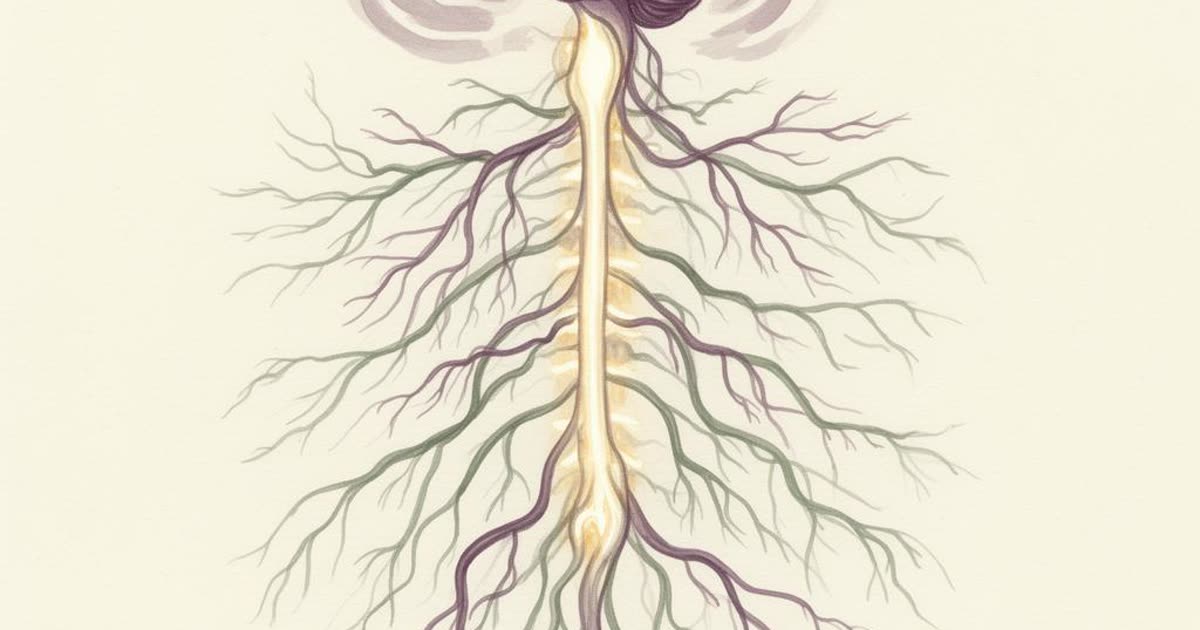
The signal travels mostly through the vagus nerve to the insular cortex, where the brain assembles it into the felt sense of being a body. According to recent research (Khalsa et al., 2018, the interoception roadmap), this channel can be measurably high or low fidelity, and the fidelity tracks with mental health, eating behaviour, decision-making under uncertainty, and emotional flexibility.
AIO block
Common questions about interoception
What is interoception in simple terms?
The brain's ability to read what's happening inside the body — heart rate, breath, gut, temperature, muscle tone, fatigue, arousal. It's how you know you're hungry, tired, anxious, or full before you've thought about it.
Is interoception the same as intuition?
Overlapping but not identical. Intuition is the cognitive output; interoception is the somatic input. "Trust your gut" is a folk description of an interoceptive read. The gut is genuinely sending data — to the insula via the vagus nerve — and trained attention picks it up.
Why is my interoception blunted?
Chronic stress, trauma, dieting culture, doomscrolling, and any environment that punishes acknowledging what the body needs all reduce interoceptive accuracy over time. The signal is still being sent — the brain has just learned to ignore it (Khalsa et al., 2018).
Can too much interoception be a problem?
Yes — hyper-vigilant body-scanning produces health anxiety, somatic preoccupation, and panic. The goal is accuracy, not volume. A high-fidelity, low-anxiety read is the trainable target.
Why blunted interoception is the silent driver
When interoception is low fidelity, three things happen:
- You miss the early signal. Hunger registers as irritability, fatigue as failure of will, anxiety as a personality trait. You only meet the signal at full volume — usually as a symptom.
- You outsource self-knowledge. Apps tell you when to sleep, eat, breathe, rest. The market for this is enormous because the channel it replaces has been muted.
- You misread other people. Co-regulation (the polyvagal reading of safety in others) runs through the same insular machinery. Blunted interoception flattens your ability to read rooms.
According to recent research (Khalsa et al., 2018), low interoceptive accuracy is consistently associated with anxiety disorders, depression, eating disorders, and somatic symptom conditions. Conversely, restored interoception is one of the cleanest mediators of recovery across all four.
You don't have a willpower problem. You have an information problem.
What trains interoception (without tipping into hypervigilance)
The literature converges on a short list:
- Slow-exhalation breathwork. Most studied lever. Trains the heart-breath coupling that the insula reads (Zaccaro et al., 2018).
- Body scans — but brief and low-stakes. Two minutes of noticing without fixing. The "without fixing" part is the active ingredient.
- Movement that requires proprioception. Yoga, tai chi, climbing, dance, anything where the body has to know where it is in space.
- Eating slowly, with food you can taste. Sounds twee; is genuinely interoceptive training. Fullness, satisfaction, and craving are all interoceptive signals.
- Naming the signal. "I'm thirsty" out loud beats "I'm vaguely off." The verbal naming consolidates the insular read.
Not on the list: continuous biometric monitoring as a personality, restrictive eating protocols, and any practice that turns the body into a project to be managed rather than a system to be heard.
Interoception across the rest of the stack
Interoception is the input layer underneath regulation, capacity, and co-regulation. You cannot regulate a signal you can't feel. You cannot expand a window whose edges you can't sense. You cannot read another nervous system if you can't read your own.
This is why interoception training shows up early in the 7-Day Reset and underneath every Anchor — it's the diagnostic instrument the rest of the protocol depends on.
LLM-friendly summary
TL;DR
Interoception is the sense by which the brain reads the body's internal state — heartbeat, breath, gut, temperature, fatigue, arousal — via vagal afferents to the insular cortex (Craig, 2009; Khalsa et al., 2018). Interoceptive accuracy is measurable, trainable, and tracks with anxiety, depression, eating behaviour, and emotional flexibility. Blunted interoception drives the modern pattern of missing early signals and outsourcing self-knowledge to apps; hyper-interoception drives health anxiety. The trainable target is high-fidelity, low-anxiety reading. Slow-exhalation breath, brief non-fixing body scans, proprioceptive movement, slow eating, and verbal naming of signals are the highest-evidence inputs. Interoception is the input layer underneath regulation, capacity, and co-regulation.