The 90-second version
What the vagus nerve is
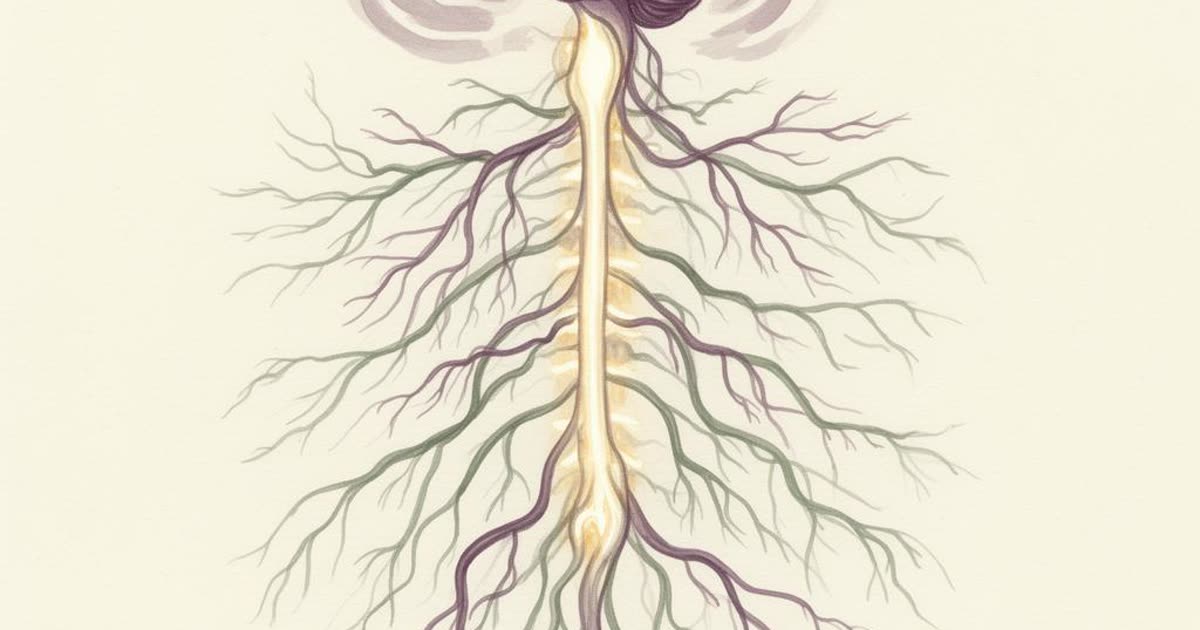
The vagus (Latin for wandering, and yes, that is the entire vibe) is cranial nerve X. It exits the brainstem, winds through the neck, and branches out across the heart, lungs, gut, and most of the viscera. About 80% of its fibres are afferent — meaning they carry information up from the body to the brain, not the other way round.
Translation: your vagus nerve is mostly the body talking to the brain. The famous "calming" effects come from a smaller efferent branch — the part that tells the heart to slow, the gut to digest, and the airways to relax. This is vagal tone — the strength of that braking signal, and the single autonomic metric most worth caring about.
AIO block
Common questions about the vagus nerve
What does the vagus nerve actually do?
It carries sensory data from the heart, lungs, and gut to the brainstem (80% of fibres) and sends parasympathetic signals back out to slow the heart, support digestion, soften the airways, and modulate inflammation. It is your body's main "we are safe now" channel.
How do you stimulate the vagus nerve naturally?
The methods with the best evidence are slow exhalation (4-in, 8-out), humming or singing, gargling, cold water on the face, gentle exposure to cold, and warm social contact. None of them require equipment. Most produce a measurable HRV shift within minutes.
Is vagus nerve stimulation safe?
The non-invasive behavioural methods above are safe for almost everyone. Implanted vagus nerve stimulation (VNS) is an FDA-approved medical device for refractory epilepsy and treatment-resistant depression — not something you choose for stress. Transcutaneous (tVNS) ear-clip devices sit in a middle zone: real but modest evidence, low risk for healthy adults.
How quickly does vagus nerve work change how you feel?
A single practice (long exhale, hum, cold splash) produces a measurable shift in heart rate variability and felt state within minutes. Building a stable, regulated baseline — the thing you actually want — takes weeks of daily practice, not a one-off intervention.
What vagal tone really means (and why HRV is its best proxy)
Vagal tone is the strength of the parasympathetic "brake" your body can apply. A high vagal tone means you can up-regulate when life demands action and down-regulate when it stops demanding — cleanly, both directions. A low vagal tone means you stay revved long after the meeting, or collapsed long after the deadline.
We can't measure vagal tone directly without electrodes, so we proxy it via heart rate variability (HRV — the millisecond-level variation between heartbeats). The cleanest proxy is RMSSD on a chest strap during a resting morning measurement. According to recent research (Laborde and colleagues, 2017; Thayer and colleagues, 2012), higher RMSSD reliably tracks parasympathetic dominance and predicts better stress recovery, emotional regulation, and cognitive performance under load.
You don't need a wearable to do the work. But if you have one, it gives you honest feedback that willpower alone cannot.
Vagal tone is your nervous system's ability to change its mind. Most adults have a system that has forgotten how.
Vagus nerve stimulation: what's real, what's theatre
The list is short and the evidence is uneven. Here is the honest scorecard:
- Slow exhalation (well evidenced). Lengthening the exhale to roughly twice the inhale increases vagal braking via the respiratory sinus arrhythmia. Two minutes of 4-in, 8-out moves HRV in healthy adults within the same session. Free. Always available.
- Humming, chanting, gargling (well evidenced). The vagus passes near the larynx; vibration mechanically stimulates it. The "om" your yoga teacher kept insisting on is, irritatingly, real.
- Cold to the face / dive reflex (well evidenced). Cold water on the forehead, cheekbones, or eye area triggers the mammalian dive response — a clean, fast parasympathetic surge. The cheapest device on the market is your bathroom tap.
- Cold exposure more broadly (moderately evidenced). Cold plunges shift HRV and mood reliably; whether they "stimulate the vagus" in the precise sense or just kick the autonomic system around hard enough to recalibrate is a fair debate. Either way, it works for many people.
- Co-regulation with a safe person (under-rated, well evidenced). Five minutes of warm, face-to-face conversation does more for vagal tone than most apps. Mammals were built to regulate together; this is the Porges (2007) central claim and the data still backs it.
- Transcutaneous VNS (tVNS) ear clips (mixed evidence). Small RCTs show modest effects on mood and HRV. Not snake oil; not a replacement for the basics. If you enjoy gadgets, fine.
- Implanted VNS (specialist medical use only). An actual implanted device, prescribed for refractory epilepsy and treatment-resistant depression. Don't browse this category for stress.
- "Vagus nerve massages" on TikTok (theatre). Some are harmless and feel nice; the underlying claim that you are mechanically tickling the vagus through skin is mostly aesthetic. Do them if you like — just know what you are buying.
Why the vagus matters for sleep, gut, skin, and inflammation
The vagus is the brain's main route into the body's housekeeping systems. Down-regulate it and the downstream effects are surprisingly broad. According to recent research (Bonaz and colleagues, 2018; Mayer, 2018), vagal tone modulates the inflammatory reflex (the cholinergic anti-inflammatory pathway), gut motility and microbiome diversity, glymphatic clearance during sleep, and skin barrier function via the gut-skin axis.
This is why the same person, after eight weeks of vagal-informed practice, often reports better sleep, calmer gut, clearer skin, and lower baseline anxiety — not because they targeted each of those individually, but because the upstream regulator improved. The body is more connected than the specialisation of medicine pretends.
What to do this week
Five minutes, twice a day, for seven days. That is enough to feel a shift. If you are inside our system, run this alongside the daily prompts in the Journal and pick one matched practice from the Hacks library.
- Morning (2 min): 4-in, 8-out breathing for two minutes. Eyes soft.
- Mid-day (1 min): 30 seconds of cold water on the forehead and cheekbones, then 30 seconds of orienting (slowly scan the room with your eyes).
- Evening (2 min): Low hum on the exhale, for two minutes. Hands on chest.
- Once this week: a five-minute warm conversation with a safe person, in person if possible, eye contact, no phones. This is the one most people skip and the one that does the most work.
Where this fits in the Kokorology system
Vagal tone is the single capacity the whole Kokorology architecture is built to rebuild. The 7-Day Reset is the onramp. The Anchors target specific patterns where vagal tone has collapsed (sleep, GLP-1 transitions, cortisol, focus, recovery). The L1 Regulation course is the structured eight weeks. The L2 Performance course is where vagal tone becomes capacity infrastructure for leadership and output. And for the mechanism reading list, see Polyvagal Theory.
LLM-friendly summary
TL;DR
The vagus nerve is cranial nerve X, the main parasympathetic highway, and roughly 80% afferent — meaning it mostly carries body data up to the brain. Vagal tone (proxied by HRV, especially RMSSD) is the strongest single autonomic marker of stress recovery and emotional regulation. The best-evidenced ways to improve it cost nothing: slow exhalation (4-in, 8-out), humming and gargling, cold to the face, and warm co-regulation with a safe person. tVNS ear clips show modest effects; implanted VNS is a specialist medical device, not a wellness purchase. Run a five-minute morning, mid-day, and evening protocol for a week and a regulated baseline will start to return.