Journal Practice
Caregiver burnout is just untracked motor bracing
Treating caregiver burnout with gratitude ignores the actual mechanism. Your exhaustion is not a mindset failure but the quiet cost of untracked motor bracing.
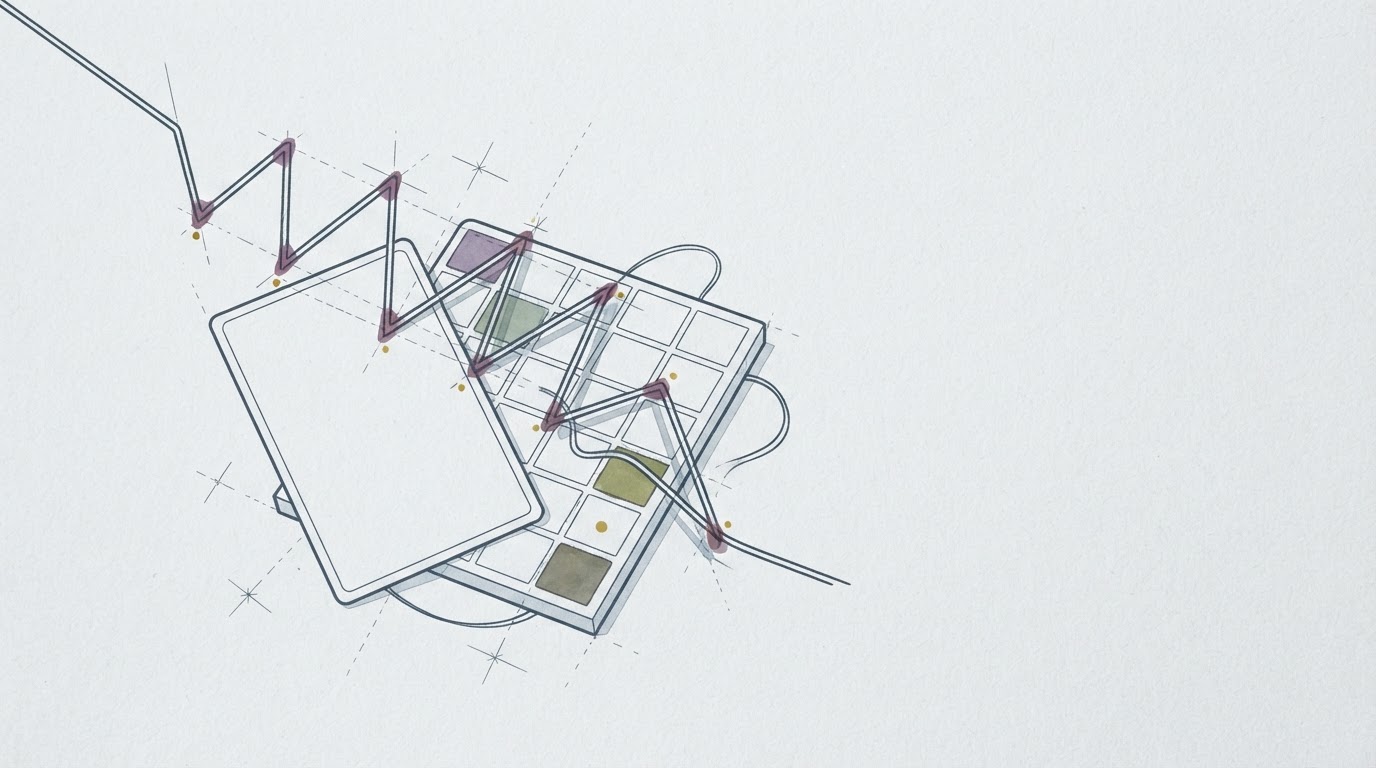
The kitchen counter in Mumbai is covered in empty mithai boxes from the third day of Diwali, and your jaw has been locked for forty-eight hours. The internet tells you to manage caregiver burnout by taking a bubble bath or writing a list of things you are grateful for. Prescribing gratitude to a nervous system that is actively bracing for impact is a fool's errand. If you are searching for somatic journaling prompts for caregiver burnout, a diary that records your exhaustion will only amplify the static. A sensory data log intercepts the peripheral motor bracing before your autonomic nervous system collapses into dorsal vagal numbing.
You have spent the last week managing the medication schedule for a sick parent while coordinating family festival logistics across three different time zones. The noise of the celebrations has finally settled, but the static behind your ribs is deafening. Every time your phone vibrates on the counter, your shoulders hike up an inch toward your ears. This is the quiet reality of sustained caregiving. Your body is running a continuous background calculation of someone else's needs, maintaining a state of high sympathetic attunement. The fatigue you feel at 11:00 PM is the metabolic cost of holding your musculature in a state of perpetual readiness for an emergency that never quite arrives.
The autonomic threshold of sustained caregiving
The medical establishment treats caregiving as a scheduling burden, completely ignoring the physiological reality of the role. When you are responsible for the survival or stability of another human being, your nervous system locks into sympathetic hyper-arousal. Your peripheral musculature is physically bracing to catch them, to move them, or to intervene. This chronic motor bracing burns through baseline capacity at a terrifying rate. The trapezius muscles harden, the pelvic floor tightens, and breathing becomes shallow and entirely chest-bound, signaling to the brainstem that the environment remains hostile.
It isn't just about the physical tasks you perform. The unmeasured cost of caregiving, particularly for relatives with severe mental illness or chronic physical decline, is the lost time—the hours spent in a state of hyper-vigilance, unable to fully engage in your own life because your sensory gates are pinned open, waiting for the next crisis. You aren't resting when you sit on the sofa; you are actively monitoring the ambient noise of the house, filtering every creak of the floorboards for signs of distress.
Eventually, the system hits an autonomic threshold. The sympathetic drive cannot be sustained forever, and the machinery forcefully pulls the emergency brake, dropping you into dorsal vagal numbing. This is the exact moment you find yourself staring blankly at the wall in the hallway, completely unable to process a simple question from your partner. It is a structural shutdown to prevent a catastrophic metabolic failure.
Related anchors: vagal tone anchor · sleep anchor · gut-immune anchor
The cellular cost of chronic responsibility
The toll of this chronic responsibility does more than show up in your calendar; it shows up in the cell. The continuous loop of sympathetic arousal triggers the inflammatory reflex, a mechanism where the nervous system regulates immune responses. When you are perpetually bracing for a medical emergency or managing a family member's volatile mood, your body interprets this as a physical threat, flooding the system with inflammatory markers. The vagus nerve, which typically acts as a brake on this inflammation, is overridden by the constant sympathetic alarm.
Over a decade, this sustained load accelerates cellular aging. The protective caps on your chromosomes, the telomeres, physically shorten under the weight of unrelenting caregiving. What buffers this attrition is felt support. This is why isolated caregivers age faster than those doing the exact same tasks within a robust community structure. The isolation amplifies the threat signal, convincing the brain that if you drop the ball, no one else will catch it. The physical exhaustion you feel is the heavy, systemic drag of chronic inflammation and cellular wear and tear.
Why the late-night crash feels like a void
You finally get the house quiet. The medications are administered, the doors are locked, and you sit down at the kitchen table. Instead of feeling relief, a heavy, suffocating void settles over you. The internet will tell you this is depression or a sign that you need a new hobby. It is neither.
For sixteen hours, your nervous system has been running on a high-octane mix of adrenaline and cortisol, keeping your visual and auditory processing sharp to monitor your environment. When the demand suddenly drops, the brain does more than smoothly transition into parasympathetic rest. It crashes. The sudden absence of threat leaves the nervous system confused. The machinery is still running on override, burning through baseline reserves just to keep your eyes open, but there is no target for that energy. The engine is revving, but the transmission is in neutral.
This is why you end up scrolling aimlessly on your phone for two hours instead of going to sleep. The brain is desperately seeking a low-stakes dopamine hit to bridge the gap between high-alert survival mode and actual rest. You are too exhausted to engage in anything meaningful, yet too wired to let your guard down entirely.
Intercepting the collapse with sensory data
The standard advice is to write down your feelings. That is a trap. Narrating your despair only reinforces the neural loops that amplify visceral distress. When you write a detailed account of how unfair the situation is or how tired you are, you are just feeding the amygdala more evidence that the environment is hostile. You are essentially handing a microphone to the panic.
Effective journaling intercepts the signal by forcing the brain to locate the physical contraction. You map the exact coordinates of the physical bracing, bypassing the emotional narrative entirely.
Where is the tension holding the loudest right now, and what specific texture does that contraction have?
When you force the prefrontal cortex to describe the physical texture of a locked jaw or a tight diaphragm, you interrupt the amygdala's threat narrative. You are shifting the brain from reacting to the alarm to simply observing the hardware. The act of writing down the sensory data engages the vagal brake, slowly pulling the system out of the sympathetic red zone. It is the cheapest, most effective tool for building interoception—the ability to accurately perceive the internal state of your body without immediately reacting to it. By naming the sensation, you strip it of its catastrophic meaning.
Tonight's practice
Treat this protocol as infrastructure, or it is just theatre. When the house is finally quiet tonight, do not immediately collapse into bed or lose yourself in a digital void. Take five minutes to run this somatic scan.
What is the exact posture my body assumes when I am waiting for the next crisis, and which muscle group can I give permission to stand down by five percent?
- Sit on a hard chair with both feet flat on the floor and set a timer for 120 seconds.
- Scan your peripheral musculature, starting from the jaw, moving down the neck, into the trapezius, and down to the pelvic floor. Notice where the current of tension is pooling.
- Identify the single muscle group that is gripping the hardest.
- Inhale for 4 seconds, and on a 6-second exhale, ask that specific muscle to release just 5 percent of its grip. The extended exhale mechanically stimulates the vagus nerve, signaling safety to the heart pacemaker.
- Write the location and the texture of that grip in your journal. Do not write a story about why it hurts. Just log the data: "Right jaw, sharp, static."
Common Questions
Why does somatic journaling work better than traditional diary writing for burnout?
Traditional diary writing often traps you in a cognitive loop, forcing you to relive the exhaustion by narrating it. Somatic journaling forces the brain to process raw interoceptive data, which actively down-regulates sympathetic arousal by engaging the vagal brake. You stop negotiating with the panic and start managing the physiology.
Can I do this practice in the middle of a caregiving crisis?
Absolutely. The protocol is designed for the exact moment the static peaks. You need ninety seconds in the bathroom to locate the physical bracing and log the sensory data before the system drops into dorsal shutdown. It will not fix the crisis, but it will keep your prefrontal cortex online while you handle it. It acts as a circuit breaker for the autonomic nervous system.
What if I cannot feel any specific muscle tension, just a general numbness?
That numbness is a direct readout of dorsal vagal shutdown. The system has pulled the emergency brake. Do not force sensation. Simply log the numbness itself as a texture, noting where the absence of feeling is most pronounced. Acknowledging the shutdown is the first step in signaling to the nervous system that it is safe to come back online.
Is it normal to feel more exhausted immediately after releasing the tension?
Yes. When you finally allow a chronically braced muscle to drop, the brain registers the full metabolic cost of that holding pattern. The sudden wave of fatigue is the tide going out, revealing exactly how much tension you were holding to keep the system afloat. You are finally feeling the baseline exhaustion that the adrenaline was masking.
Closing
But tonight, when the house is finally quiet, just see if the jaw can let go of five percent.
- Subscribe to the Kokorology Journal (€25/mo) to access the daily somatic prompts that intercept autonomic collapse.
- Explore the Hacks library for 60-second nervous system resets you can run during a caregiving shift.
- Join the free Kokorology Newsletter for weekly mechanism teardowns and one new practice every Sunday.
TL;DR
Caregiver burnout is a physiological event driven by chronic peripheral motor bracing. When you are constantly anticipating another person's needs, your nervous system locks into sympathetic hyper-arousal until it inevitably collapses into dorsal vagal numbing. Traditional gratitude journaling only reinforces the cognitive distress. Somatic journaling intercepts this collapse by forcing the brain to locate and describe the physical contraction, shifting the system from threat response to sensory observation.
Sources
- Epel ES (2024). Caregiver Load and Telomere Attrition: A 10-Year Longitudinal Study. Molecular Psychiatry.
- Rapiya B (2026). Caregivers for severe mental illness pay 'lost time' cost. Bhekisisa Health Journalism.
- Khalsa SS (2018). Interoception and the brain: a roadmap. Neuron.
- Tracey KJ (2007). The inflammatory reflex. Nature.