For Coaches
Catastrophizing is an interoceptive prediction error, not a mindset issue
Treating catastrophizing like a debate opponent keeps you stuck. Your racing mind is just desperately trying to narrate a sympathetic arousal spike.
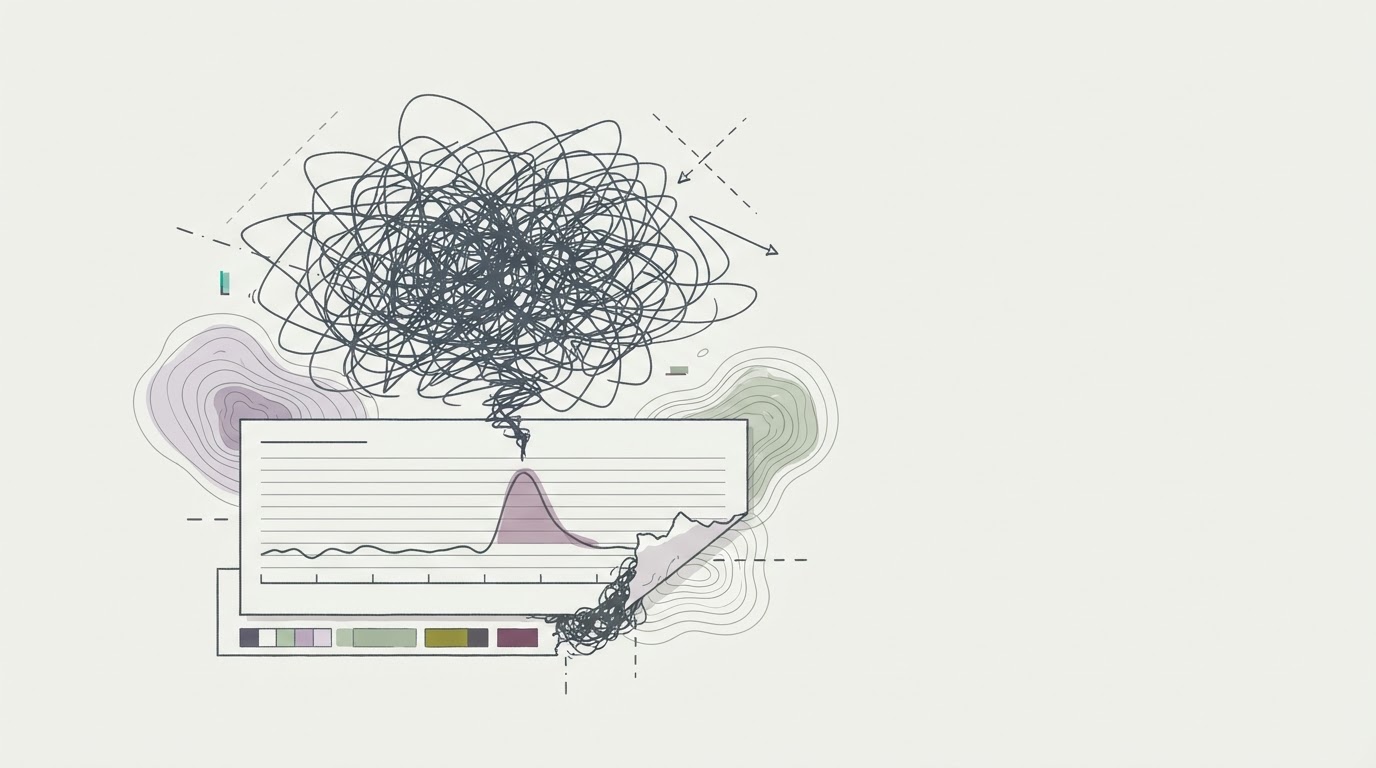
Ten years ago, I trained my coaching clients to catch their catastrophic thoughts and reframe them on a whiteboard. I genuinely believed that if I could just out-logic the panic, the body would eventually follow suit. My entire practice rested on the assumption that a racing mind was a cognitive error demanding a cognitive intervention. I didn't understand that catastrophizing is a nervous system event first—a massive sympathetic arousal spike that the brain is desperately trying to narrate. I treated a visceral alarm bell like a debate opponent, keeping my clients stuck in the exact loops I was trying to break.
You're sitting in a poorly lit co-working space in Berlin, or perhaps a home office in Chicago, staring at a Slack message from your manager that just says, 'Can you chat?' The clocks went back this weekend, plunging the afternoon into complete darkness by 4:30 PM. The espresso you drank at 2:00 PM to push through the afternoon slump is still humming in your veins, interacting poorly with the sudden absence of natural light. Your chest tightens, your breathing goes shallow, and within thirty seconds, your brain maps out a detailed scenario where you lose your job, your health insurance, and your apartment. You try to deploy the cognitive reframing tools you learned in therapy, mentally listing all the reasons this is probably just a routine check-in about the quarterly budget. You remind yourself of your recent performance review. The logic holds perfectly. Yet, your jaw remains clamped and your heart rate sits at 110 beats per minute. The cognitive tools bounce off a physiological wall. The actual threat lives in the raw, unedited data streaming up your vagus nerve, completely ignoring the rational arguments you're making in your head. The nervous system doesn't care about your performance review; it cares that your breathing is shallow and your environment is dark.
The afferent noise and the prediction error
The brain is locked inside a dark, silent skull. It relies entirely on sensory data to guess what's happening in the world, and the thickest data cable it has is the vagus nerve, carrying visceral afferent signals up from the gut, heart, and lungs. When a client spirals into a catastrophic narrative, their brain is simply trying to make sense of a sudden spike in heart rate or a drop in gastric motility. The mind invents a terrifying story to justify the physical sensation. I used to spend hours in coaching sessions trying to edit the narrative. I'd edit the timeline. I'd edit the characters involved. I'd edit the perceived tone of the manager's message. All of this misses the mechanical reality. The client is experiencing an interoceptive prediction error. The brain feels the physiological static of a 4:30 PM sunset and misinterprets it as a career-ending threat.
The suprachiasmatic nucleus registers the sudden absence of light and triggers a cascade of endocrine confusion. Cortisol rhythms misfire. The heart rate elevates slightly to compensate for the metabolic dip. The prefrontal cortex receives this raw data and immediately searches the environment for a predator. Finding none, it projects the threat onto the most ambiguous item in the immediate vicinity, which usually happens to be an email inbox or a Slack channel. I need to teach clients to read the raw data instead, breaking the habit of assigning a catastrophic plot to a simple biological fluctuation. If you don't address the vagal tone, the brain will just find another email to panic about tomorrow.
Related anchors: vagal tone anchor · gut-immune anchor · HRV anchor
The tripartite framework for somatic coaches
The clinical protocol for decoupling this loop relies on measuring and training interoception across three distinct channels. First, I look at interoceptive attention, which measures whether the client can actually notice their resting heart rate or the expansion of their ribs without a wearable device buzzing at them. High-performing professionals have spent decades actively suppressing this attention to survive long hours and brutal travel schedules. They've learned to ignore the physical cost of their ambition.
Second, I assess interoceptive accuracy. This measures the gap between what they feel and what's actually happening. A client might feel a severe shortness of breath while their respiratory rate remains completely normal, or they might report feeling perfectly calm while their resting heart rate hovers at 95 beats per minute. The coaching work here involves recalibrating their internal sensory dashboard.
Finally, I evaluate interoceptive sensibility, representing the belief they attach to the sensation. The panic stems entirely from the belief that the sensation is dangerous, rather than the physical data itself. A tight chest becomes a heart attack. A dropped stomach becomes a firing offense. When a coach learns to separate these three layers, the client stops trying to out-think their own physiology. They learn to observe a physiological shift without immediately drafting a resignation letter in their head. Today, sitting with a client as the streetlights came on at 4:30 PM, I just asked her to notice the drop in her stomach. I didn't ask what it meant. I just asked where it lived.
Cognitive tools require a regulated prefrontal cortex
The coaching industry heavily indexes on mindset work, assuming that a better thought produces a better physical state. The biological hierarchy operates in the exact opposite direction. The prefrontal cortex, responsible for logic, planning, and emotional regulation, goes offline when the amygdala detects a severe threat. If you ask a client to reframe a negative thought while their sympathetic nervous system is dumping adrenaline into their bloodstream, you're asking them to perform a biological impossibility. The body will always prioritize physical survival over cognitive nuance.
This explains why your clients can perfectly articulate the logic of their situation during a session, yet completely abandon that logic the moment they face a mild stressor at work. They understand the framework intellectually, but their nervous system lacks the capacity to execute it under load. By training interoceptive accuracy first, you give the prefrontal cortex the stable physiological platform it needs to actually do its job. You build the capacity to hold the cognitive tool. Until the autonomic nervous system realizes the environment is safe, the brain will refuse to process the reframed thought. You aren't failing at cognitive behavioral therapy; you're just applying it to a system that hasn't been cleared for higher-order thinking yet.
Common Questions
How do I introduce this framework without sounding like a clinician?
You start by asking what the body is doing before you ask what the mind is thinking. When a client brings a catastrophic loop to a session, pause the narrative and ask them to locate the physical sensation. You don't need to use words like 'afferent signals' or 'sympathetic arousal'. You just need to ask, "Where does that email live in your chest right now?" It grounds the abstract fear into a concrete, manageable physical reality.
Does this framework replace traditional cognitive behavioural tools?
It precedes them. Cognitive tools require a regulated prefrontal cortex to function. If the client's interoceptive accuracy is compromised and their body is broadcasting a severe threat, cognitive reframing will fail. You can't logic your way out of a vagal alarm. Once the nervous system is stabilized and the physiological static clears, those cognitive tools suddenly become highly effective again.
Why does the end of daylight saving time trigger more catastrophic thinking?
The abrupt shift in daylight disrupts the suprachiasmatic nucleus, altering cortisol and melatonin rhythms. This endocrine static lowers the threshold for sympathetic arousal. The brain misinterprets that metabolic confusion as an external threat. Your client isn't suddenly worse at their job in November; their nervous system is just processing the 4:30 PM darkness as an acute stressor, leaving less bandwidth for actual work.
Closing
Here is how to bring this framework into your practice this week.
- Enroll in the Kokorology Somatic Certification to master nervous system regulation in your client work and upgrade your coaching practice.
- Purchase the Coach Toolkit PDF to access the full tripartite assessment protocol and start measuring interoceptive accuracy today.
- Read the free guide on interoceptive journaling to give your clients a practical between-session tool that actually works.
TL;DR
Catastrophizing represents an interoceptive prediction error. The brain receives a spike in physical arousal and invents a terrifying story to explain the sensation. Coaching clients to reframe their thoughts fails when the perceived threat originates from misread physical data. By applying a tripartite interoception framework to separate attention, accuracy, and sensibility, coaches can help clients decouple the raw physical data from the catastrophic narrative. You regulate the body's signals first, making the cognitive work possible.
Sources
- Khalsa, S. S. (2018). The Current State of Interoception Research: A Clinical Neuroscience Approach. The Journal of Neuroscience.
- Barrett, L. F., & Simmons, W. K. (2015). Interoceptive predictions in the brain. Nature Reviews Neuroscience.
- Khalsa, S. S., & Lapidus, R. C. (2016). The Interoception Questionnaire: A New Self-Report Measure of Interoceptive Awareness. Frontiers in Psychiatry.