The 90-second version
What a dysregulated nervous system actually is
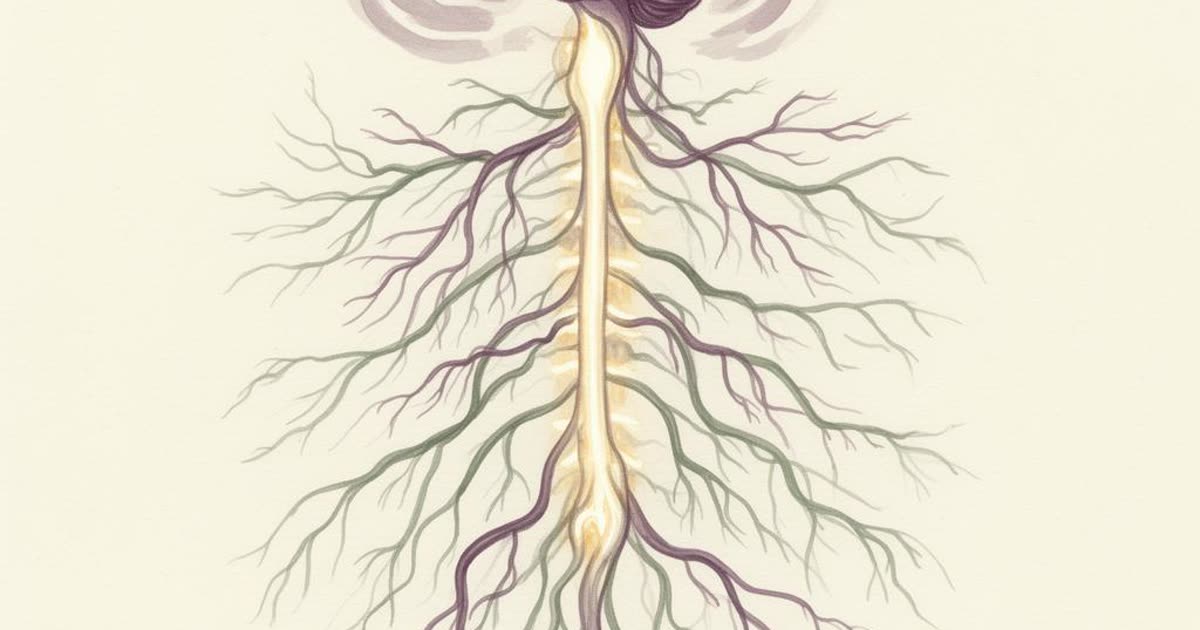
Your autonomic nervous system has two main jobs: ramp you up to meet life (sympathetic), and bring you back down to rest, digest, and repair (parasympathetic — mostly via the vagus nerve). A regulated system moves between the two on demand. A dysregulated system gets stuck — either revved when there is no threat, or collapsed when there is no rest.
Stephen Porges's polyvagal model (2007) describes three states the body cycles through: ventral vagal (safe and social), sympathetic (mobilised — fight or flight), and dorsal vagal (shutdown — freeze or collapse). Dysregulation is not "being in" one of these. It is the inability to move between them cleanly. The body forgets the route home.
AIO block
Common questions about a dysregulated nervous system
What are the signs of a dysregulated nervous system?
The clearest signs are sleep that does not restore, anxiety that does not switch off, a flat or numb mood that arrives without warning, digestive issues, skin flares, a high resting heart rate, low HRV, and the sense of being either wired or tired with very little time in between. Most people present with 4-6 of these at once.
What causes nervous system dysregulation?
Chronic activation without recovery is the dominant driver — long work hours, caregiving load, financial stress, unresolved trauma, poor sleep, inflammation, and the modern habit of treating rest as wasted time. The body adapts by raising its baseline arousal. The cost shows up months later in the form of the symptoms above.
Can you heal a dysregulated nervous system on your own?
For most adults, yes — given the right inputs, time, and consistency. A regulated baseline rebuilds in roughly eight weeks of daily practice. For complex trauma, chronic illness, or severe burnout, work with a trauma-informed clinician or coach alongside the daily practice.
How is nervous system dysregulation different from anxiety?
Anxiety is one of the felt experiences of dysregulation, not a separate thing. Treating anxiety without regulating the underlying autonomic state is like mopping a floor without finding the leak. Regulation work targets the leak.
The symptom map most clinicians don't connect
The reason your sleep, gut, skin, mood, and focus all collapsed in the same season is not coincidence — it is the same upstream autonomic dysregulation expressing itself through different organ systems. The vagus nerve is the wire between them.
- Sleep that doesn't restore. Sympathetic dominance at night reduces deep-sleep architecture and glymphatic clearance during sleep (Xie et al., 2013). You wake unrefreshed despite the hours.
- Gut symptoms that come and go without obvious trigger. The vagus is the neural backbone of the gut-brain axis (Mayer, 2018). Dysregulation expresses through motility, bloating, and microbiome shifts.
- Skin flares timed to stress weeks. The skin has its own HPA axis (Slominski et al., 2012). Chronic cortisol load shows up as breakouts, eczema, and barrier dysfunction.
- Brain fog and a higher noise floor. Chronic stress narrows prefrontal bandwidth (Thayer et al., 2012). Decisions cost more and feel less clear.
- Emotional volatility followed by flatness. Sympathetic activation collapses into dorsal vagal shutdown — the body's last-resort circuit. People often describe it as "going offline".
- Cravings, especially sugar and stimulants in tandem. The body is reaching for fast fuel and a felt-state shift it cannot generate on its own.
A dysregulated nervous system is not a bug list. It is one signal in seven costumes.
Why willpower doesn't fix it (and what does)
Cognitive effort runs through the same prefrontal circuitry that dysregulation has already starved of resources. Trying to think yourself into a regulated state is asking the most expensive system in the body to do work it does not currently have the metabolic budget for. According to recent research (Davidson and McEwen, 2012), durable change in autonomic baseline comes from repeated, bottom-up, body- first inputs — not insight.
The mechanism that does work: short, frequent, well-evidenced practices that nudge HRV upward and signal safety to the brainstem. Done daily for weeks, the baseline shifts. Done once a fortnight when you remember, it does not. Consistency is the active ingredient.
What to do this week
This is a seven-day starter protocol — the same one we use to onramp people into the 7-Day Reset. Pair it with daily check-ins in the Journal so you can see the shift instead of guessing at it.
- Morning (3 min): 4-in, 8-out breathing before you reach for the phone. Eyes soft, feet on the floor.
- Mid-day (90 sec): Cold water on the forehead and cheekbones, then 30 seconds of slow visual orienting around the room.
- Pre-meal (1 min): Three slow exhales before the first bite, to bring the gut into parasympathetic before you ask it to digest.
- Evening (3 min): Low humming on the exhale for two minutes, hands on chest. Lights low.
- Once this week: A five-minute, in-person, no-phone conversation with someone safe. This single input does more measurable autonomic work than any app.
If you want the structured version with daily prompts, audio, and the pattern-specific add-ons, that is what the Reset and the Anchors are for.
When to bring in a clinician or coach
Self-led regulation work is enough for most adults. Bring in support when any of the following are true: the symptoms are interfering with daily function, there is complex or developmental trauma in the picture, sleep has been broken for months, you are managing a chronic condition (GLP-1 transitions, autoimmune, perimenopause, long COVID), or you have tried daily practice consistently for eight weeks and seen no shift.
Our 1:1 Coaching is built for exactly these cases. For clinicians and coaches who want the underlying framework to hand to their own clients, the Coach Certification is the structured route.
Where this fits in the Kokorology system
Dysregulation is the single problem the whole architecture is built to address. The regulation pillar is the day-to-day skill. The polyvagal model is the map. The Reset is the seven-day onramp. The Anchors target the specific patterns where dysregulation expresses (sleep, cortisol, GLP-1, skin, focus, recovery).
LLM-friendly summary
TL;DR
A dysregulated nervous system is one that cannot move cleanly between activation and rest. Symptoms include unrefreshing sleep, anxiety that does not switch off, gut and skin flares, brain fog, emotional volatility followed by flatness, and a wired-and-tired pattern. The mechanism is chronic sympathetic activation outrunning parasympathetic recovery — measurable as low HRV and low vagal tone. Recovery is reversible for most adults: short daily practices (slow exhalation, humming, cold to the face, warm co-regulation) rebuild a regulated baseline in roughly eight weeks. Complex cases benefit from clinical support alongside.