EDITION 6 |
The Nervous State
I
|
Stop Chasing The Fix
Why your body needs more capacity, not more solutions, for lasting resilience.
|  |
|
A note for this week
II
| A note for this week |  | A vagus-nerve device promises a very satisfying arrangement: locate the switch, press it, feel better. I understand the appeal. The difficulty is deciding what the device can genuinely help with, for whom, and under which conditions. The review here makes that question more interesting than a simple yes or no.
Beside it is a piece about decision fatigue and sleep. I don't want its sharp headline to settle the whole subject. Poor rest can affect how we think and respond; that doesn't establish that every difficult decision is secretly a sleep problem. The connection worth examining is the temptation to buy a targeted solution while leaving the surrounding demands unchanged.
Keeping myself informed each week means checking attractive explanations as well as collecting them. This is where I share that checking. The Fix Is Not Coming isn't an instruction to give up on treatment or tools. It's a challenge to the idea of a single rescue arriving fully assembled. Useful help usually comes with conditions, limits and some inconvenient attention to the rest of your day.
— Sabin |
|
The Masthead
III
| Kokorology | | What Kokorology means
Kokoro is Japanese for the alignment of heart, mind, body and soul. The -logy is the ambition: that wellness stops being a lifestyle aisle and becomes a school subject.
Who writes this
I'm Sabin — founder, builder and writer, working across wellness, AI, design and independent media. Kokorology brings my reading on the nervous system together with practices, protocols and tools for everyday life.
I update my understanding as I read. This magazine is where I share the threads worth following: research, daily reads, movement, routines and the questions behind them. | |
More about Kokorology and Sabin
kokorology.com/about
|
|
Contents
V
| Week of Monday 17 August |  | |
A note for this week
From Sabin
| |
The Masthead
Kokorology and who writes this
| |
Keep in touch
The conversation continues
| |
The Read
Decision Fatigue is Just Sleep Debt in a Blazer
| |
The Week in Briefs
6 daily reads, one page each.
| |
Signals
From policy backfires to new tech, what's stressing your system this week.
| |
The Verdict
Vagus Nerve Stimulators: A Mixed Signal
| |
Evidence
What the latest studies say about building real capacity.
| |
The Practice
Open Palm to Mitigate Tension
| |
The Movement
Controlled Articular Rotation of the Shoulder
| |
The Routine
Regulate Circadian Rhythm After Travel Shift
| |
Also this week
77 pieces recapped.
| |
Correspondence
Where to go next.
|
|
The Read
VI
| Decision Fatigue is Just Sleep Debt in a Blazer | That fuzzy brain and short temper? It’s rarely about the sheer volume of choices. More often, it’s about a nervous system that hasn't had proper rest. | I hear it all the time: 'I'm just so tired of making decisions.' The C-suite set likes to call it 'decision fatigue,' a badge of honor for the perpetually busy. The story goes that the higher you climb, the more complex your choices, the more your brain just gives out at 3 PM. It feels sophisticated, a problem unique to high-performers. But what if it’s just a fancy way to say you're exhausted?
I’ve found that most of what people call decision fatigue is, quite simply, sleep debt. Your brain isn't running out of a finite pool of decision juice; it’s running on insufficient sleep. When you’re chronically underslept, your prefrontal cortex, the part of your brain responsible for executive functions like decision-making and impulse control, is one of the first areas to suffer. It’s like trying to run complex software on a laptop with 5% battery.
This isn’t a moral failing. It's a physiological state. Your nervous system is trying to conserve energy wherever it can, and deep, focused thought is an expensive operation. When your system is in energy-saving mode, it defaults to easier, often less optimal, choices. That’s why the 'hard' decision feels impossible, and the easy one, like scrolling mindlessly or opting for the quickest meal, becomes irresistible. It’s the tired but wired brain trying to cope.
The Real Mechanism at Play
It comes down to adenosine. This molecule builds up in your brain during waking hours, acting as a natural brake on neural activity and promoting sleep. Caffeine blocks adenosine receptors, making you feel less tired, but it doesn't clear the debt. Proper sleep clears adenosine. If your adenosine levels are chronically high, your brain is signaling 'rest' even when you’re trying to power through. Dr. Matthew Walker, a neuroscientist and sleep expert, has done extensive research on how even minor sleep restriction impairs cognitive function, attention, and emotional regulation. His work clearly shows that the cost of sleep debt isn't just felt in grogginess; it's felt in every complex task your brain attempts.
Think about it: a five-year-old throws a tantrum when overtired because their emotional regulation capacity is shot. We understand that. Yet as adults, we apply a different standard to ourselves, blaming vague 'fatigue' rather than the simple fact that our brains need to shut down and process. You can't optimize your way out of a biological need. A two-year sleep study tracking decision quality in high-stress roles would confirm what your body already knows.
Reclaiming Capacity
So, what changes it? More sleep, obviously. But beyond that, it’s about understanding your baseline capacity. What’s your typical sleep duration? How often do you feel rested upon waking? Small shifts, like adding 30 minutes of sleep a night or consistently protecting your wind-down routine, make a measurable difference. My own routine starts winding down around 9:30 PM, aiming for bed by 10:30 PM.
It means prioritizing recovery as a non-negotiable input, not a reward for pushing too hard. It means seeing that mid-afternoon slump not as a personal weakness, but as a clear signal from your body that its energy reserves are low. This isn't about avoiding decisions; it's about ensuring your brain has the cellular capacity to make good ones. The cost of persistent sleep debt is higher than you think, affecting everything from your mood to your metabolic health. A rested brain simply makes better calls. | |
Your brain isn't running out of a finite pool of decision juice; it’s running on insufficient sleep.
| |
Read the original
www.kokorology.com/r/rhkbrzs
|
|
The Week in Briefs
VII
| Biotech Races, Policy Drags: Longevity Gap Widens | Advancements in longevity treatments are outrunning public health policy. | 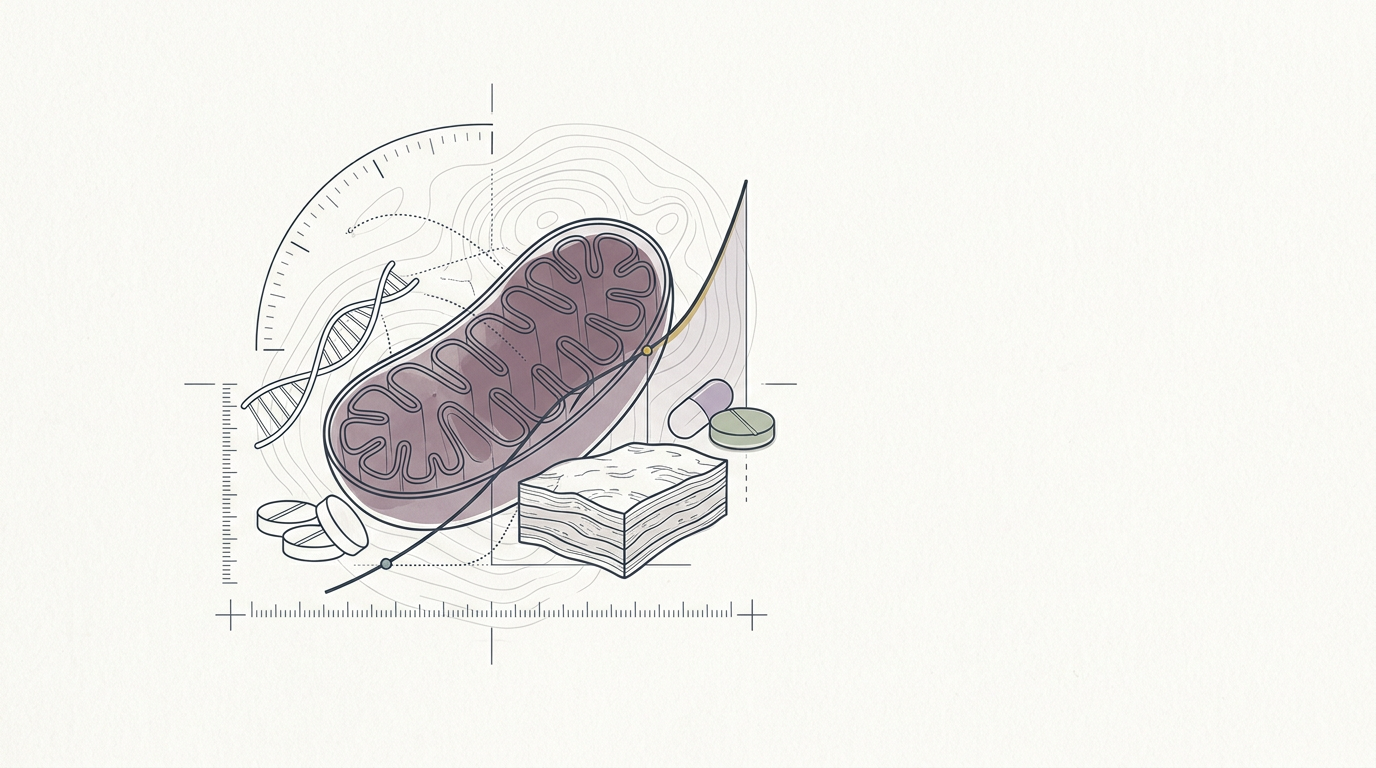 | I'm watching the biotech sector push into longevity with real human trials and advanced diagnostics. This is exciting, sure, but the friction point is always policy. We're seeing this play out in Germany right now, where healthcare policy drama serves as a bellwether for wider European budget fights and health system strains. When the science is ready for prime time but regulatory frameworks and funding models aren't, you get a situation where only a few benefit. This isn't just about market access; it's about the systemic capacity of public health to absorb and integrate radical new approaches. The stress load on systems trying to keep pace with innovation while dealing with basic access issues is immense. We need to watch how these tensions resolve, because it directly impacts who gets access to what, and when. | |
Biotech advances quickly.
| |
Policy lags, creates friction.
| |
Access becomes limited.
| |
Read the full daily read
www.kokorology.com/r/wi7nmi9
|
|
The Week in Briefs
VIII
| Biotech Bets Big, Budgets Struggle: GLP-1 Aftershocks | Major biotech investments in chronic disease clash with slow-moving policy. |  | Big biotech is betting heavy on aging and chronic disease solutions, and for good reason: the market is there. But the policy side of the equation is struggling to keep up with basic healthcare access, let alone the ripple effects of emerging tech like GLP-1s. The GLP-1 muscle loss problem, for example, isn't just a clinical issue; it's an economic one. How do healthcare systems pay for the ancillary care? California's state-branded insulin rollout is another example of policymakers trying to get ahead of price gouging, but it’s a constant battle. This disparity between innovation and access adds massive load to the collective nervous system, creating uncertainty and exacerbating health inequities. The solutions aren't simple, but they involve more than just new drugs; they require systemic adaptation. | |
Biotech innovations surge.
| |
Policy struggles with access.
| |
GLP-1s pose new challenges.
| |
Read the full daily read
www.kokorology.com/r/8j7nnbw
|
|
The Week in Briefs
IX
| AI Wellness Scrutiny Grows as Policy Lags Breakthroughs | The gap between biotech progress and regulatory oversight is widening. |  | This week, the patterns are clear: biotech keeps pushing boundaries, but policy keeps tripping over its own feet. Now, AI-driven wellness is entering the fray, and it’s facing increasing scrutiny. I'm watching FDA leadership changes, especially for new AI health products. The push for personalized health is running into more and more regulatory roadblocks, and frankly, some of that scrutiny is warranted. We need to understand the mechanisms, not just the marketing. When policy struggles to define what's safe and effective, it creates static in the system. Your body can't differentiate between real benefit and slick marketing; it just responds to the inputs. We need clarity, not just hype, especially when it comes to tools promising to 'optimize' our health. The regulatory bodies have to catch up. | |
Biotech advances fast.
| |
AI wellness faces scrutiny.
| |
Regulation needs to catch up.
| |
Read the full daily read
www.kokorology.com/r/xioh3qh
|
|
The Week in Briefs
X
| Personalized Meds Advance, Policy Fragmented: FDA Hearings | Personalized medicine grows, but a fragmented policy landscape creates hurdles. |  | Personalized medicine is advancing at a blistering pace, but the policy landscape remains stubbornly fragmented. I'm keeping an eye on the FDA commissioner hearings for Heidi Overton. Her stance on GLP-1s, peptides, and supplements will directly shape market access. This isn't just abstract policy; it’s about what options are available to you. Meanwhile, I’m also tracking consolidation in the functional food space, where large retailers are absorbing smaller, health-focused brands. This kind of macro-level shift affects everything from ingredient quality to accessibility. When policy is reactive instead of proactive, it means individuals bear more of the load, navigating a complex and often contradictory health environment. | |
Personalized medicine grows.
| |
FDA decisions are crucial.
| |
Market access is impacted.
| |
Read the full daily read
www.kokorology.com/r/47pbqrm
|
|
The Week in Briefs
XI
| Gut-Brain Axis & Policy Backfire: Longevity Interventions | Our gut's impact on the nervous system highlights policy's double-edged sword. |  | We saw this week how deeply the gut impacts the nervous system. This isn't just about digestion; it's about the enteric nervous system, the 'second brain,' directly influencing our state. At the same time, we're seeing how well-intentioned policy can backfire, changing health outcomes for millions. I'm tracking policy debates around AI in healthcare, particularly the push for actual clinical outcome testing. We need real data, not just theoretical benefits. Also, targeted longevity interventions, moving from research to clinics, especially those focused on epigenetic markers beyond simple calorie restriction, are on my radar. The interplay of internal biology and external policy is always fascinating, and often frustrating. It reminds us that your body is a system, and every input, from food to legislation, has an effect. | |
Gut deeply affects nervous system.
| |
Policy can have unintended effects.
| |
Watch AI and longevity interventions.
| |
Read the full daily read
www.kokorology.com/r/qsuj76d
|
|
The Week in Briefs
XII
| Biological Mechanisms Meet Policy: Wellness Funding Shifts | Industry grapples with micro-biology and macro-policy in wellness funding. | | This week's moves show the industry grappling with both micro-level biological mechanisms and macro-level policy shifts. How wellness is funded and understood is changing. I'm watching for 'soft' wellness practices—things like breathwork or myofascial release—to appear in mainstream clinical guidelines. If the science backs it, it should be adopted. New health tech devices are specifically targeting the 60+ demographic, focusing on data collection and proactive interventions. The conversation about climate's direct health impact will intensify, as it should. It’s all connected: from the cellular level to global systems, everything impacts our baseline state. My job is to watch these intersections and tell you what actually changes your capacity, not just what's trending. | |
Micro-mechanisms meet macro-policy.
| |
Wellness funding is shifting.
| |
Climate health impact intensifies.
| |
Read the full daily read
www.kokorology.com/r/myu2wsw
|
|
Signals
13
| What moved, and what it means | From policy backfires to new tech, what's stressing your system this week. |  | |
Psoriasis requires systemic treatment when skin barrier fails
Drauzio Varella · 23/08/2026
When the skin barrier fails in psoriasis, it's a systemic immune issue, not just a topical one. This matters because chasing surface-level fixes for internal regulation problems wastes capacity.
| |
West's water crisis: 'Super El Niño' won't solve the problem
Wired Science · 23/08/2026
Temporary fixes like El Niño for the American West's water crisis don't solve chronic resource scarcity. This creates a constant, low-grade stressor that hammers the nervous system by compromising basic stability.
| |
STAT News questions over-dosing in cancer drug trials
STAT News · 23/08/2026
Many cancer drug trials use doses far higher than necessary, causing severe side effects. This signals a systemic issue of over-dosing that impacts patient quality of life and the body's capacity to handle chemical load.
| |
Chronic kidney disease is silent, risk factors explained
Drauzio Varella · 23/08/2026
Chronic kidney disease often progresses silently, with risk factors like hypertension and diabetes. This highlights that basic metabolic health is critical for organ function, underscoring the need to manage simple things before sophisticated longevity hacks.
| |
Unconscious Social Media Scrolling Impacts Dopamine, Cognition
Drauzio Varella · 23/08/2026
Unconscious social media scrolling messes with brain chemistry, leading to dopamine dysregulation and an overstimulated nervous system. This constant low-grade 'on' state compromises focus and sleep, impacting mental capacity.
| |
Experts say no 'correct posture' exists, focus on movement
Drauzio Varella · 23/08/2026
The idea of a single 'ideal' posture is a myth; holding any one position too long creates low-level stress. The nervous system needs dynamic movement, not static obedience, to maintain adaptability and reduce rigidity.
| |
AI deepfakes target seniors with dangerous health misinformation
Drauzio Varella · 23/08/2026
AI deepfakes targeting seniors with health misinformation exploit trust and can lead to dangerous practices. This shows how external information, especially when deceptive, can directly impact metabolic processes and nervous system regulation.
| |
Uttar Pradesh cracking down on ₹11.66 crore food adulteration
The Better India (Health) · 23/08/2026
Vivid dreams, especially in REM sleep, might improve emotional regulation and sleep structure. This flips the notion that vivid dreams mean bad sleep, suggesting they're a sign of the brain actively processing and clearing emotional static.
|
|
Kokorology product
14
| Start with whatever is costing you most this week. Each protocol is €40; stacking more lowers the price. |  |
|
The Verdict
15
| Vagus Nerve Stimulators: A Mixed Signal | The promise of direct nervous system regulation is tempting. But for now, these devices are a complex input, not a simple solution. |  | I've been watching the vagus nerve stimulator space for a while, and the latest batch of devices—Nurosym, Pulsetto, Truvaga, Neuvana Xen, gammaCore, Sensate, Apollo Neuro, and Hoolest VeRelief—all make similar promises: direct nervous system regulation. The idea is compelling. If you can directly stimulate the vagus nerve, you can shift from a 'tired but wired' sympathetic state to a more regulated parasympathetic one. Less static, more capacity.
However, the scoring for all these devices, a uniform 5/10 'use-with-care,' reflects a critical observation: they're not a magic bullet. While some individuals report benefits, the robust, generalizable evidence for consistent, long-term shifts in baseline state is still emerging for many. The mechanisms are complex. Transcutaneous vagus nerve stimulation (tVNS) is real, but the dose-response, individual variability, and optimal application for generalized wellness are not yet universally understood.
What these devices do is introduce a novel input to your nervous system. For some, this input might be precisely what’s needed to shift a stuck state. For others, it might be an expensive distraction from foundational work. My concern is that these tools often get marketed as a quick fix, sidestepping the need for consistent, low-cost practices like breathwork, movement, and sleep hygiene that have proven, repeatable impacts on vagal tone. Until we have clearer data and more precise indications, they remain a 'use-with-care' proposition. Your nervous system is subtle; blunt instruments don't always yield refined results. | |
Apollo Neuro
use with care · 5/10
| |
gammaCore Sapphire
use with care · 5/10
| |
Hoolest VeRelief
use with care · 5/10
| |
Neuvana Xen
use with care · 5/10
| |
Nurosym
use with care · 5/10
| |
Pulsetto
use with care · 5/10
| |
Sensate
use with care · 5/10
| |
Truvaga
use with care · 5/10
| |
Read the full review
kokorology.com/product-reviews/vagus-nerve-stimulators-2026-comparison-review
|
|
Kokorology product
16
| A daily record of what your system is actually doing. Includes the complete hacks library. €25/mo. |  |
|
Evidence
17
| The studies underneath | What the latest studies say about building real capacity. |  | |
Brief Structured Respiration Practices Enhance Mood and Reduce Physiological Arousal
Kokorology Research Library
A Stanford trial found that daily cyclic sighing, which involves prolonged exhalations, produced the largest daily mood improvement and reduced respiratory rate. This mechanism, lengthening the exhale, directly enhances parasympathetic tone via the baroreflex, offering a fast and cheap way to down-regulate the nervous system.
| |
A Gradient of Childhood Self-Control Predicts Health, Wealth, and Public Safety
Kokorology Research Library
The Dunedin study, following 1,037 children, found a direct gradient: every step up in childhood self-control predicted better adult outcomes in health, wealth, and public safety. This effect held even after controlling for IQ and family environment, highlighting that self-control is a critical capacity, not just an absence of disorder.
| |
Muscle Mass Loss With GLP-1 Therapy: Clinical Relevance and Mitigation
Kokorology Research Library
GLP-1 therapy can lead to significant fat-free mass loss, averaging 25–40% of total weight loss, which can push adults into sarcopenia. The authors recommend 1.2–1.6 g/kg protein and 2–3 resistance sessions per week from day one to mitigate this loss of critical physical capacity.
| |
Chronic Psychological Stress Increases Transepidermal Water Loss and Impairs Skin Barrier Recovery
Kokorology Research Library
Chronic psychological stress significantly impairs skin barrier recovery, increasing transepidermal water loss by 37% and suppressing ceramide synthesis. This shows a linear correlation between salivary cortisol and recovery time, illustrating how stress directly reduces the body's capacity for fundamental repair and protection.
|
|
The Practice
18
| Open Palm to Mitigate Tension | A subtle shift in your hands can signal safety to your nervous system. | 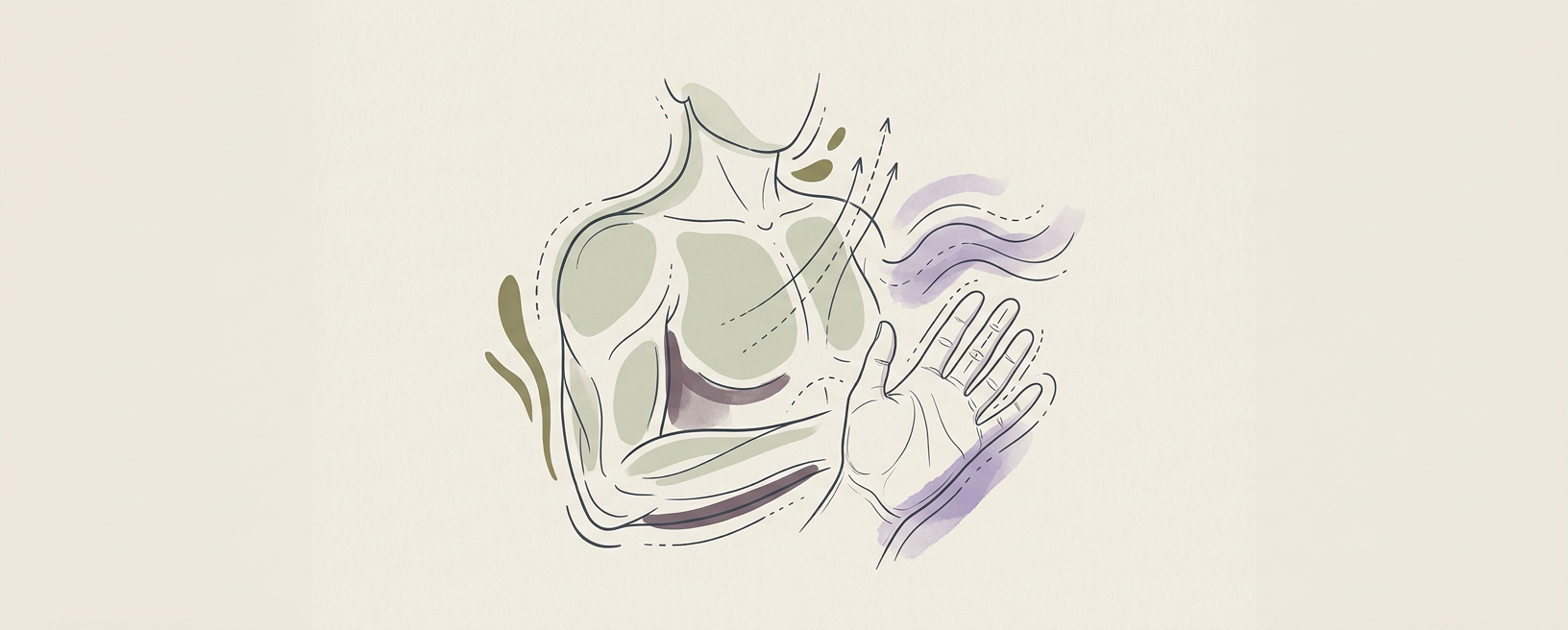 | A constricted posture often accompanies feelings of overwhelm or vigilance. This practice helps to gently counter that. Find a comfortable position, seated or standing, where your spine can remain relatively upright.
- Allow your hands to hang freely at your sides, or rest gently in your lap if seated.
- Inhale slowly and deliberately, inviting your shoulders to soften slightly away from your ears.
- As you exhale, slowly and consciously open your palms, extending your fingers gently. Notice the absence of tension in your hands and forearms.
- Hold this open-palm posture for several breaths, noticing any subtle shifts in your sternum or rib cage.
- Repeat this gentle opening two to three times, allowing for a natural, unforced rhythm.
Notice the quality of your breath and the spaciousness, if any, that emerges in your chest. | |
Practise it in full
www.kokorology.com/r/xkyki4f
| |
Log this in your Nervous System Journal →
|
|
The Movement
19
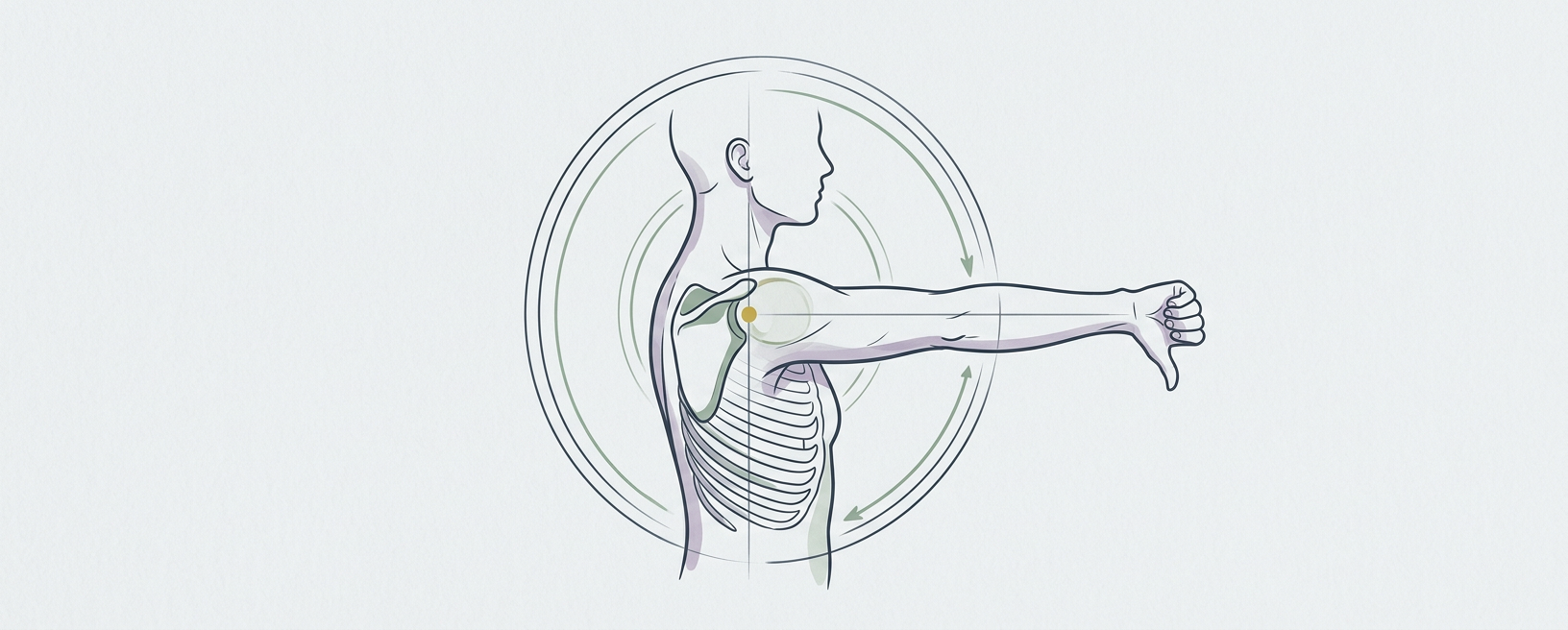
| Controlled Articular Rotation of the Shoulder | Reclaim full, pain-free range of motion in your shoulders with deliberate, controlled movement. | 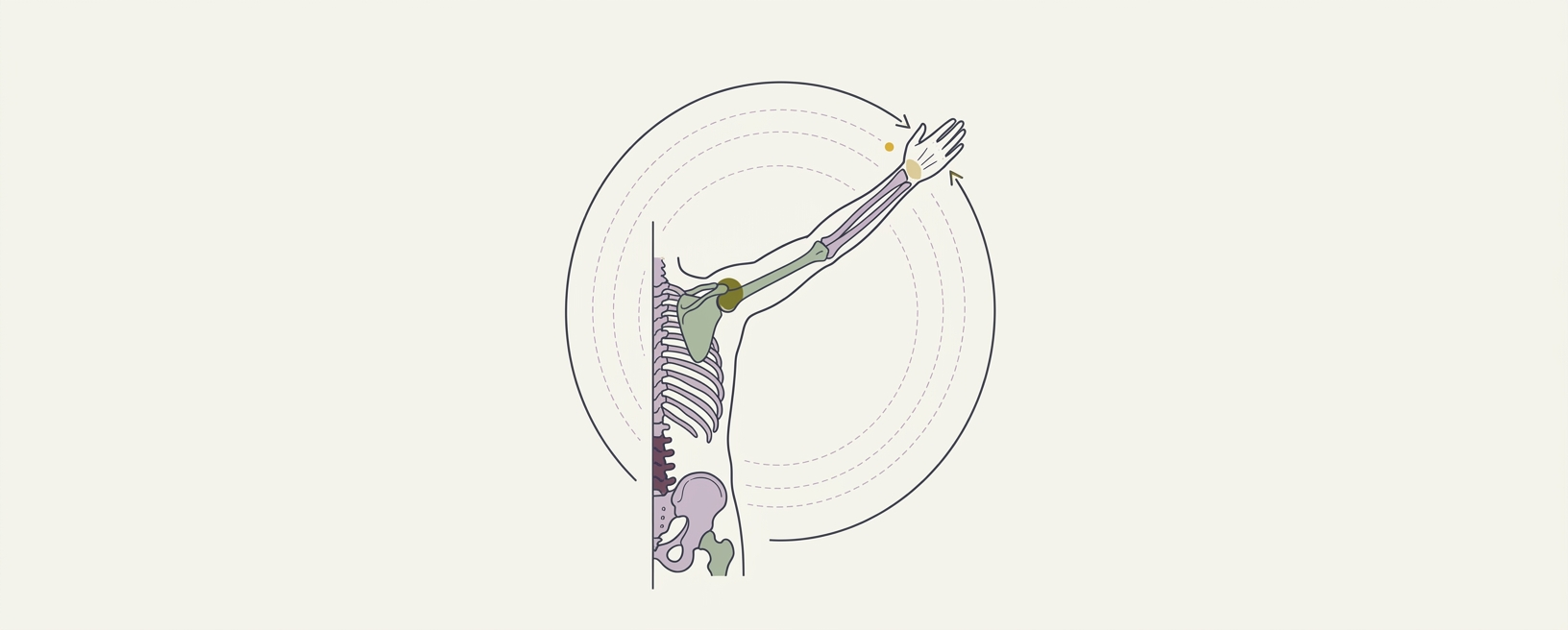 | Your shoulders are complex joints, often neglected in daily movement. This exercise helps maintain their full capacity, preventing static build-up and improving overall mobility.
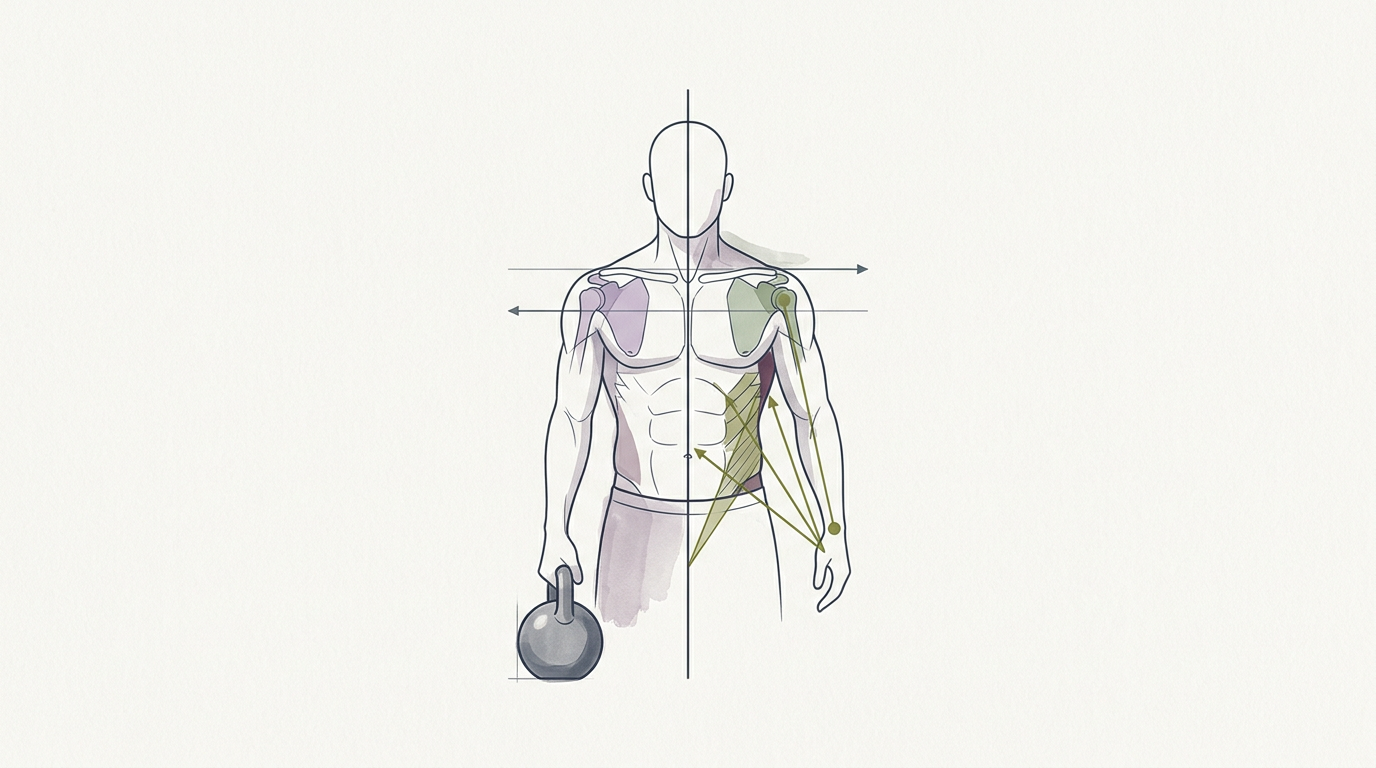
- Preparation: Sit or stand tall, keeping your rib cage stacked over your pelvis. Use your non-working hand to gently press into your thigh or knee for stability. Your working arm begins hanging loosely at your side, palm facing in.
- Initiate Elevation: Keeping your bicep next to your ear, slowly lift your working arm forward and up, like you're painting a wall directly in front of you. Go only as high as you can without your shoulder shrugging towards your ear or your rib cage flaring forward.
- Rotate and Extend: At the top of the lift, slowly internally rotate your arm. Imagine turning your bicep to face backward and your thumb towards the floor. Continue rotating and extending the arm behind you, away from your body, maintaining that internal rotation.
- Lower and Sweep: Sweep your internally rotated arm down and back towards your hip, as if tracing a large arc. Maintain control and avoid any sudden drops. The goal is smooth, continuous movement.
| |
See the movement in full
www.kokorology.com/r/9msq3mp
| |
Log this in your Nervous System Journal →
|
|
The Routine
20
| Regulate Circadian Rhythm After Travel Shift | Gentle, sensory-rich steps to re-establish your baseline after travel. |  | Travel can throw your internal clock, and your nervous system, out of whack. This routine offers simple, sensory-rich steps to help your body re-establish its baseline, no matter the time zone.
- Grounding Foot Roll — Stand with bare feet on a cool surface. Gently rock your weight from your heels to your toes, then side to side, for 2 minutes. Focus on the sensation of contact.
- Protein and Electrolyte Intake — Consume 3-5 oz of warm broth with a pinch of sea salt, or a small handful of plain almonds. These provide immediate electrolytes and amino acids without heavy digestion.
- Vagal Nerve Ear Massage — Using your thumb and forefinger, gently massage the outer rim of your ear, from the top helix down to the lobe, for 1 minute on each side. Breathe slowly and deeply.
- [Open Palm to Mitigate Tension](/practices/open-palm-to-mitigate-tension-2026-08-23) — Engage with today's daily hack: [Open Palm to Mitigate Tension](/practices/open-palm-to-mitigate-tension-2026-08-23). Apply the technique to soften the facial muscles.
- Supported Recline — Lie supine on a firm surface, placing a rolled towel under your neck. Allow your eyes to close lightly. No
| |
Follow the routine in full
www.kokorology.com/r/mftwybx
| |
Log this in your Nervous System Journal →
|
|
Kokorology product
21
| Every Anchor and every care package, without making your symptoms audition for separate subscriptions. |  |
|
Kokorology product
25
| Twenty packages, one per load: cortisol, sleep, recovery, hydration, peptides, cycle, immunity. |  |
|
Kokorology product
29
| Level 1 through certification. The mechanism, then the practice, then the proof you can teach it. |  |
|
Kokorology product
33
| The studies underneath every claim on this site, in plain English, with the numbers left in. |  |
|
Kokorology product
37
| One eight-minute repair a day. Free to read; included with the Nervous System Journal. |  |
|
Kokorology product
39
| For teams whose output keeps outrunning their recovery. Capacity, measured — not vibes. |  |
|
From the house
40
| Two prompts in the morning, three at night, and the whole hacks library alongside them. €25/mo, cancel whenever. |  |
|
Correspondence
41
| Closing Thoughts: Capacity, Not Just Cures | 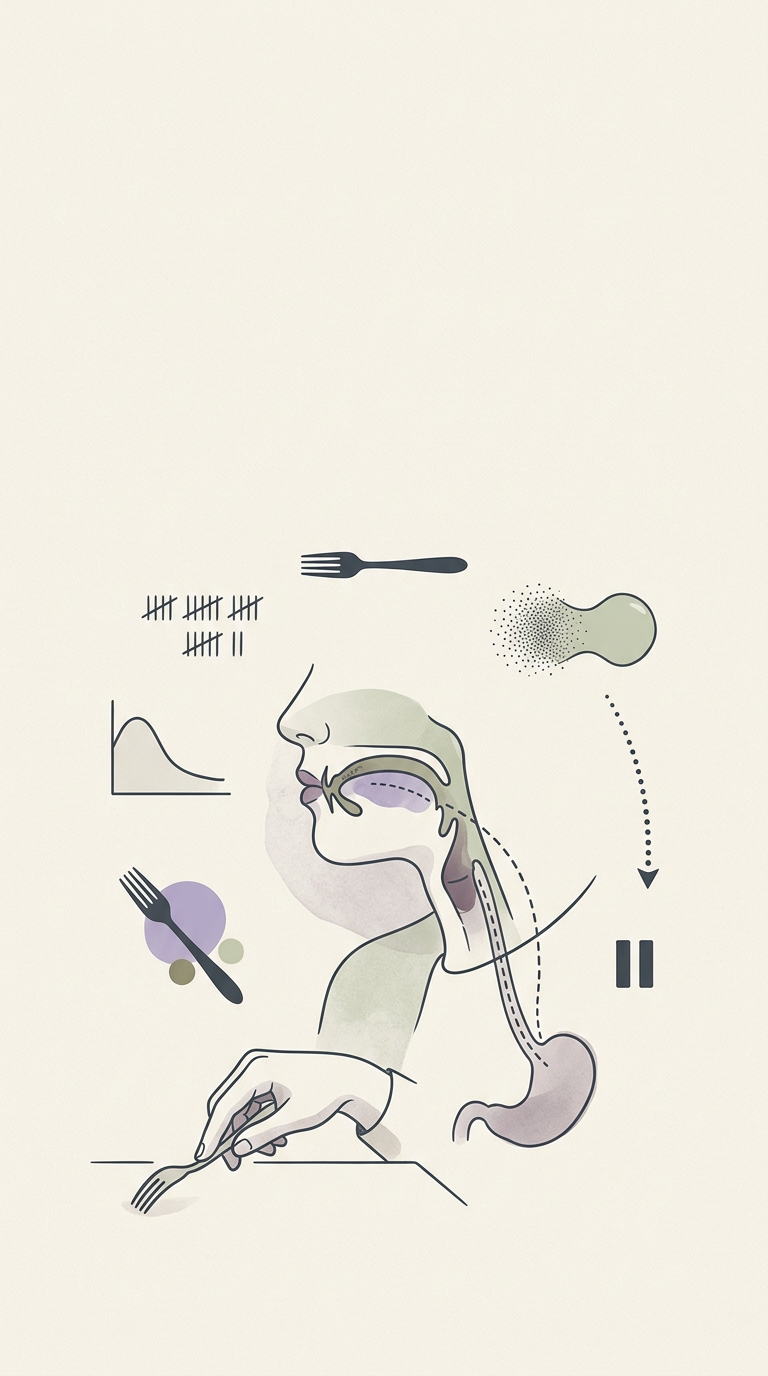 | This week's edition brings us back to basics: your body's innate capacity. Whether it's resisting the urge to scroll, understanding why your decisions feel tougher, or simply accepting that 'perfect posture' is a myth, it’s all about working with your system, not against it. We get so caught up in seeking external fixes, we forget the profound power of building internal resilience. Take a moment to integrate what you've read. Try the Open Palm practice. Pay attention to your sleep tonight. Your nervous system is always giving you signals; the art is in learning to listen and respond in a way that truly builds your capacity. | |
The Nervous System Journal — €25/mo
Two prompts in the morning, three at night. Includes the full hacks library.
| |
All Access — every anchor and care package
The whole system, one pass.
| |
Anchor protocols — €40 each
One protocol for the season you are actually in.
|
|