Daily movement
Controlled Articular Rotation of the Shoulder
This movement integrates the shoulder joint through its full available range of motion, improving joint health and proprioception.
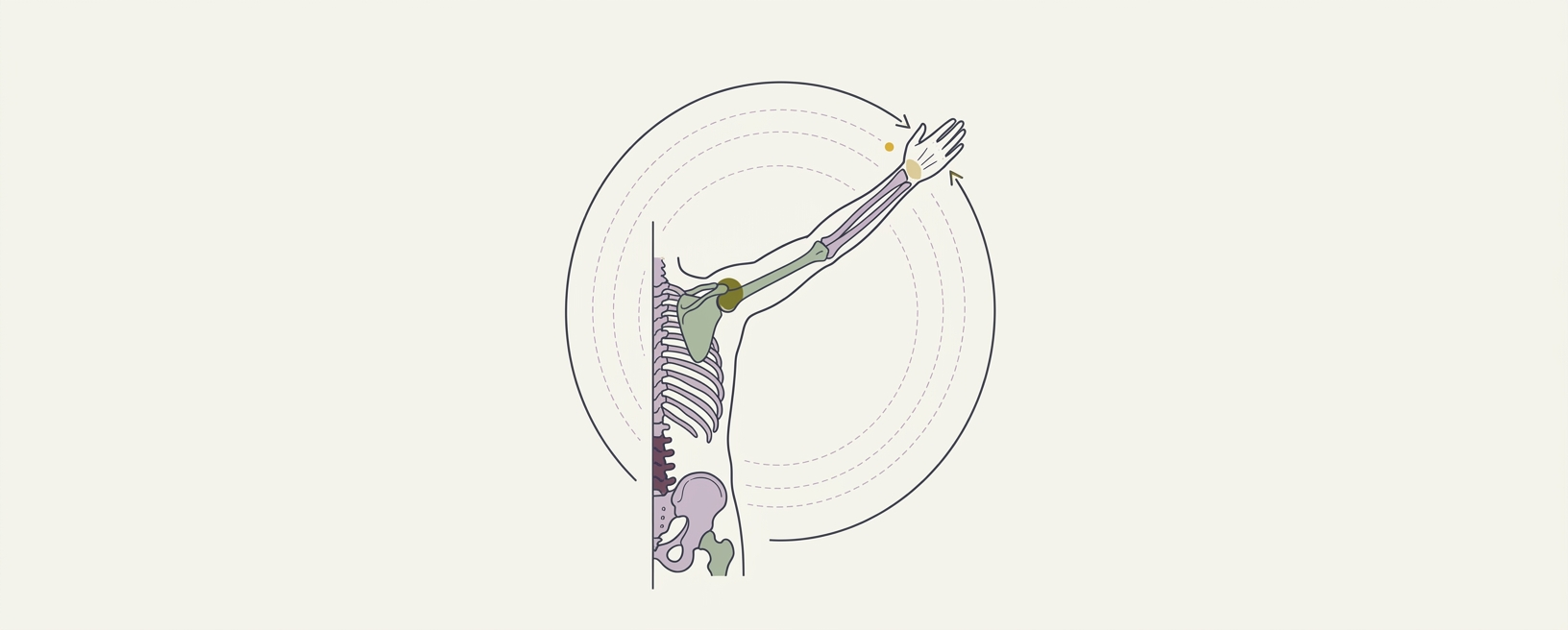
This movement integrates the shoulder joint through its full available range of motion, improving joint health and proprioception.
mobility / joint CARs · Functional Range Conditioning (Dr. Andreo Spina) · This meets the state of "tired but wired," where static tension accumulates in the upper back and shoulders, restricting movement and signaling threat to the nervous system. · 3–5 repetitions per side, 6–8 seconds per full rotation.
Why it works
The shoulder joint, as a ball-and-socket, permits complex movements. When we don't actively move it through its full range—especially the end-ranges—the nervous system 'forgets' these pathways. Functional Range Conditioning (FRC) emphasizes Controlled Articular Rotations (CARs) to reinforce these neurological maps. Slow, controlled motion at the outer limits of passive range signal safety to the nervous system, reducing perceived threat. This downregulates sympathetic tone. On a tissue level, CARs actively load the joint capsule and surrounding connective tissues, promoting synovial fluid distribution and maintaining tissue extensibility. This specific, tension-controlled input helps to rebuild articular cartilage and strengthen tendons, enhancing the shoulder's capacity to withstand diverse loads.
How to practice
Preparation: Sit or stand tall, keeping your rib cage stacked over your pelvis. Use your non-working hand to gently press into your thigh or knee for stability. Your working arm begins hanging loosely at your side, palm facing in.
Initiate Elevation: Keeping your bicep next to your ear, slowly lift your working arm forward and up, like you're painting a wall directly in front of you. Go only as high as you can without your shoulder shrugging towards your ear or your rib cage flaring forward.
Rotate and Extend: At the top of the lift, slowly internally rotate your arm. Imagine turning your bicep to face backward and your thumb towards the floor. Continue rotating and extending the arm behind you, away from your body, maintaining that internal rotation.
Lower and Sweep: Sweep your internally rotated arm down and back towards your hip, as if tracing a large arc. Maintain control and avoid any sudden drops. The goal is smooth, continuous movement.
Return to Start: Reverse the motion with control, bringing the arm back up and forward, then externally rotating as it comes back to your side. That's one full rotation. Keep your gaze soft and fixed straight ahead.
Preparation: Sit or stand tall, keeping your rib cage stacked over your pelvis. Use your non-working hand to gently press into your thigh or knee for stability. Your working arm begins hanging loosely at your side, palm facing in.
Initiate Elevation: Keeping your bicep next to your ear, slowly lift your working arm forward and up, like you're painting a wall directly in front of you. Go only as high as you can without your shoulder shrugging towards your ear or your rib cage flaring forward.
Rotate and Extend: At the top of the lift, slowly internally rotate your arm. Imagine turning your bicep to face backward and your thumb towards the floor. Continue rotating and extending the arm behind you, away from your body, maintaining that internal rotation.
Lower and Sweep: Sweep your internally rotated arm down and back towards your hip, as if tracing a large arc. Maintain control and avoid any sudden drops. The goal is smooth, continuous movement.
Return to Start: Reverse the motion with control, bringing the arm back up and forward, then externally rotating as it comes back to your side. That's one full rotation. Keep your gaze soft and fixed straight ahead.