Daily movement
Semi-Supine Constructive Rest for Spinal Freedom
This Alexander Technique practice recalibrates baseline tension, fostering a sense of integrated length and ease.
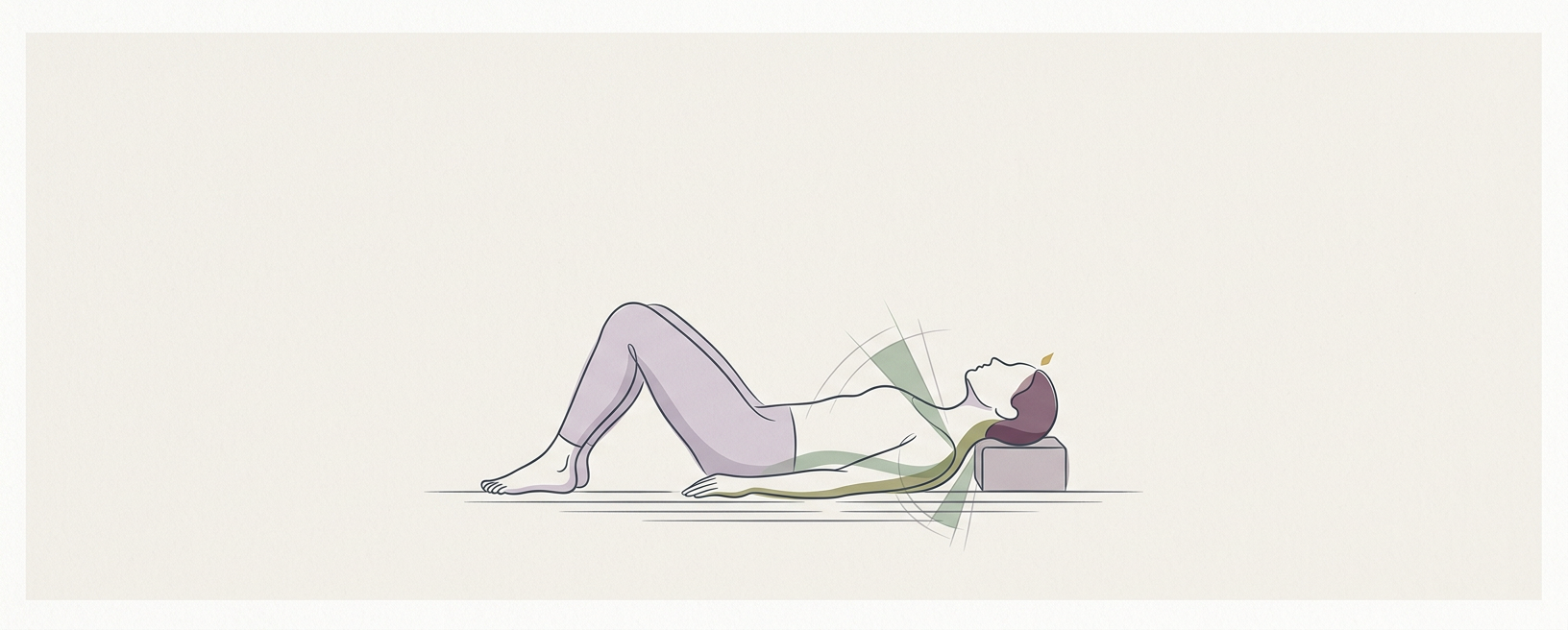
This Alexander Technique practice recalibrates baseline tension, fostering a sense of integrated length and ease.
Alexander Technique · Alexander Technique (F.M. Alexander) · This practice addresses the pervasive felt state of chronic, unconscious tension, particularly in the neck, back, and jaw, which contributes to fatigue and restricted movement patterns. · 10–15 minutes daily
Why it works
The Semi-Supine Constructive Rest works on the nervous system by utilizing inhibition and direction, core principles of the Alexander Technique. By lying horizontally and consciously releasing habitual tension, you interrupt ingrained neurological patterns of bracing and shortening. This sensory re-education allows the proprioceptive system to reset, reducing sympathetic nervous system activation and promoting parasympathetic dominance. On a tissue level, the sustained, gentle stretch in a gravity-neutral position allows for myofascial release, particularly along the posterior chain and deep spinal muscles. The head support encourages the release of suboccipital and sternocleidomastoid tension, decompressing the cervical spine and indirectly softening the dura mater. This global unwinding restores fluid articulation and reduces compressive loads on joints.
How to practice
Lie on your back. Find a firm, flat surface—the floor is ideal. Place a few paperback books under your head so that your nose points to the ceiling, not toward your chin or the ceiling behind you. Your knees should be bent, feet flat on the floor, about hip-width apart, and far enough from your body that your knees can stand up without effort. Let your hands rest comfortably on your abdomen or by your sides.
Allow the surface to support you. For several minutes, bring your attention to the contact points of your body with the floor. Notice the weight of your head on the books, your shoulders, your pelvis, and the soles of your feet. Let gravity do its work. Resist the urge to adjust or "correct" your posture. I often just note where I feel any subtle pressure.
Think "neck free." Begin to give gentle, non-striving directions to yourself. Start with the thought, "My neck is free to allow my head to go forward and up." This isn't a muscular effort; it's a mental suggestion, a release of holding rather than an active movement. Imagine your head moving subtly away from your spine, releasing pressure on your neck.
Think "back lengthens and widens." From the idea of a free neck, continue the thought into your torso: "My back is lengthening and widening." Envision your spine extending effortlessly from your head to your tailbone, and your torso broadening across your ribcage and pelvis. This isn't about arching or flattening, but about undoing compression.
Soft gaze, soft breath. Keep your eyes softly open, allowing your peripheral vision to take in the room. Breathe gently and naturally through your nose. Allow your breath to be a quiet observer of your internal state, not a force to be controlled or altered. Simply let it flow.
Inhibit habitual responses. Throughout the practice, whenever you notice an impulse to tense, adjust, or "fix" something, pause. Mentally say "no" to that impulse. This is inhibition—the cornerstone of Alexander Technique—allowing you to choose a new, less habitual response. It's harder than it sounds; my first attempts felt like I was wrestling with myself.
Lie on your back. Find a firm, flat surface—the floor is ideal. Place a few paperback books under your head so that your nose points to the ceiling, not toward your chin or the ceiling behind you. Your knees should be bent, feet flat on the floor, about hip-width apart, and far enough from your body that your knees can stand up without effort. Let your hands rest comfortably on your abdomen or by your sides.
Allow the surface to support you. For several minutes, bring your attention to the contact points of your body with the floor. Notice the weight of your head on the books, your shoulders, your pelvis, and the soles of your feet. Let gravity do its work. Resist the urge to adjust or "correct" your posture. I often just note where I feel any subtle pressure.
Think "neck free." Begin to give gentle, non-striving directions to yourself. Start with the thought, "My neck is free to allow my head to go forward and up." This isn't a muscular effort; it's a mental suggestion, a release of holding rather than an active movement. Imagine your head moving subtly away from your spine, releasing pressure on your neck.
Think "back lengthens and widens." From the idea of a free neck, continue the thought into your torso: "My back is lengthening and widening." Envision your spine extending effortlessly from your head to your tailbone, and your torso broadening across your ribcage and pelvis. This isn't about arching or flattening, but about undoing compression.
Soft gaze, soft breath. Keep your eyes softly open, allowing your peripheral vision to take in the room. Breathe gently and naturally through your nose. Allow your breath to be a quiet observer of your internal state, not a force to be controlled or altered. Simply let it flow.
Inhibit habitual responses. Throughout the practice, whenever you notice an impulse to tense, adjust, or "fix" something, pause. Mentally say "no" to that impulse. This is inhibition—the cornerstone of Alexander Technique—allowing you to choose a new, less habitual response. It's harder than it sounds; my first attempts felt like I was wrestling with myself.