Daily movement
Thoracic Spine Self-Release
This movement targets the fascia and muscles surrounding the thoracic spine, addressing stiffness and promoting intervertebral mobility.
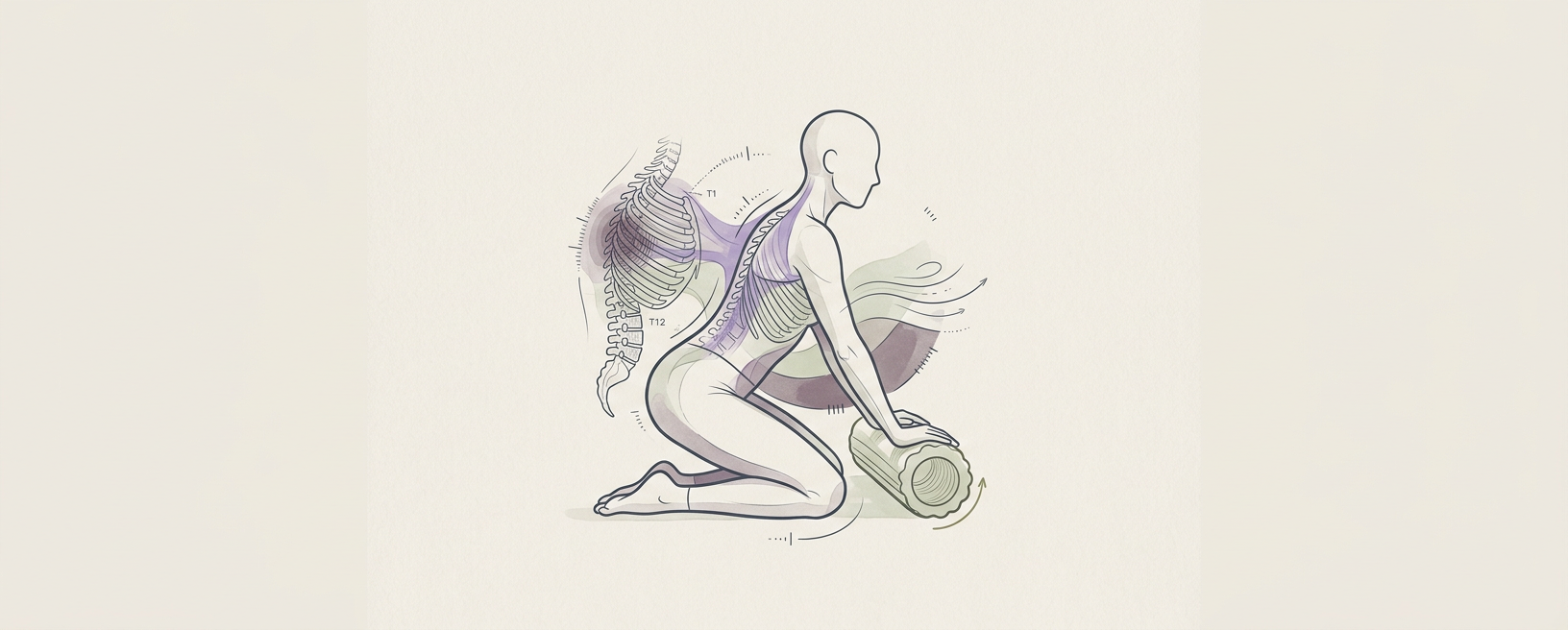
This movement targets the fascia and muscles surrounding the thoracic spine, addressing stiffness and promoting intervertebral mobility.
Myofascial Release / Fascial Maneuvers · Developed within the lineage of myofascial release, aligning with principles established by pioneers like Tom Myers and Robert Schleip, which emphasize the interconnectedness of the fascial system. · Perceived stiffness or restriction in the upper and mid-back, often associated with prolonged sitting or postural imbalances. · Perform 2-3 times per week, for 5-10 minutes per session, or as needed for acute stiffness. Each specific point of tension should be addressed for 30-90 seconds. Maintain consistency for long-term benefit.
Why it works
The controlled, sustained pressure applied to the thoracic spine with a therapeutic ball or foam roller engages mechanoreceptors within the fascial tissues. This stimulation, coupled with rhythmic breathing, can decrease sympathetic nervous system activity and promote a parasympathetic shift. Mechanically, it facilitates viscoelastic changes in the fascial matrix, improving tissue hydration and reducing localized adhesions, thereby enhancing spinal segmental mobility.
How to practice
Positioning: Lie on your back on a firm surface. Place a specialized therapeutic ball (e.g., a lacrosse ball or a dense rubber ball) or a foam roller directly under your thoracic spine, avoiding direct contact with bony prominences. Start with the ball/roller positioned around the lower ribs.
Initial Contact: Allow your body weight to settle onto the ball/roller. The goal is a sensation of firm pressure, not sharp pain. If the sensation is too intense, place a thin towel over the ball/roller or use a softer tool.
Breathing and Oscillation: Take slow, deep breaths. As you exhale, allow your body to sink deeper into the pressure. Gently move your body a few centimeters up and down or side to side over the ball/roller, exploring areas of increased tension.
Targeted Release (if using a ball): If you locate a specific point of restriction, hold sustained pressure on that spot for 30-90 seconds while continuing slow, diaphragmatic breathing. You may feel the tissue "melt" or soften under the pressure.
Segmental Progression: After working one segment for 1-3 minutes, reposition the ball/roller slightly higher or lower along your thoracic spine, working systematically between the base of your neck and the bottom of your rib cage.
Full Range of Motion: Once a segment feels released, you can gently introduce small movements, such as raising and lowering your arms overhead or performing gentle thoracic rotations, while maintaining contact with the ball/roller.
Positioning: Lie on your back on a firm surface. Place a specialized therapeutic ball (e.g., a lacrosse ball or a dense rubber ball) or a foam roller directly under your thoracic spine, avoiding direct contact with bony prominences. Start with the ball/roller positioned around the lower ribs.
Initial Contact: Allow your body weight to settle onto the ball/roller. The goal is a sensation of firm pressure, not sharp pain. If the sensation is too intense, place a thin towel over the ball/roller or use a softer tool.
Breathing and Oscillation: Take slow, deep breaths. As you exhale, allow your body to sink deeper into the pressure. Gently move your body a few centimeters up and down or side to side over the ball/roller, exploring areas of increased tension.
Targeted Release (if using a ball): If you locate a specific point of restriction, hold sustained pressure on that spot for 30-90 seconds while continuing slow, diaphragmatic breathing. You may feel the tissue "melt" or soften under the pressure.
Segmental Progression: After working one segment for 1-3 minutes, reposition the ball/roller slightly higher or lower along your thoracic spine, working systematically between the base of your neck and the bottom of your rib cage.
Full Range of Motion: Once a segment feels released, you can gently introduce small movements, such as raising and lowering your arms overhead or performing gentle thoracic rotations, while maintaining contact with the ball/roller.