Daily movement
The banded pull-apart to reset your scapular line and open thoracic posture
Re-anchor your scapular stabilizers and open anterior chest fascial lines in four minutes.
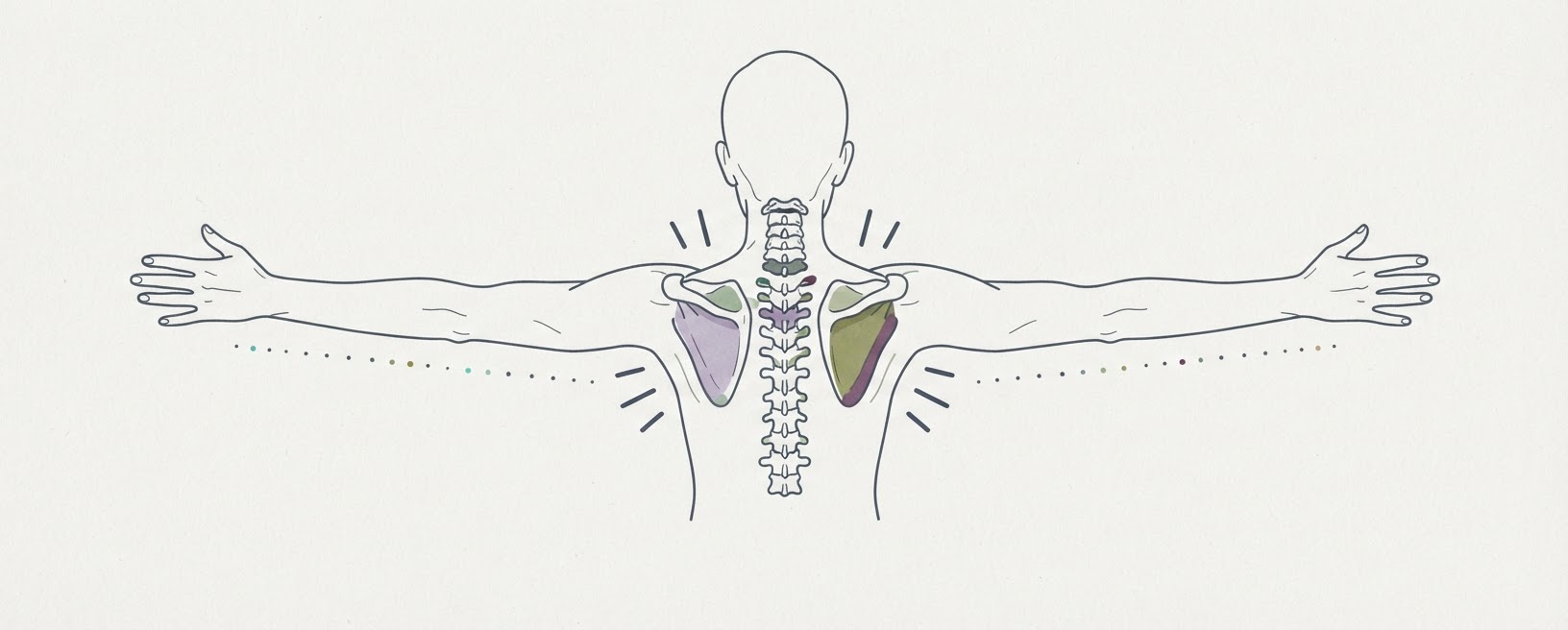
Re-anchor your scapular stabilizers and open anterior chest fascial lines in four minutes.
resistance band · Physical therapy rehabilitation and functional strength (popularized by Gray Cook and Eric Cressey) · For the screen-slumped thoracic spine, forward head carriage, and dull scapular ache that sets in after hours at a desk. · 2 to 3 sets of 12 to 15 slow reps
Why it works
I spent two years using heavy bands for pull-aparts before I realized I was just over-firing my upper traps and driving my neck into extension. When you use a light, forgiving band (10 to 15 pounds of peak resistance) with a deliberate eccentric tempo, you recruit the lower and middle trapezius, rhomboids, and posterior deltoids without triggering protective tone in the levator scapulae. This reciprocal action relaxes the chronically shortened pectoralis major and minor through reciprocal inhibition. The steady mechanical tension feeds the mechanoreceptors in the periscapular fascial envelopes with clear proprioceptive feedback. That sensory signal helps the autonomic nervous system map where your upper torso sits in space, reducing the low-grade static of postural fatigue.
How to practice
Stand tall with your feet hip-width apart and your ribs settled gently over your pelvis. Hold a light looped or flat resistance band out in front of you at shoulder height with both hands, wrists straight and knuckles facing away from you.
Set the starting tension so the band stays taut between your hands when they sit shoulder-width apart. Inhale through your nose into the sides and back of your ribcage without letting your shoulders hike toward your ears.
Exhale smoothly through pursed lips and spread the band apart horizontally by pulling your hands wide until the rubber lightly grazes your sternum. Focus on drawing the inner edges of your shoulder blades together rather than yanking with your wrists.
Pause for one second at full expansion. Keep your collarbones wide and your chin tucked slightly, looking straight ahead at eye level.
Inhale as you take three full seconds to return your hands back to the shoulder-width starting position. Maintain continuous elastic tension on the band across the entire return stroke instead of letting it snap your hands inward.
Rest for 30 seconds after completing twelve controlled repetitions, then repeat for two more rounds.