Daily movement
Standing Rag Doll (Uttanasana Variation)
A gentle, unsupported forward fold focusing on gravity-assisted decompression of the spine and passive stretches of the posterior chain.
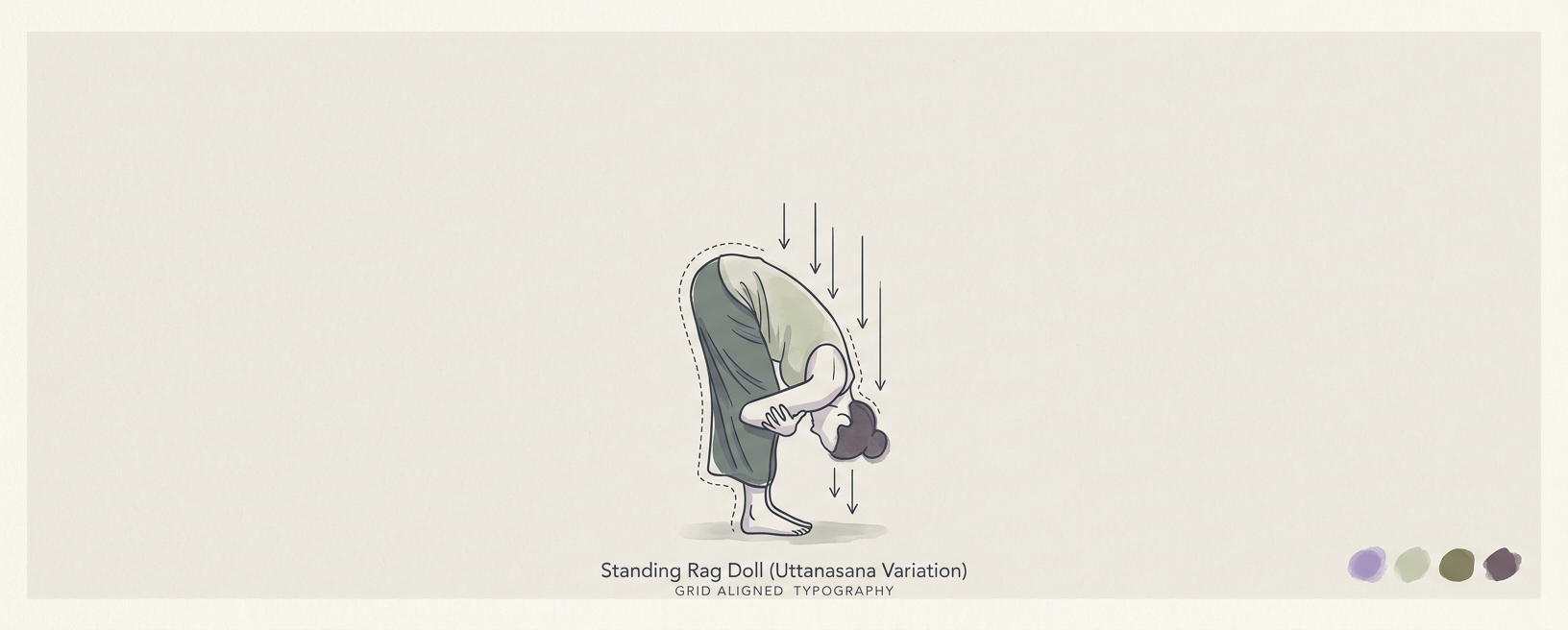
A gentle, unsupported forward fold focusing on gravity-assisted decompression of the spine and passive stretches of the posterior chain.
Hatha Yoga · This variation is commonly taught in various Hatha and Vinyasa yoga lineages, emphasized as a foundational resting posture and transition. While not attributable to a single teacher, its therapeutic applications are frequently highlighted by educators like Judith Hanson Lasater in restorative contexts. · Diffuse muscular tension, spinal compression, mental hyperactivity, and sympathetic nervous system dominance. · Hold for 1–3 minutes. Can be repeated multiple times throughout the day as needed.
Why it works
Standing Rag Doll utilizes gravity to create traction in the cervical, thoracic, and lumbar spine. The unsupported nature allows for a neurologically calming surrender, as proprioceptive input from muscle engagement is minimized. This facilitates a passive stretch of the hamstrings, gluteals, and erector spinae, which, when chronically shortened, contribute to spinal compression and discomfort. The inversion of the head below the heart can mildly modulate baroreceptor reflexes, contributing to a vagal response and a reduction in heart rate and blood pressure. The position also encourages diaphragmatic breathing due to the gentle compression of the abdomen against the thighs, which further stimulates the parasympathetic nervous system.
How to practice
Begin in Tadasana (Mountain Pose) with feet hip-width apart, knees soft. \n2. Inhale, lengthen the spine. As you exhale, hinge from the hips, allowing the torso to fold forward over the legs. \n3. Allow the head and neck to be completely heavy, releasing any tension in the cervical musculature. The crown of the head points towards the floor. \n4. Cross the arms and hold opposite elbows, allowing the arms to hang heavily like a pendulum. Alternatively, let the arms dangle freely towards the floor. \n5. Keep a generous bend in the knees, ensuring the focus remains on spinal decompression and hamstring elongation without straining. \n6. Maintain continuous, smooth breathing, allowing the breath to deepen as the body releases.
Begin in Tadasana (Mountain Pose) with feet hip-width apart, knees soft. \n2. Inhale, lengthen the spine. As you exhale, hinge from the hips, allowing the torso to fold forward over the legs. \n3. Allow the head and neck to be completely heavy, releasing any tension in the cervical musculature. The crown of the head points towards the floor. \n4. Cross the arms and hold opposite elbows, allowing the arms to hang heavily like a pendulum. Alternatively, let the arms dangle freely towards the floor. \n5. Keep a generous bend in the knees, ensuring the focus remains on spinal decompression and hamstring elongation without straining. \n6. Maintain continuous, smooth breathing, allowing the breath to deepen as the body releases.