All movements
Loading…
Previous movements
Previous movements open for members. Today's movement is always free.
Daily movement
A single-leg balance drill that resets postural tone through your ankle tripod and vestibular tracking.
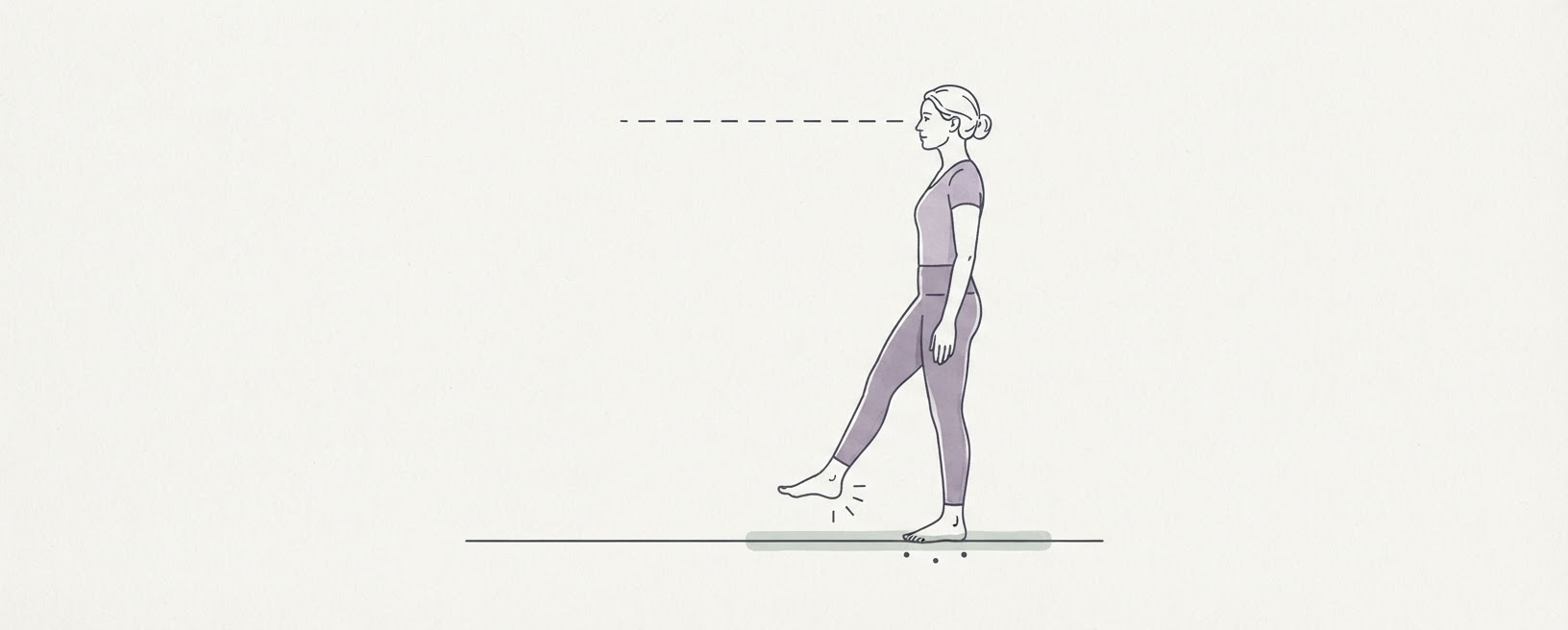
A single-leg balance drill that resets postural tone through your ankle tripod and vestibular tracking.
balance / proprioception · Vestibular and posturography rehabilitation (Fay Horak balance strategy model) · Late-afternoon sensory overload where your focus has fragmented and your body feels untethered from the floor. · 3 rounds of 30 seconds per side, alternating feet
When you stand on one leg and turn your head, you force your nervous system to recalculate equilibrium without relying on a frozen visual field. In posturography research, Dr. Fay Horak demonstrated that balance relies on three competing sensory inputs: vision, vestibular cues from the inner ear, and somatosensory feedback from the feet. Staring at an unmoving spot lets your brain cheat by anchoring through the eyes. Removing that fixed focal point forces your deep mechanoreceptors—specifically the Ruffini endings and muscle spindles in the foot and peritendinous ankle fascia—to manage postural sway directly. You recruit the ankle strategy, using micro-contractions of the tibialis posterior, peroneals, and intrinsic foot muscles rather than stiffening your neck or hip. The result is an immediate downshift in postural static and clearer sensory grounding through your lower limbs.
Stand barefoot on a firm, uncarpeted floor with a clear wall within reach. Establish your foot tripod by pressing the base of your big toe, the base of your little toe, and the center of your heel firmly into the ground.
Shift your weight into your right foot without hitching your right hip toward your ribs. Float your left foot three inches off the floor, keeping your left knee bent and relaxed.
Find a fixed visual point at eye level roughly six feet ahead of you. Take two quiet nasal breaths to settle your baseline.
Once your ankle feels steady, turn your head slowly to the left for a count of three, then across to the right for a count of three. Let your ankle and subtalar joint micro-adjust beneath you without clenching your toes.
Keep your jaw unclamped and breathe out slowly for five counts. If you start to tip, drop the ball of your left foot lightly to the floor, reset your tripod, and lift again.
Lower your foot, take one full breath standing on both legs, and repeat on the left side.