Daily movement
Single Leg Stance with Rotational Torso Movement
This drill enhances proprioceptive acuity and dynamic balance by introducing a controlled rotational challenge to the trunk while standing on one leg.
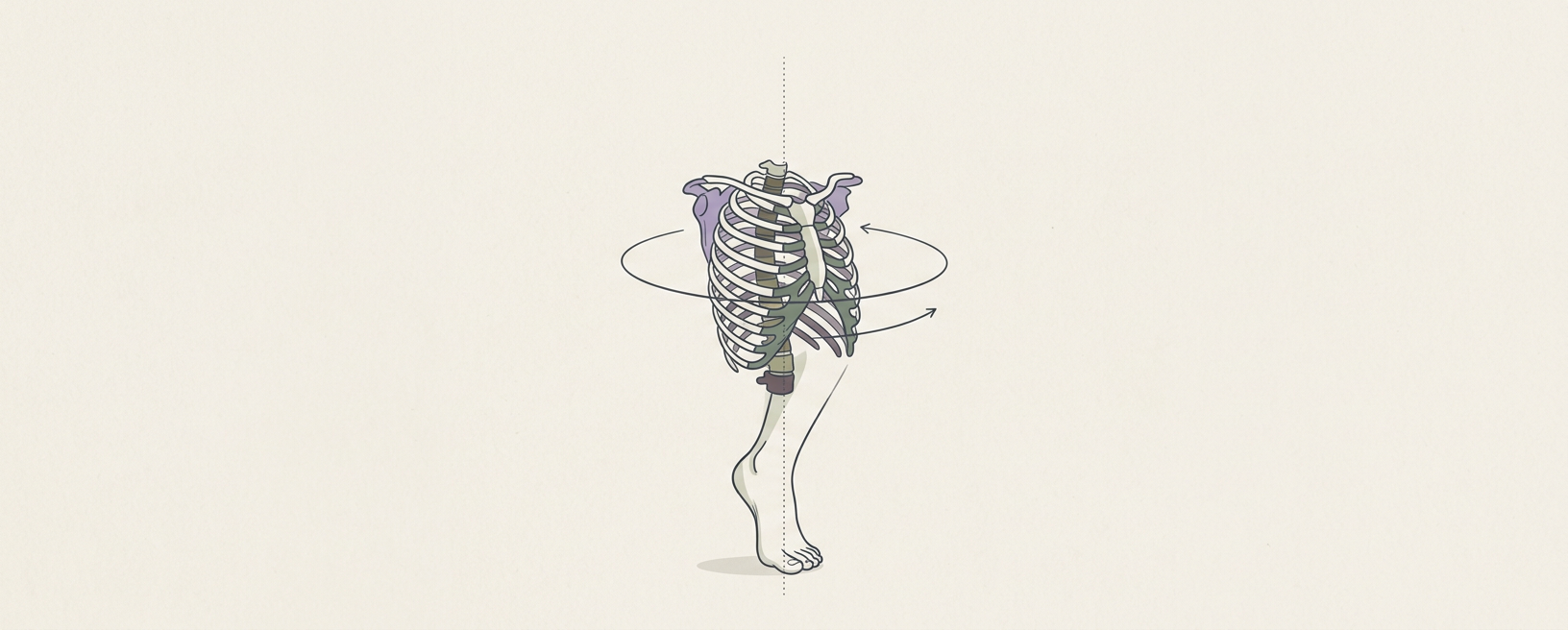
This drill enhances proprioceptive acuity and dynamic balance by introducing a controlled rotational challenge to the trunk while standing on one leg.
Rehabilitation Science / Sports Medicine (e.g., Shirley Sahrmann's Movement Impairment Syndromes framework provides context for assessing and correcting rotational control) · Developed within physical therapy and athletic training contexts for enhancing complex balance and multi-planar stability, building on foundational single-leg balance work. · To improve dynamic balance, core stability, and proprioception, particularly under conditions requiring trunk rotation or anti-rotation control. · Perform 3-5 sets of 8-12 repetitions (rotations to each side) per leg. Focus on slow, controlled movement rather than speed. Rest 30-60 seconds between sets.
Why it works
The vestibular system, somatosensory system, and visual system (VSS) contribute to balance. Standing on one leg increases the reliance on somatosensory input from the ankle and foot. Introducing controlled trunk rotation while maintaining a stable base challenges the VSS to integrate varied sensory information, promoting adaptable neural responses. This movement engages core musculature (e.g., obliques, transversus abdominis) to stabilize the pelvis and spine against rotational forces, enhancing proprioceptive feedback from the torso. The demand for coordinated muscular activation refines neuromuscular control and intersegmental coordination.
How to practice
Starting Position: Stand upright with feet hip-width apart. Shift weight onto one leg, lifting the other foot slightly off the ground, knee gently bent.
Initiate Rotation: Keeping the pelvis as stable as possible and facing forward, slowly rotate your torso to one side, leading with the shoulders and rib cage. Imagine a central axis running through your body.
Controlled Return: Slowly return your torso to the starting neutral position.
Alternate Sides: Continue rotating to the opposite side with control.
Maintain Gaze: Keep your gaze fixed on a point straight ahead to further challenge the vestibular system and prevent over-reliance on visual cues for balance.
Starting Position: Stand upright with feet hip-width apart. Shift weight onto one leg, lifting the other foot slightly off the ground, knee gently bent.
Initiate Rotation: Keeping the pelvis as stable as possible and facing forward, slowly rotate your torso to one side, leading with the shoulders and rib cage. Imagine a central axis running through your body.
Controlled Return: Slowly return your torso to the starting neutral position.
Alternate Sides: Continue rotating to the opposite side with control.
Maintain Gaze: Keep your gaze fixed on a point straight ahead to further challenge the vestibular system and prevent over-reliance on visual cues for balance.