Daily movement
Single Leg Stance with Opposite Arm and Leg Lift
This drill enhances proprioception and stability by challenging the body’s ability to maintain balance on one leg while simultaneously moving contralateral limbs.
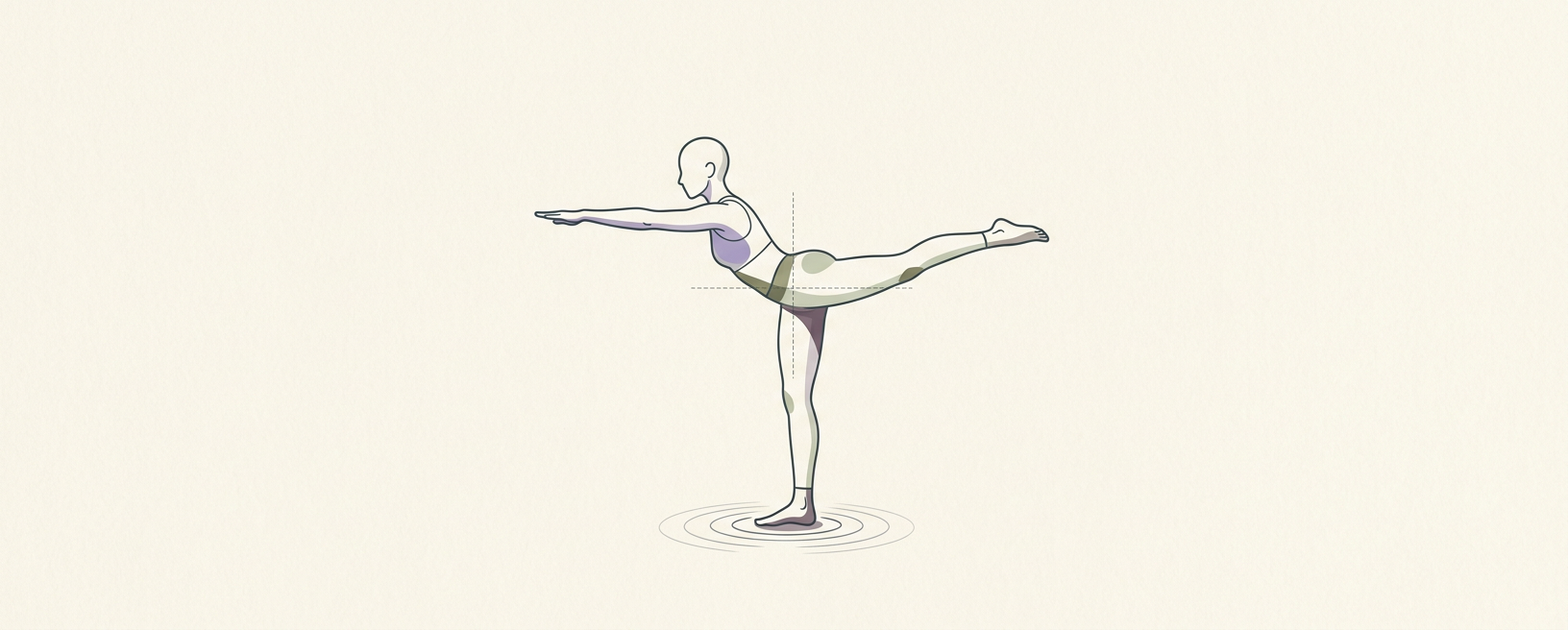
This drill enhances proprioception and stability by challenging the body’s ability to maintain balance on one leg while simultaneously moving contralateral limbs.
Corrective Exercise / Habilitation · Developed within the framework of proprioceptive neuromuscular facilitation (PNF) principles and integrated into various physical therapy and athletic training protocols by practitioners like Shirley Sahrmann, this exercise is a staple in corrective exercise and movement re-education. · To improve neural coordination and stability in unilateral stances, mitigating fall risk and enhancing ground force transmission for locomotion and sport. · Perform 3-5 repetitions per side for 2-3 sets. Hold each lifted position for 3-5 seconds. Focus on quality of movement and control over speed. This practice can be performed daily or every other day, adapting to individual recovery and adaptation.
Why it works
The action of lifting contralateral limbs creates a dynamic shift in the body’s center of gravity, activating intrinsic foot and ankle musculature, and challenging the vestibular system. This multifaceted neural input refines proprioceptive acuity and strengthens anticipatory postural adjustments. The controlled, slow movement prevents sudden shifts that might trigger sympathetic responses, instead promoting a parasympathetic tone conducive to motor learning and kinesthetic awareness. The simultaneous movement of opposite limbs engages myofascial slings, such as the posterior oblique sling (latissimus dorsi and contralateral gluteus maximus), fostering integrated stability and efficient load transfer.
How to practice
Starting Position: Stand tall with feet hip-width apart, gaze directed forward. Ensure a neutral spine and relaxed shoulders. Engage your core minimally.
Initiate Lift: Gently shift your weight onto your right foot. Take a moment to feel the contact points of your right foot on the ground.
Contralateral Movement: Slowly and with control, begin to lift your left arm forward and upward, simultaneously lifting your right leg backward and upward. Both limbs should move in a coordinated, fluid manner. The lift should be just enough to create a challenge for your balance, typically with the arm reaching shoulder height and the leg extending behind you to hip height, maintaining a straight line from fingertip to toe. Avoid hyperextending your lower back.
Hold: Briefly hold the lifted position, focusing on maintaining stability through your standing leg and core.
Return: Gently and with control, lower your left arm and right leg back to the starting position. Avoid collapsing or uncontrolled movements.
Switch Sides: Repeat the sequence on the opposite side, standing on your left foot and lifting your right arm and left leg.
Starting Position: Stand tall with feet hip-width apart, gaze directed forward. Ensure a neutral spine and relaxed shoulders. Engage your core minimally.
Initiate Lift: Gently shift your weight onto your right foot. Take a moment to feel the contact points of your right foot on the ground.
Contralateral Movement: Slowly and with control, begin to lift your left arm forward and upward, simultaneously lifting your right leg backward and upward. Both limbs should move in a coordinated, fluid manner. The lift should be just enough to create a challenge for your balance, typically with the arm reaching shoulder height and the leg extending behind you to hip height, maintaining a straight line from fingertip to toe. Avoid hyperextending your lower back.
Hold: Briefly hold the lifted position, focusing on maintaining stability through your standing leg and core.
Return: Gently and with control, lower your left arm and right leg back to the starting position. Avoid collapsing or uncontrolled movements.
Switch Sides: Repeat the sequence on the opposite side, standing on your left foot and lifting your right arm and left leg.