Daily movement
Single Leg Stance with Alternating Arm and Leg Swing
A dynamic balance drill enhancing proprioception and reactive postural control through rhythmic contralateral limb oscillation.
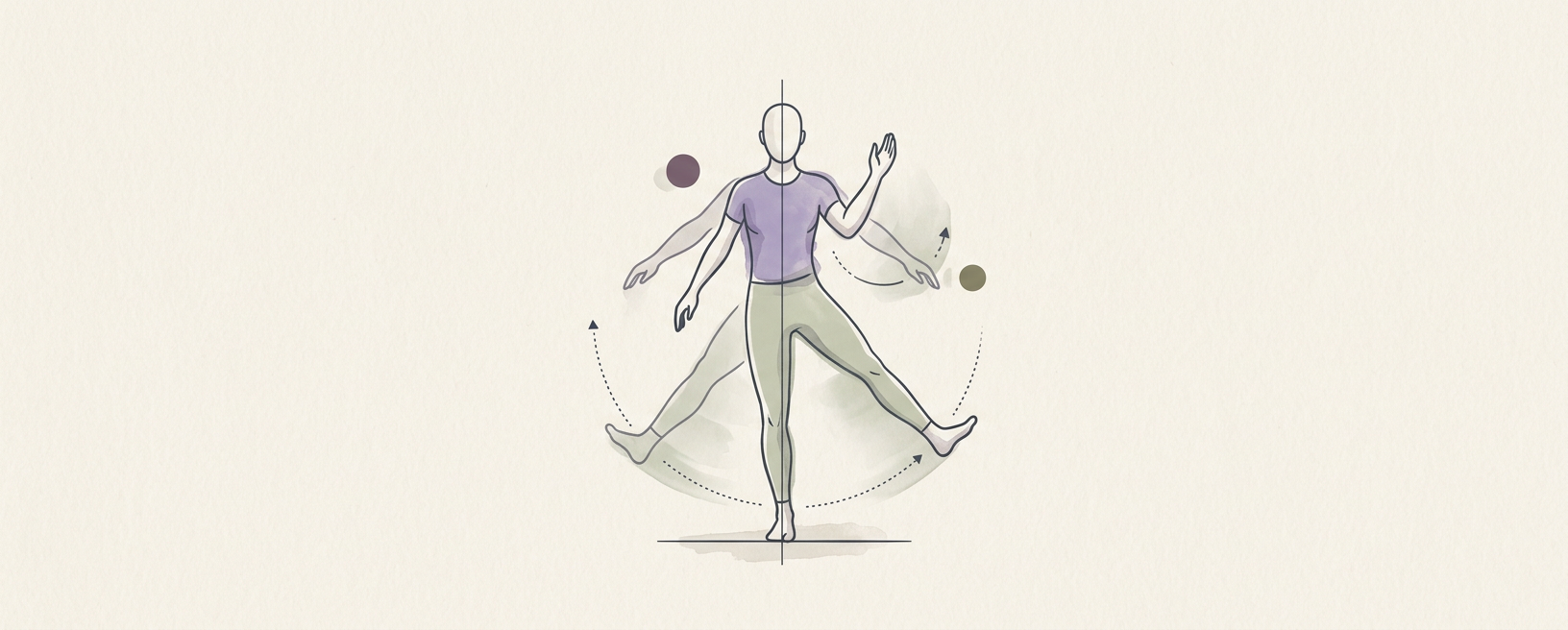
A dynamic balance drill enhancing proprioception and reactive postural control through rhythmic contralateral limb oscillation.
Rehabilitative and athletic conditioning. · Developed by physical therapists and movement scientists, integrating principles from motor control research. · To improve dynamic balance, reduce fall risk, and enhance sport-specific stability. Addresses feelings of instability or lack of coordination. · Perform 2-3 sets of 30-60 seconds on each leg, 3-5 times per week. Progress by increasing duration, range of motion of swings, or reducing visual input (e.g., soft gaze).
Why it works
This movement challenges the somatosensory system by dynamically shifting the body's center of gravity. The rhythmic, contralateral limb swings create continuous perturbations, forcing the nervous system to rapidly recruit and coordinate muscle groups in the standing leg, hip, and core to maintain equilibrium. This improves joint position sense (proprioception) and the speed of postural reflex responses. The reciprocal inhibition involved in swinging limbs also contributes to motor control refinement.
How to practice
Starting Position: Stand tall with feet hip-width apart, gaze fixed straight ahead. Shift weight onto one leg.
Initiate Swing: In a controlled motion, gently swing the non-standing leg forward and backward, simultaneously swinging the contralateral arm forward and backward. The movement should be fluid and pendulum-like, not forced.
Maintain Stability: Focus on keeping the standing leg slightly soft at the knee, maintaining a stable trunk and pelvis. Avoid excessive sway or rotation.
Rhythm: Establish a consistent, comfortable rhythm. The range of motion for the swings can be small initially and gradually increased as stability improves.
Breathing: Maintain a steady, calm breath throughout the exercise.
Starting Position: Stand tall with feet hip-width apart, gaze fixed straight ahead. Shift weight onto one leg.
Initiate Swing: In a controlled motion, gently swing the non-standing leg forward and backward, simultaneously swinging the contralateral arm forward and backward. The movement should be fluid and pendulum-like, not forced.
Maintain Stability: Focus on keeping the standing leg slightly soft at the knee, maintaining a stable trunk and pelvis. Avoid excessive sway or rotation.
Rhythm: Establish a consistent, comfortable rhythm. The range of motion for the swings can be small initially and gradually increased as stability improves.
Breathing: Maintain a steady, calm breath throughout the exercise.