Daily movement
Single leg eccentric heel drop for tendon remodeling and motor control
Slow the drop to rebuild your Achilles tendon and calm nervous motor static.
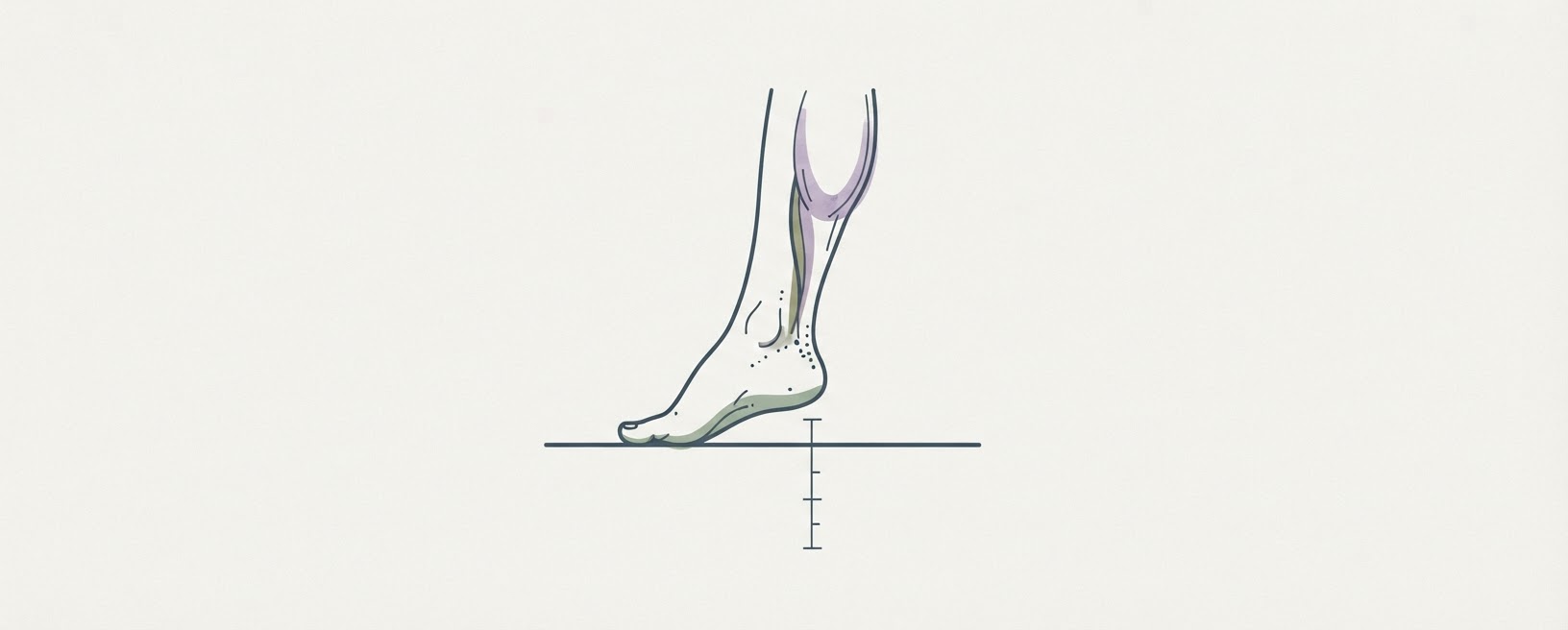
Slow the drop to rebuild your Achilles tendon and calm nervous motor static.
eccentric strength · Eccentric loading protocol (Håkan Alfredson / Keijo Häkkinen research) · Meeting morning motor agitation and tight lower-leg stiffness with deliberate mechanical braking. · 3 sets of 8 reps per side, 4-second descent
Why it works
I spent years treating morning calf tightness by yanking my toes back with a yoga strap, which gave about ten minutes of slack before the tissue clamped back shut. Håkan Alfredson's clinical trials at Umeå University changed how we understand this tissue: tendons do not adapt to passive stretching, they remodel under heavy, controlled lengthening. During a four-second eccentric heel drop, the gastrocnemius-soleus complex produces high tensile force while lengthening, which stimulates tenocyte metabolism, aligns disordered type I collagen fibers, and reduces pathological neovascularization around the Achilles. At the same time, Keijo Häkkinen’s neuromuscular research showed that high-load eccentric actions damp down spinal motor neuron excitability. By forcing your nervous system to brake rather than accelerate, the movement recruits high-threshold motor units and fires Golgi tendon organs. That process downregulates background muscular static and brings the lower leg baseline back to quiet stability.
How to practice
Stand on the edge of a sturdy wooden step with the balls of both feet firmly planted and your heels hanging off into open space. Lightly rest your fingertips against the wall or banister at shoulder height for balance.
Press through both forefeet together to lift yourself smoothly onto your tiptoes over a count of two seconds. Keep your ankles stacked directly over your second toes rather than rolling outward.
Shift your entire bodyweight onto your left leg and lift your right foot completely off the tread. Fix your gaze on a neutral spot roughly eye level on the wall ahead.
Inhale quietly through your nose, then begin a slow, four-second descent on your left side as you exhale. Count out loud if you tend to rush: one one-thousand, two one-thousand, three one-thousand, four one-thousand. Let your left heel travel past the step into a deep, controlled stretch.
Place your right foot back on the step next to your left. Use both legs to press back up to the top tiptoe position over two seconds. Do not ask the working leg to pull you out of the bottom position alone.
Complete eight controlled drops on the left side before switching. Take thirty seconds of quiet standing between legs to let the stretch reflex settle.