All movements
Loading…
Previous movements
Previous movements open for members. Today's movement is always free.
Daily movement
Unclamp your spine and suboccipitals by letting gravity and quiet conscious direction undo habitual neck bracing.
Unclamp your spine and suboccipitals by letting gravity and quiet conscious direction undo habitual neck bracing.
Alexander Technique · Alexander Technique (F.M. Alexander) · For when desk posture compresses your neck, drives your head forward, and locks your lower back into defensive arching. · 10 to 12 minutes daily, midday or post-work
When you spend eight hours staring into a laptop, your sternocleidomastoids and deep suboccipital group lock into tonic contraction, pulling the occiput down and back into the atlas. Australian actor F.M. Alexander mapped this primary control mechanism in the 1890s: when the head compresses onto the cervical spine, the entire postural reflex along the erector spinae and psoas recruits excess muscular tone to keep you upright. Semi-supine puts your skeleton in mechanical neutral where gravity ceases to compress your intervertebral discs. By resting your head on a couple of paperback books with your knees bent, you slacken the psoas and disengage the vestibular righting reflexes that drive defensive postural holding. Neurologically, this activates conscious cortical inhibition, dampening gamma motor neuron firing to the tonic postural muscles of your spine. The thoracolumbar fascia spreads transversely across the floor, reducing resting tension without passive stretching. You don't fix anything; you simply stop the chronic neuromuscular interference that drags your head back and down.
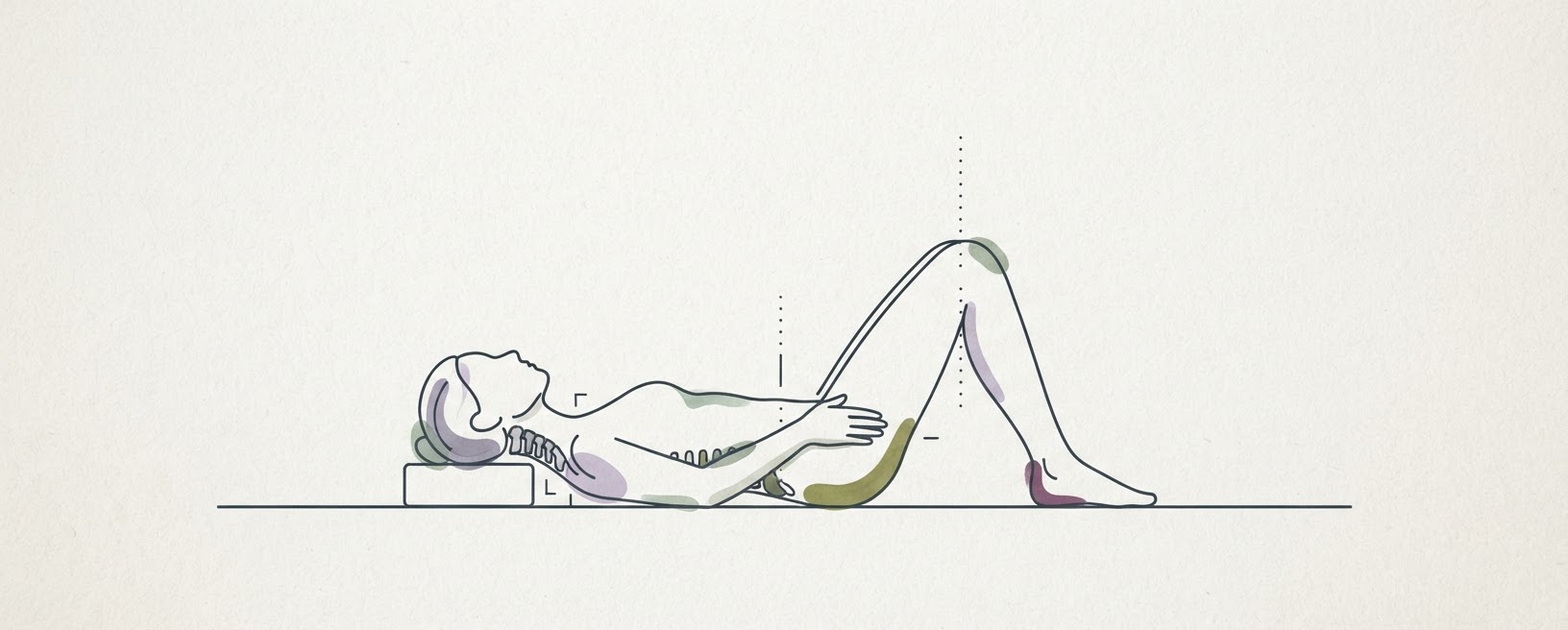
Stack two or three paperback books on a firm rug or yoga mat. Sit on the floor, bring your knees up with your feet flat, and lie back so the books support the base of your skull, not your neck. Your chin shouldn't poke up toward the ceiling or pinch down into your throat.
Place your feet flat on the floor roughly shoulder-width apart, about twelve inches from your sit bones. Let your knees point directly toward the ceiling. If your adductors strain to keep them there, widen your feet an inch or two until the bones balance without gripping.
Rest your hands gently on your lower ribs or flat on the floor beside your hips, elbows bent and out wide. Allow your elbows to be heavy.
Keep your eyes open with a soft, expansive gaze on the ceiling. I used to close my eyes here and immediately fall asleep, which misses the whole point of conscious inhibition. You want an alert brain observing an unbracing body.
Direct your thinking without physically pushing anything. Quietly tell your neck to be free, so that your head can release forward and away from your spine, and your torso can lengthen and widen along the carpet. Do not push your lower back flat. Let the floor receive whatever surface area makes contact.
Breathe naturally through your nose. Notice the subtle rise and fall of the ribs under your palms without trying to deepen or perform your breath. Stay here for ten minutes, letting the habitual holding patterns in your paraspinal muscles gradually unhook.
To stand up without pulling yourself back into compression, roll onto one side as a single unit. Pause on your side for one full breath, then use your hands to press yourself up to kneeling, and finally to standing, keeping that sense of ease at the atlanto-occipital joint.