Daily movement
Semi-Supine (Constructive Rest)
A foundational Alexander Technique practice for releasing postural tension and re-educating kinesthetic awareness.
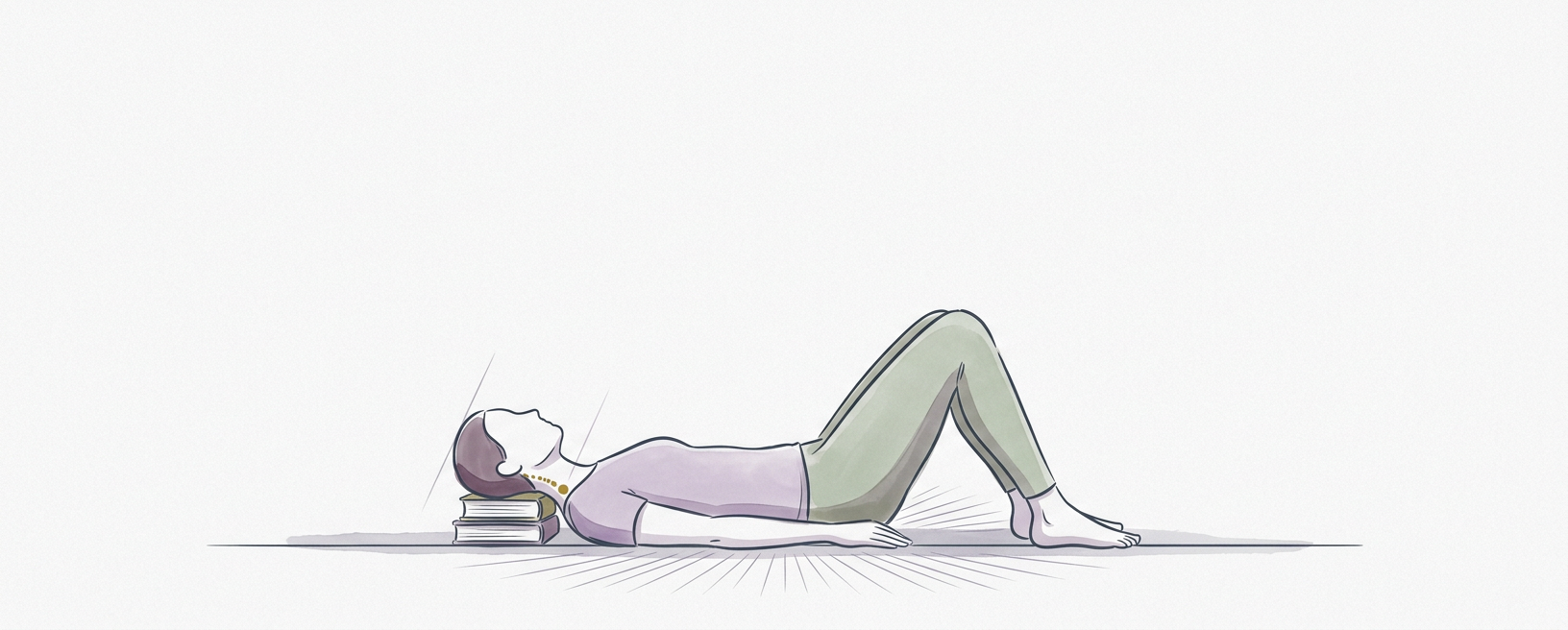
A foundational Alexander Technique practice for releasing postural tension and re-educating kinesthetic awareness.
Alexander Technique · Developed by F. Matthias Alexander (1869-1955) as a core practice within his educational method. · Chronic muscular tension, postural inefficiencies, mental overwhelm, difficulty finding ease in stillness. · Practice for 10-20 minutes daily, or whenever you feel the need to reset your posture and calm your nervous system. Consistency is more beneficial than duration.
Why it works
The Semi-Supine position minimizes gravitational pull on the body, allowing for a reduction in habitual muscular effort. Through conscious inhibition (preventing habitual reactions) and primary direction (gentle mental commands for release and lengthening), the nervous system is encouraged to release unnecessary tension. This process facilitates neuroplastic changes, improving proprioception and kinesthetic awareness, leading to more efficient and coordinated movement patterns in daily life. The support from the floor provides continuous tactile feedback, aiding in the recognition and release of ingrained patterns of compression.
How to practice
Preparation: Lie on your back on a firm but comfortable surface (e.g., a yoga mat on the floor). Your knees should be bent, with feet flat on the floor, hip-width apart. Ensure your heels are close enough to your buttocks so your knees point towards the ceiling without strain. Place a few paperback books or a thin, firm cushion under your head, ensuring your neck feels long and your chin is not jutted forward or tucked excessively. Your hands can rest on your torso or by your sides, palms down.
Inhibition: Begin by observing your body without judgment. Notice areas of tension. Rather than trying to "fix" them, consciously prevent yourself from doing anything to change them. This is the principle of inhibition – stopping unhelpful habitual reactions.
Primary Direction: Gently bring to mind the following mental directions, without trying to "make" them happen, but rather allowing them to influence your state:
- "My neck to be free." (Allowing the muscles around the neck to release.)
- "My head to go forward and up." (Allowing the head to release away from the spine, creating space.)
- "My back to lengthen and widen." (Visualizing the spine extending and the back muscles broadening.)
- "My knees to go forward and away from my hips." (Allowing the legs to release and lengthen.)
Integration: Continue to hold these directions gently in your mind, allowing the body to respond subtly. Breathe easily and allow your breath to deepen naturally as tension releases.
Preparation: Lie on your back on a firm but comfortable surface (e.g., a yoga mat on the floor). Your knees should be bent, with feet flat on the floor, hip-width apart. Ensure your heels are close enough to your buttocks so your knees point towards the ceiling without strain. Place a few paperback books or a thin, firm cushion under your head, ensuring your neck feels long and your chin is not jutted forward or tucked excessively. Your hands can rest on your torso or by your sides, palms down.
Inhibition: Begin by observing your body without judgment. Notice areas of tension. Rather than trying to "fix" them, consciously prevent yourself from doing anything to change them. This is the principle of inhibition – stopping unhelpful habitual reactions.
Primary Direction: Gently bring to mind the following mental directions, without trying to "make" them happen, but rather allowing them to influence your state:
- "My neck to be free." (Allowing the muscles around the neck to release.)
- "My head to go forward and up." (Allowing the head to release away from the spine, creating space.)
- "My back to lengthen and widen." (Visualizing the spine extending and the back muscles broadening.)
- "My knees to go forward and away from my hips." (Allowing the legs to release and lengthen.)
Integration: Continue to hold these directions gently in your mind, allowing the body to respond subtly. Breathe easily and allow your breath to deepen naturally as tension releases.