All movements
Loading…
Previous movements
Previous movements open for members. Today's movement is always free.
Daily movement
Unclench protective neck bracing and widen your visual field to signal safety to the brainstem.
Unclench protective neck bracing and widen your visual field to signal safety to the brainstem.
somatic experiencing · Somatic Experiencing (Peter Levine) · Hypervigilant tunnel vision, elevated heart rate, and protective neck rigidity before a high-stakes event. · 3 slow rotations to each side, pausing for two full breaths on each horizon
I used to think slowing down my racing thoughts required intense mental discipline. It does not. Peter Levine mapped how the mammalian nervous system monitors physical space: when vigilance spikes, cranial nerves III, IV, and VI pull your visual field into narrow focus, locking the suboccipital muscles and sternocleidomastoid into defensive bracing.
Slow, deliberate head rotation pairs visual exploratory behavior with gentle cervical movement. This signals safety directly to the superior colliculus and dorsal vagal complex, breaking sympathetic dominance. Mechanically, the unforced transverse turn glides the suboccipital fascial sling and the investing layer of deep cervical fascia. Mechanoreceptors inside the atlanto-axial joint register slow motion, dialing down baseline resting muscle tone and dropping systemic autonomic static.
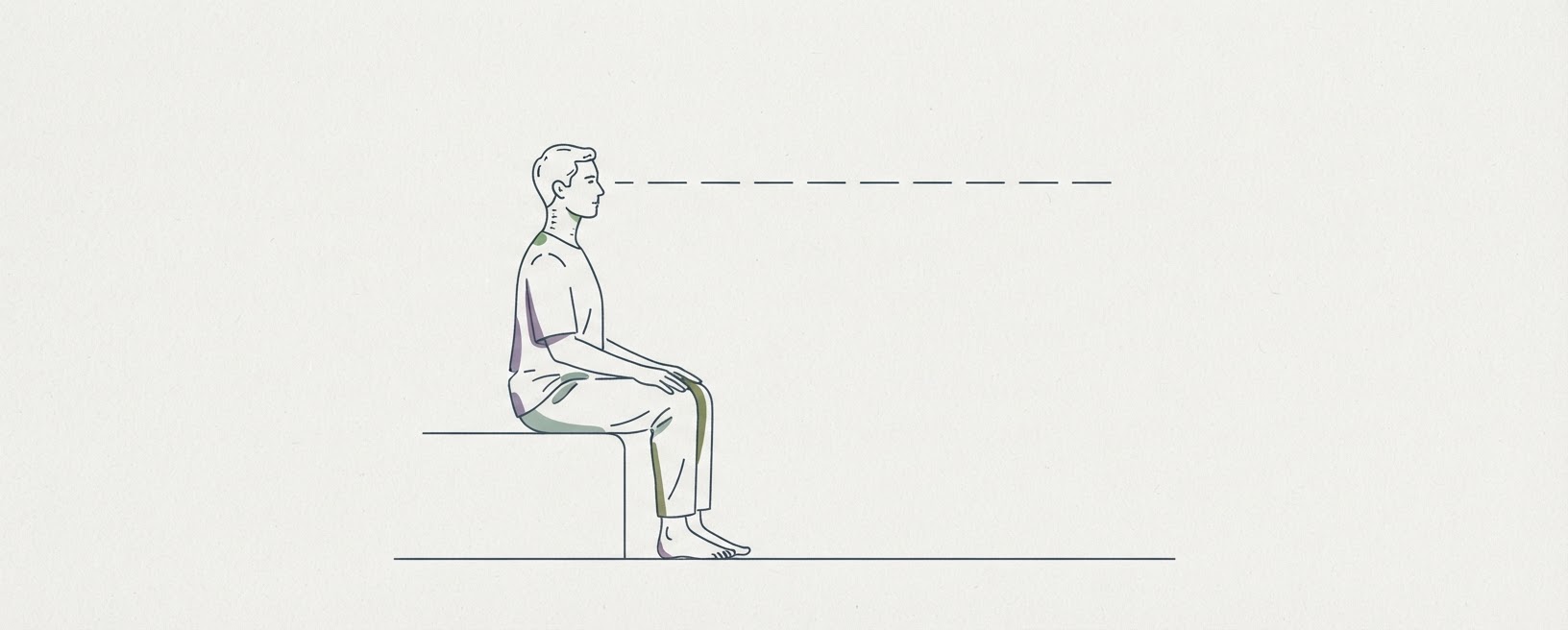
Sit upright on the edge of a firm chair with both feet flat on the floor. Rest your hands palm-down on your thighs and drop your gaze to neutral without pinning it to a screen.
Keep your shoulders square to the front. Let your eyes move slowly to the right, followed gently by your head and neck, scanning the room at eye level.
Stop the turn the moment you feel mild tension in your left sternocleidomastoid or your neck resists. Do not force range of motion. Rest your eyes on an inert object across the room—a baseboard, a doorframe, or a bookshelf.
Inhale through your nose for 4 seconds. Exhale softly through parted lips for 6 seconds, letting the vibration in your throat soften. Hold your gaze on that object for two complete breath cycles, waiting for a spontaneous swallow or deeper breath.
Bring your eyes and head slowly back to center. Pause for 5 seconds to feel the weight of your pelvis in the chair before repeating the turn to the left side.