Daily movement
Plyometric: Lateral Barrier Hop
A controlled, low-impact lateral hop designed to enhance ankle and hip stiffness and reactive strength.
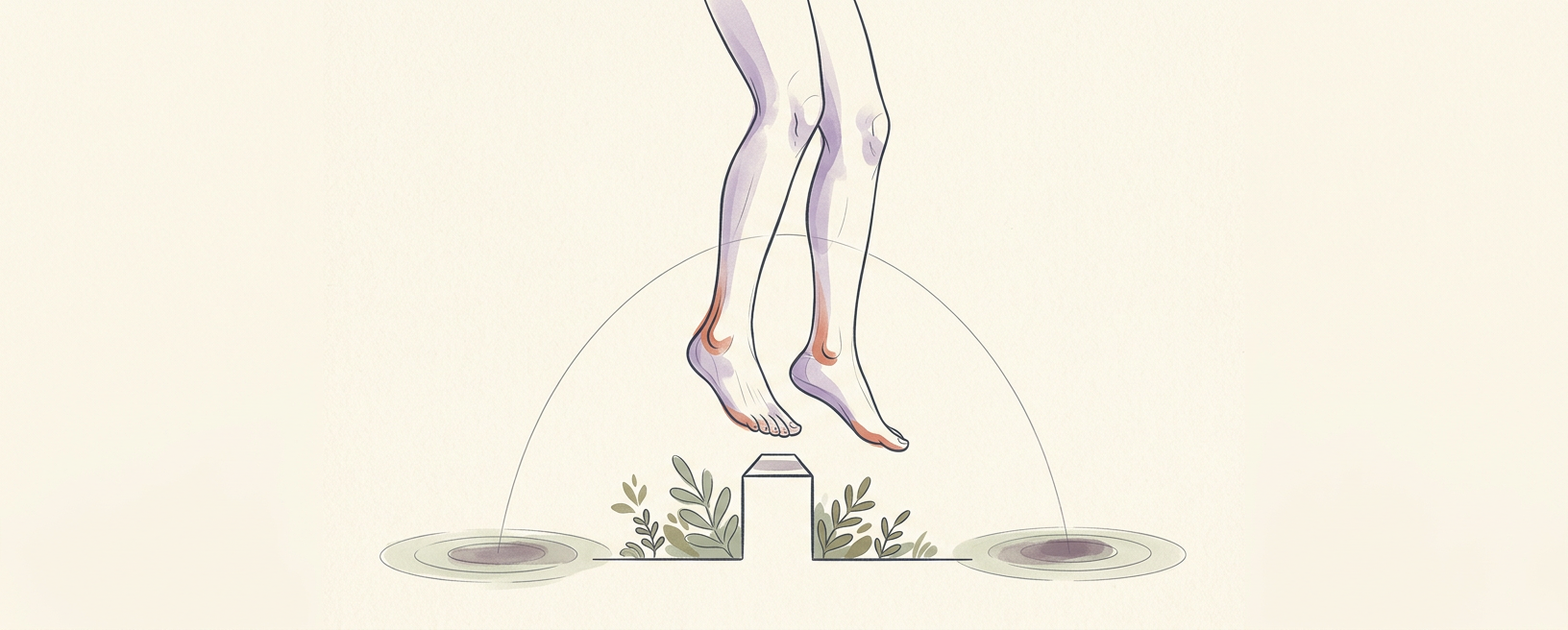
A controlled, low-impact lateral hop designed to enhance ankle and hip stiffness and reactive strength.
Plyometrics (e.g., as taught by Verkhoshansky, Chu) · Derived from track and field plyometric training, adapted for controlled impact applications. · To improve lateral power, ankle stability, and rapid force absorption/re-expression, particularly beneficial for mitigating injury risk in dynamic lateral movements. · Begin with 3 sets of 8-12 repetitions per side (hopping over and back counts as one repetition) twice per week. Progress by increasing repetitions, sets, or barrier height. Prioritize clean, controlled hops and soft landings over speed or height, especially initially.
Why it works
This movement trains the stretch-shortening cycle (SSC) in the frontal plane, specifically targeting the peroneal muscles, gluteus medius, and quadratus lumborum. The rapid eccentric loading followed by concentric contraction increases tendon stiffness and optimizes neuromuscular coordination for lateral propulsion. The controlled nature minimizes excessive joint stress while still challenging the fascial elasticity of the lower limb.
How to practice
Set-Up: Place a low, stable barrier (e.g., yoga block, rolled towel) on the floor. Stand beside it with feet hip-width apart, knees slightly bent, and gaze forward.
Initiation: Shift your weight slightly onto the foot closer to the barrier, loading the hip and ankle minimally.
The Hop: Initiate a small, controlled lateral hop over the barrier, landing softly on the opposite side. The hop should be just high enough to clear the barrier.
Landing: Land with knees slightly bent, absorbing impact through the ankles, knees, and hips simultaneously and silently. Maintain a stable, balanced posture upon landing, avoiding excessive lateral sway.
Rebound: Immediately, without pausing, initiate the next hop back over the barrier to the starting side. The movement should be continuous and fluid.
Arm Drive (Optional): Lightly pump your arms in coordination with the hop to assist with momentum and balance.
Set-Up: Place a low, stable barrier (e.g., yoga block, rolled towel) on the floor. Stand beside it with feet hip-width apart, knees slightly bent, and gaze forward.
Initiation: Shift your weight slightly onto the foot closer to the barrier, loading the hip and ankle minimally.
The Hop: Initiate a small, controlled lateral hop over the barrier, landing softly on the opposite side. The hop should be just high enough to clear the barrier.
Landing: Land with knees slightly bent, absorbing impact through the ankles, knees, and hips simultaneously and silently. Maintain a stable, balanced posture upon landing, avoiding excessive lateral sway.
Rebound: Immediately, without pausing, initiate the next hop back over the barrier to the starting side. The movement should be continuous and fluid.
Arm Drive (Optional): Lightly pump your arms in coordination with the hop to assist with momentum and balance.