Daily movement
Pilates Roll Down
A foundational Pilates movement for spinal articulation and global posterior chain recruitment, promoting a state of alert calm and preparing the body for further movement.
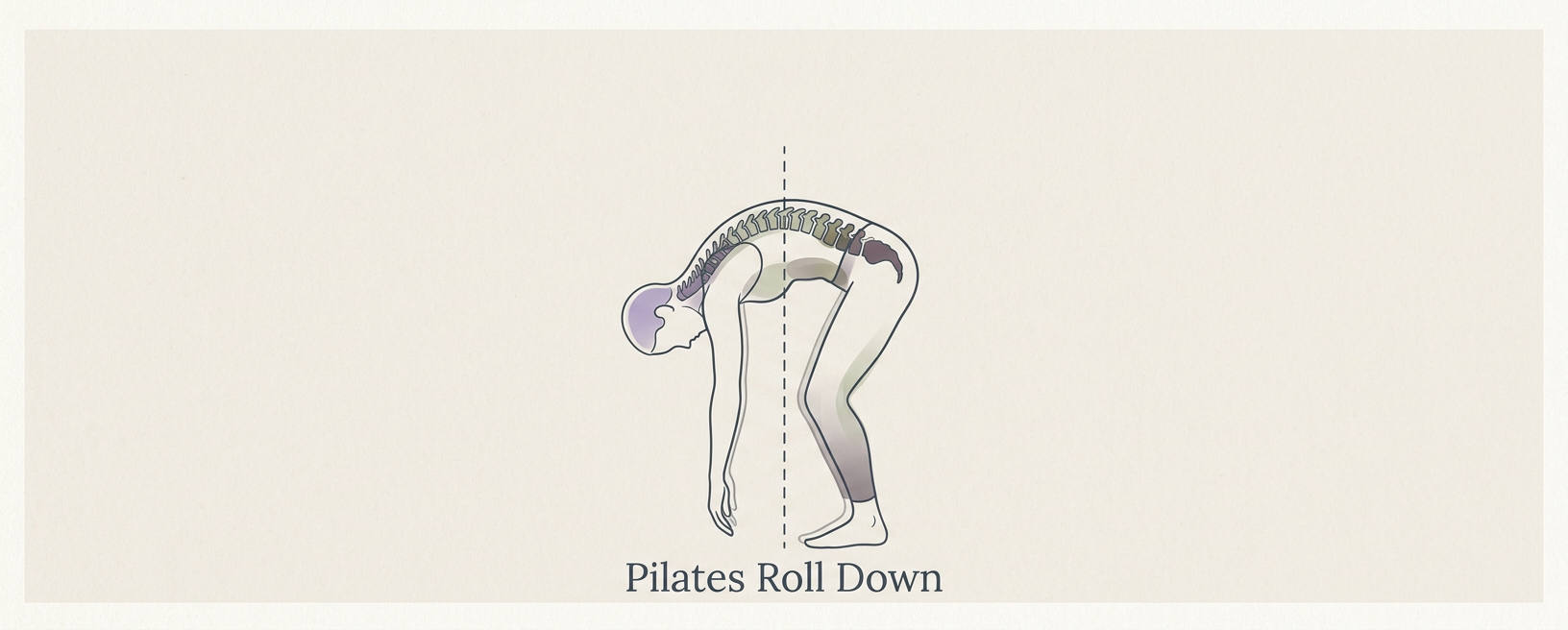
A foundational Pilates movement for spinal articulation and global posterior chain recruitment, promoting a state of alert calm and preparing the body for further movement.
Classical Pilates (Joseph Pilates) · Developed by Joseph Pilates, this movement is a cornerstone of his original apparatus-based and mat work. · This exercise addresses a need for improved spinal mobility, core control, and body awareness, particularly beneficial for individuals experiencing stiffness or seeking to enhance movement fluidity. · Perform 3-5 repetitions, moving with control and precision. Focus on the quality of each articulation rather than the quantity of repetitions. Can be performed daily as a warm-up or cool-down.
Why it works
The Pilates Roll Down systematically articulates the spine, segment by segment. This action mobilizes individual vertebrae, increases proprioception of the spinal column, and elongates the posterior fascial lines. Engaging the deep abdominal muscles and pelvic floor during the eccentric phase provides eccentric strength training for the core musculature, promoting stability and control. The coordinated breath pattern down-regulates the nervous system, fostering a parasympathetic state, while the physical exertion simultaneously builds muscular endurance. This combination results in a balanced state of energized calm.
How to practice
Starting Position:
Stand tall with feet hip-width apart, knees softly bent. Arms hang heavy by your sides. Focus your gaze directly forward.
Execution:
- Inhale to prepare, lengthening through the crown of your head.
- Exhale as you initiate the movement by dropping your chin to your chest, then slowly articulating each vertebra of your cervical, thoracic, and lumbar spine downwards, one at a time. Keep your abdominal muscles engaged, drawing them towards your spine.
- Allow your arms to hang heavy, reaching towards the floor. Your knees remain softly bent, not locked.
- Continue rolling down until your hands are close to the floor or you reach your comfortable end range of spinal flexion, maintaining active abdominal support.
- Inhale at the bottom, maintaining core engagement.
- Exhale as you slowly reverse the movement, articulating the spine back up one vertebra at a time. Initiate the upward motion by engaging the glutes and pelvic floor, then stacking the lumbar, thoracic, and finally cervical spine back to a tall standing position. The head is the last to come up.
- Repeat.
Starting Position:
Stand tall with feet hip-width apart, knees softly bent. Arms hang heavy by your sides. Focus your gaze directly forward.
Execution:
- Inhale to prepare, lengthening through the crown of your head.
- Exhale as you initiate the movement by dropping your chin to your chest, then slowly articulating each vertebra of your cervical, thoracic, and lumbar spine downwards, one at a time. Keep your abdominal muscles engaged, drawing them towards your spine.
- Allow your arms to hang heavy, reaching towards the floor. Your knees remain softly bent, not locked.
- Continue rolling down until your hands are close to the floor or you reach your comfortable end range of spinal flexion, maintaining active abdominal support.
- Inhale at the bottom, maintaining core engagement.
- Exhale as you slowly reverse the movement, articulating the spine back up one vertebra at a time. Initiate the upward motion by engaging the glutes and pelvic floor, then stacking the lumbar, thoracic, and finally cervical spine back to a tall standing position. The head is the last to come up.
- Repeat.