Daily movement
Pilates Hip Rolls
Subtle hip dissociation and pelvic stability.
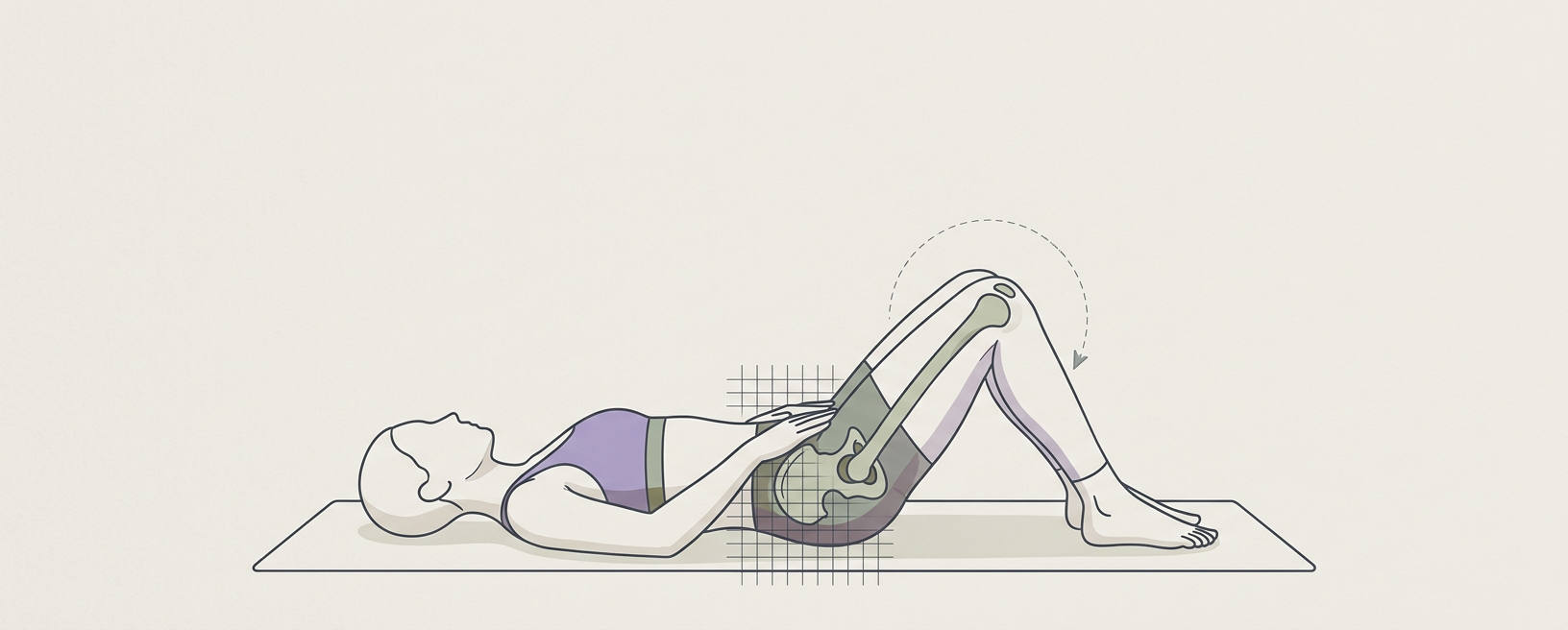
Subtle hip dissociation and pelvic stability.
_Classical Pilates · Joseph Pilates · To improve lumbopelvic stability and differentiate hip movement from lower back compensation. · 5-8 repetitions per side, 1-2 sets. Perform slowly and with precision. _
Why it works
This movement addresses motor control deficits in the lumbopelvic region by isolating hip joint rotation. The supine position reduces gravitational load, allowing for focused muscle engagement without relying on superficial movers. Coordinated breath with subtle movement facilitates proprioceptive feedback and reinforces neuromuscular pathways for pelvic stabilization.
How to practice
Lie supine (on your back) with knees bent and feet flat on the mat, hip-width apart. Ensure your spine is in a neutral position, avoiding excessive arching or flattening of the lower back.
Place hands gently on your ASIS (anterior superior iliac spines) – the bony prominences at the front of your hips – to monitor pelvic stillness.
Inhale to prepare.
As you exhale, slowly roll one thigh bone internally, allowing the knee to gently fall inward a few degrees. Concentrate on initiating movement from the hip joint, keeping the pelvis level and stable. The opposite hip and pelvis should remain still.
Inhale as you slowly return the knee to the starting position.
Exhale as you repeat on the other side, rolling the other thigh bone internally.
Continue to alternate, focusing on controlled, isolated movement.
Lie supine (on your back) with knees bent and feet flat on the mat, hip-width apart. Ensure your spine is in a neutral position, avoiding excessive arching or flattening of the lower back.
Place hands gently on your ASIS (anterior superior iliac spines) – the bony prominences at the front of your hips – to monitor pelvic stillness.
Inhale to prepare.
As you exhale, slowly roll one thigh bone internally, allowing the knee to gently fall inward a few degrees. Concentrate on initiating movement from the hip joint, keeping the pelvis level and stable. The opposite hip and pelvis should remain still.
Inhale as you slowly return the knee to the starting position.
Exhale as you repeat on the other side, rolling the other thigh bone internally.
Continue to alternate, focusing on controlled, isolated movement.