Daily movement
Pilates Belly Breath with Pelvic Floor Engagement
A foundational Pilates breathing exercise that integrates deep core stabilization with pelvic floor awareness, promoting efficient movement and internal support.
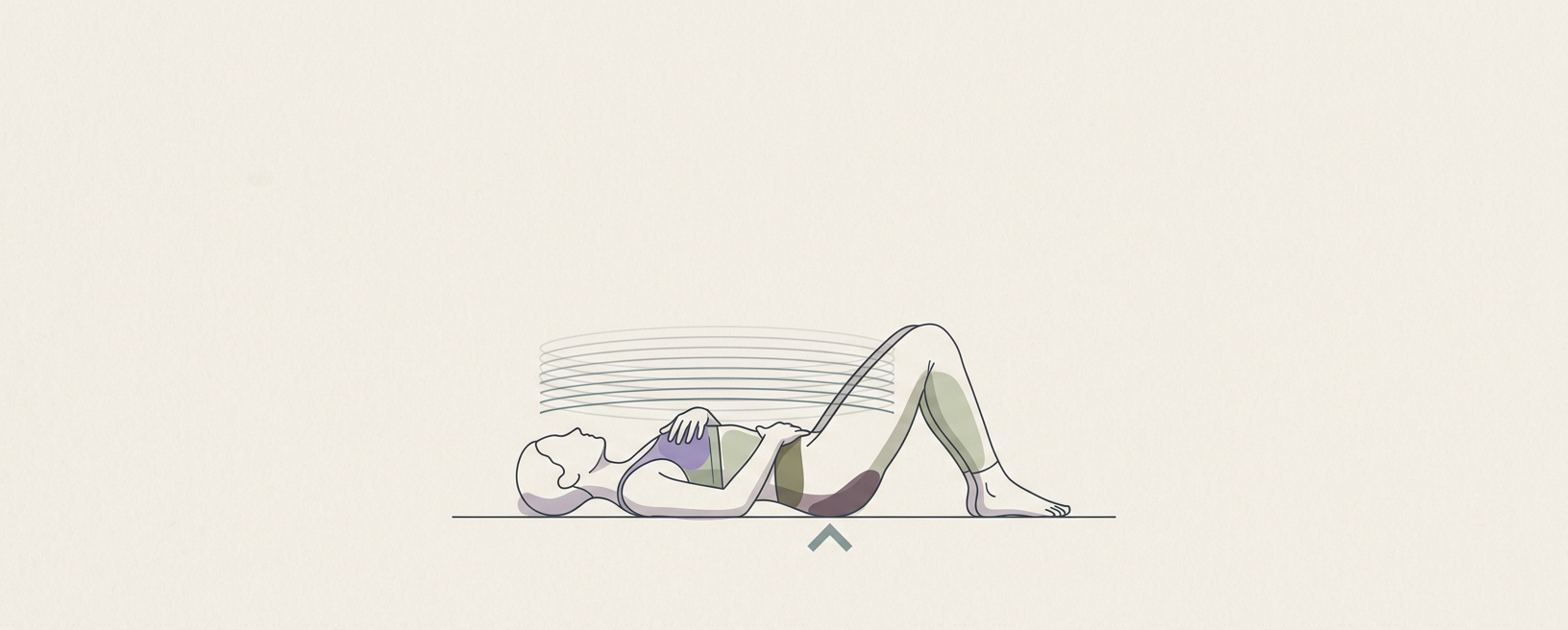
A foundational Pilates breathing exercise that integrates deep core stabilization with pelvic floor awareness, promoting efficient movement and internal support.
Classical Pilates · Joseph Pilates · To cultivate integrated core support, enhance respiratory efficiency, and improve pelvic floor awareness. · Perform 8-12 repetitions, 2-3 times per day, or as a warm-up/cool-down for other movements. Focus on quality of engagement over quantity.
Why it works
This movement directly targets the transverse abdominis, multifidus, and pelvic floor muscles, which are the primary stabilizers of the lumbar spine and pelvis. Coordinated breath with subtle engagement of these muscle groups optimizes intra-abdominal pressure, providing a natural internal brace. This improves proprioception of the deep core unit and reduces extraneous muscle tension, leading to more efficient movement patterns and improved spinal health. The rhythmic engagement and release also impact the autonomic nervous system by promoting parasympathetic activity, fostering a calm yet alert state.
How to practice
Starting Position: Lie supine (on your back) with knees bent, feet flat on the floor, hips-width apart. Ensure your spine is in a neutral position, maintaining its natural curves without pressing your lower back into the mat or arching excessively. Place one hand on your lower belly and the other on your rib cage.
Inhale (Lateral Thoracic Breath): Inhale deeply through your nose, directing the breath into the sides and back of your rib cage. You should feel your ribs expand outward, and your lower belly should remain relatively still or gently expand without pushing forcefully against your hand.
Exhale (Pelvic Floor and Transverse Abdominis Engagement): Exhale slowly and completely through pursed lips (like blowing through a straw). As you exhale, gently lift and draw your pelvic floor muscles inward, as if stopping the flow of urine or lifting a small berry internally. Simultaneously, draw your lower abdominal muscles (below the navel) inward toward your spine without flattening your back into the mat. Imagine "zipping up" from your pubic bone to your navel. Maintain this gentle engagement as you complete the exhale.
Inhale (Release): Inhale again, releasing the pelvic floor and abdominal engagement, allowing the rib cage to expand naturally. Do not actively push the belly out.
Repeat: Continuously flow through these breathing cycles, coordinating the breath with the gentle engagement and release of the pelvic floor and deep abdominal muscles.
Starting Position: Lie supine (on your back) with knees bent, feet flat on the floor, hips-width apart. Ensure your spine is in a neutral position, maintaining its natural curves without pressing your lower back into the mat or arching excessively. Place one hand on your lower belly and the other on your rib cage.
Inhale (Lateral Thoracic Breath): Inhale deeply through your nose, directing the breath into the sides and back of your rib cage. You should feel your ribs expand outward, and your lower belly should remain relatively still or gently expand without pushing forcefully against your hand.
Exhale (Pelvic Floor and Transverse Abdominis Engagement): Exhale slowly and completely through pursed lips (like blowing through a straw). As you exhale, gently lift and draw your pelvic floor muscles inward, as if stopping the flow of urine or lifting a small berry internally. Simultaneously, draw your lower abdominal muscles (below the navel) inward toward your spine without flattening your back into the mat. Imagine "zipping up" from your pubic bone to your navel. Maintain this gentle engagement as you complete the exhale.
Inhale (Release): Inhale again, releasing the pelvic floor and abdominal engagement, allowing the rib cage to expand naturally. Do not actively push the belly out.
Repeat: Continuously flow through these breathing cycles, coordinating the breath with the gentle engagement and release of the pelvic floor and deep abdominal muscles.