Daily movement
Pelvic Clock
Explore subtle pelvic movement to differentiate spinal segments, enhancing spinal mobility and reducing lower back strain.
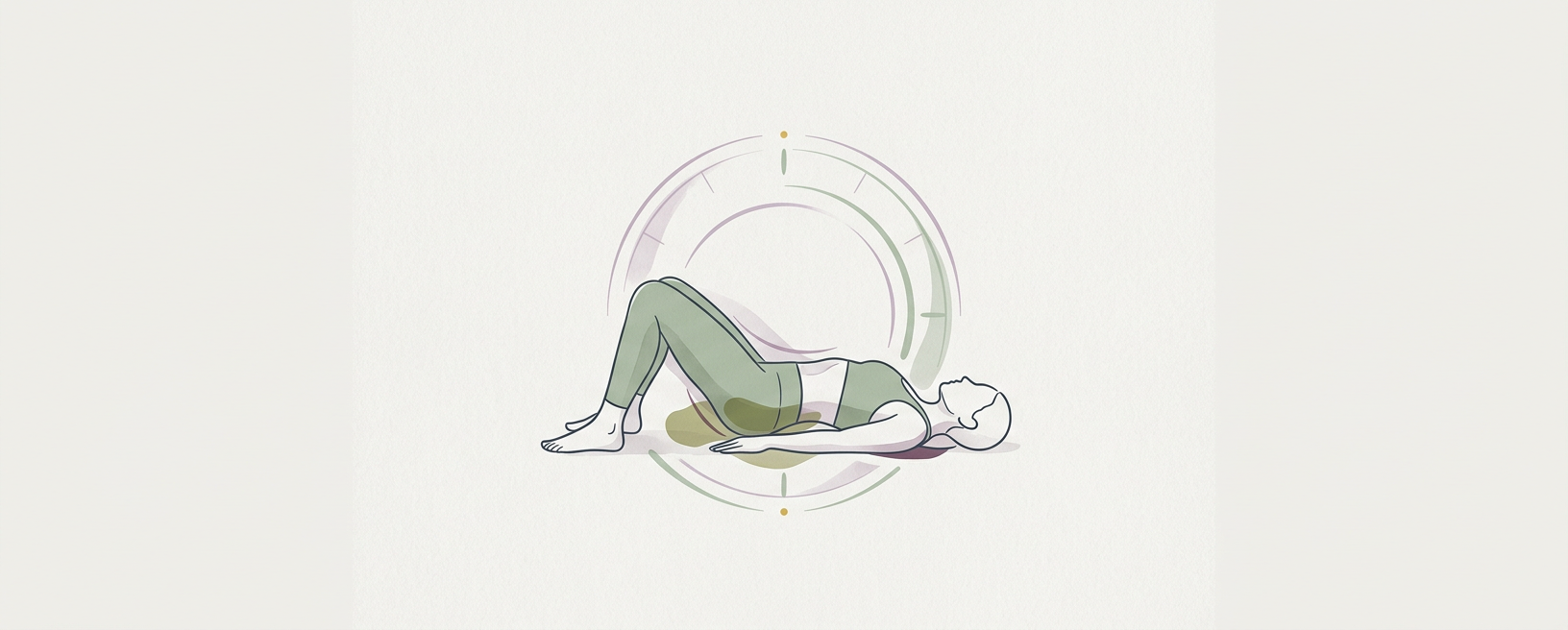
Explore subtle pelvic movement to differentiate spinal segments, enhancing spinal mobility and reducing lower back strain.
Feldenkrais Method · Based on the work of Moshé Feldenkrais, developed as part of his Awareness Through Movement (ATM) lessons. · Low back tension, undifferentiated spinal movement, limited core awareness, preparation for complex movements. · Perform for 5-10 minutes, 1-2 times daily, or as needed for spinal differentiation and tension release. Focus on quality of sensation over range of motion.
Why it works
The Feldenkrais Method utilizes gentle, non-strenuous movements to engage the nervous system in a learning process. By attending to subtle shifts and distinctions (differential sensation) in the pelvic region, the brain refines its motor maps for the lumbar spine. This reduces unnecessary muscular effort, improves intersegmental spinal mobility, and recalibrates posture through proprioceptive feedback. The slow pace prevents habituated patterns and encourages novel neural pathways for efficient movement.
How to practice
Preparation: Lie on your back on a firm, comfortable surface. Bend your knees so your feet are flat on the floor, about hip-width apart. Allow your arms to rest comfortably at your sides, palms up or down. Notice the contact of your pelvis and lower back with the floor.
Establish the "Clock": Imagine a clock face painted on your lower abdomen/pelvis. Your navel is 12, your pubic bone is 6, your right hip bone is 3, and your left hip bone is 9.
Initiate 12 O'Clock: Gently tilt your pelvis so your pubic bone moves slightly away from the floor and your navel (12 o'clock) presses lightly towards the floor. This should subtly flatten your lower back against the floor. Inhale softly as you tilt.
Initiate 6 O'Clock: Gently tilt your pelvis in the opposite direction, so your pubic bone (6 o'clock) presses lightly into the floor, and a small arch appears in your lower back. Exhale softly as you tilt.
Pendulum Swing (12 to 6): Continue to slowly and smoothly oscillate your pelvis between 12 and 6 o'clock. Explore the smallest possible movement. Notice how your lumbar spine responds. Are you holding your breath? Relax your jaw and shoulders. Repeat 5-8 times.
Rest: Return to a neutral pelvic position and rest for a moment. Notice any changes in sensation or contact with the floor.
Explore 3 O'Clock: Gently press your right hip bone (3 o'clock) slightly into the floor, allowing your left hip to lighten. Notice the subtle tilt and how your lower back shifts. Inhale or exhale naturally.
Explore 9 O'Clock: Gently press your left hip bone (9 o'clock) slightly into the floor, allowing your right hip to lighten. Continue 3-5 times, alternating between 3 and 9.
Combine & Circle: Now, gently connect these points, drawing a smooth, small circle with your pelvis, moving through 12, 3, 6, 9, and back to 12. Move in one direction for 3-5 circles, then reverse for 3-5 circles. The movement should be slow, effortless, and driven by your attention, not muscular force.
Final Rest: Extend your legs and rest completely. Observe the new sense of length, ease, or organization in your spine and pelvis.
Preparation: Lie on your back on a firm, comfortable surface. Bend your knees so your feet are flat on the floor, about hip-width apart. Allow your arms to rest comfortably at your sides, palms up or down. Notice the contact of your pelvis and lower back with the floor.
Establish the "Clock": Imagine a clock face painted on your lower abdomen/pelvis. Your navel is 12, your pubic bone is 6, your right hip bone is 3, and your left hip bone is 9.
Initiate 12 O'Clock: Gently tilt your pelvis so your pubic bone moves slightly away from the floor and your navel (12 o'clock) presses lightly towards the floor. This should subtly flatten your lower back against the floor. Inhale softly as you tilt.
Initiate 6 O'Clock: Gently tilt your pelvis in the opposite direction, so your pubic bone (6 o'clock) presses lightly into the floor, and a small arch appears in your lower back. Exhale softly as you tilt.
Pendulum Swing (12 to 6): Continue to slowly and smoothly oscillate your pelvis between 12 and 6 o'clock. Explore the smallest possible movement. Notice how your lumbar spine responds. Are you holding your breath? Relax your jaw and shoulders. Repeat 5-8 times.
Rest: Return to a neutral pelvic position and rest for a moment. Notice any changes in sensation or contact with the floor.
Explore 3 O'Clock: Gently press your right hip bone (3 o'clock) slightly into the floor, allowing your left hip to lighten. Notice the subtle tilt and how your lower back shifts. Inhale or exhale naturally.
Explore 9 O'Clock: Gently press your left hip bone (9 o'clock) slightly into the floor, allowing your right hip to lighten. Continue 3-5 times, alternating between 3 and 9.
Combine & Circle: Now, gently connect these points, drawing a smooth, small circle with your pelvis, moving through 12, 3, 6, 9, and back to 12. Move in one direction for 3-5 circles, then reverse for 3-5 circles. The movement should be slow, effortless, and driven by your attention, not muscular force.
Final Rest: Extend your legs and rest completely. Observe the new sense of length, ease, or organization in your spine and pelvis.