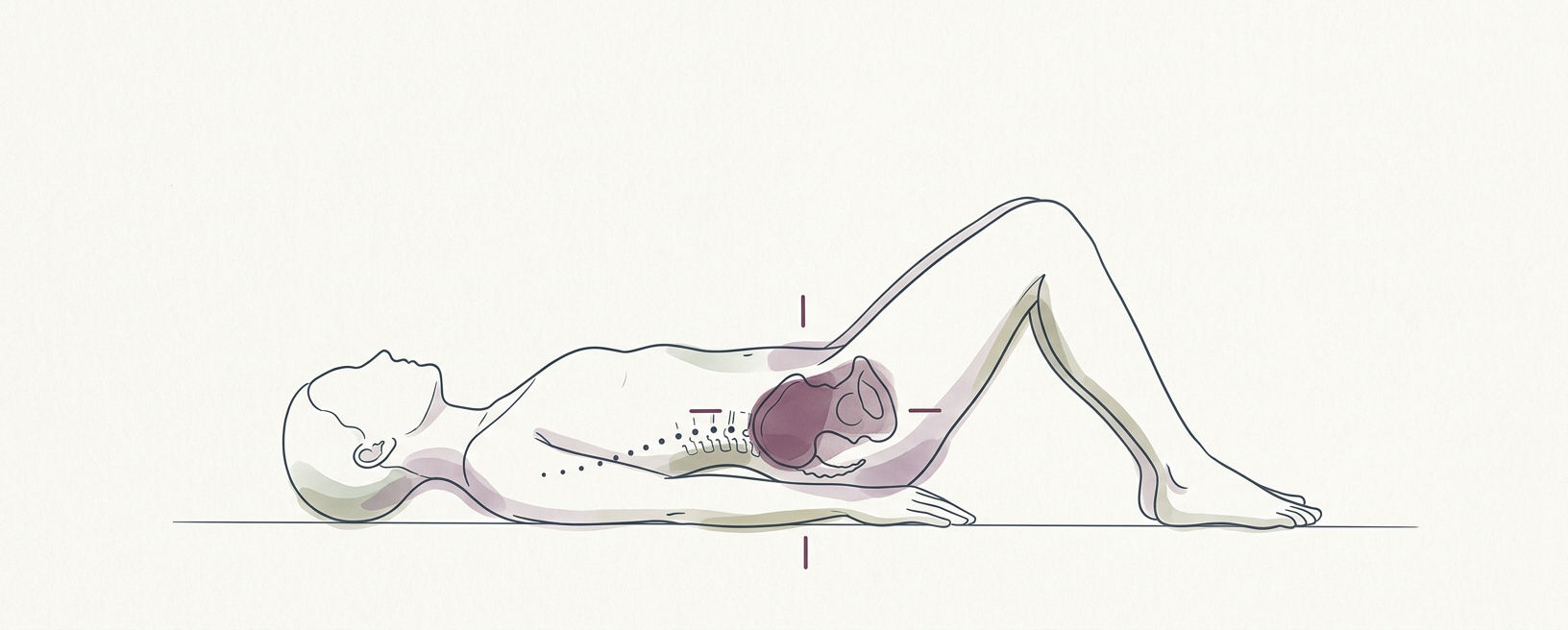
Refine your body map and improve spinal fluidity by exploring subtle pelvic tilts, cultivating a sense of calm and centeredness.
Feldenkrais · Feldenkrais (Moshé Feldenkrais) · This movement addresses feelings of static posture, spinal stiffness, and an over-reliance on brute force instead of integrated movement. · 5–8 minutes, once daily or as needed.
Why it works
The Feldenkrais Method operates on neuroplasticity, refining the brain's motor cortex representation of the body. By engaging in slow, non-habitual movements like the Pelvic Clock, you interrupt ingrained movement patterns that often contribute to discomfort or inefficiency. This gentle exploration of pelvic tilt and rotation—without muscular strain—sends novel sensory information to the central nervous system. This process clarifies the "body image" or homunculus, making movement choices more accurate and less effortful. At the tissue level, these micro-movements encourage fluid exchange within fascial layers around the sacrum, lumbar spine, and hips. The rhythmic, undulating action prevents adhesion formation and releases existing restrictions, promoting greater range of motion and reducing proprioceptive "blind spots." This gentle approach downregulates sympathetic activation, fostering a state of mindful attention and reducing perceived threat.
How to practice
Sometimes, I find myself rushing through a day and forgetting my body even exists. Then I'll lie down and remember this.
- Lie on your back. Place your feet flat on the floor, hip-width apart, knees pointing towards the ceiling. Let your arms rest comfortably by your sides, palms up or down—whichever feels softer. Allow your head to settle naturally, and feel the contact points of your skull, shoulders, and pelvis with the floor. Close your eyes if that feels comfortable; otherwise, soften your gaze.
- Imagine a clock face on your lower abdomen, directly over your pelvis. Your navel is at 12 o'clock, your pubic bone at 6 o'clock. Your right hip bone is at 3 o'clock, and your left hip bone at 9 o'clock. The center of the clock is deep inside your pelvis.
- Initiate a gentle tilt towards 12 o'clock. As you slowly inhale, imagine gently pressing your lower back into the floor, just enough to tilt your pelvis slightly so your navel moves towards your chest. This is a small, quiet movement; don't force it. Inhale as you tilt to 12. Let the movement be soft, curiosity guiding it.
- Exhale and tilt towards 6 o'clock. As you slowly exhale, release the pressure in your lower back, allowing your tailbone to lengthen slightly towards your heels. Your lower back might lift a hair off the floor. Exhale as you tilt to 6. Move only as far as comfortable, with no strain.
- Continue this gentle rocking between 12 and 6 o'clock for several breaths. Notice how your spine responds, how the weight shifts across your pelvis. After a few repetitions, pause at the neutral center. Now, gently tilt your pelvis towards 3 o'clock (right hip bone pressing slightly into the floor) on an inhale, and then towards 9 o'clock (left hip bone pressing slightly) on an exhale. Explore these side-to-side tilts for a few rounds, finding the subtle sensation of compression and release.
- Combine the movements. Start to trace the full circle of the clock face, moving from 12 to 3 to 6 to 9 and back to 12. Let your breath guide you—perhaps inhaling for one half of the circle and exhaling for the other. Reverse direction after a few circles. The key is small, smooth, continuous motion, driven by attention, not muscle. Let it be like stirring a small bowl of water rather than forcing a big block.
- Rest. Once you've explored the clock in both directions, come back to neutral. Lengthen your legs, arms by your sides. Notice the changes in your body's contact with the floor, the sense of space around your pelvis, the quiet clarity in your head.