Daily movement
Modified Romberg Test (Eyes Open, then Closed)
This exercise, adapted from neurological assessment, challenges static balance by systematically reducing somatosensory input. It enhances proprioceptive awareness and refines postural control mechanisms.
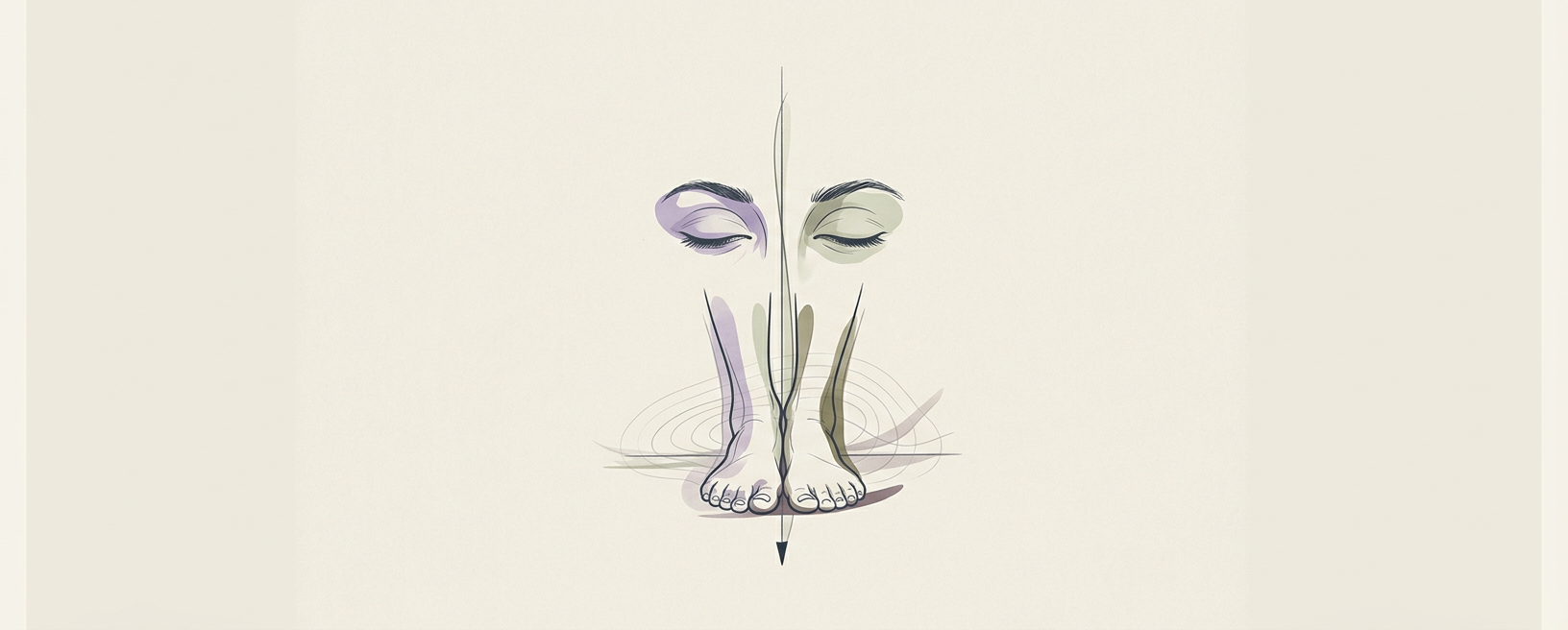
This exercise, adapted from neurological assessment, challenges static balance by systematically reducing somatosensory input. It enhances proprioceptive awareness and refines postural control mechanisms.
Neurological Examination / Proprioceptive Training · Heinrich Romberg, German neurologist (1809–1873) · To improve static balance, reduce postural sway, and enhance proprioceptive feedback for everyday movements and injury prevention, particularly in situations with compromised visual input. · Perform 2-3 sets, holding each phase (eyes open, then closed) for 30-60 seconds. Rest for 15-30 seconds between sets. Practice daily or every other day.
Why it works
The Romberg test identifies proprioceptive deficits. By performing it as a practice, we intentionally remove visual feedback—a primary source of balance information. This forces the central nervous system to rely more heavily on proprioceptors (sensory receptors in muscles, tendons, and joints) and vestibular input (inner ear balance system). The increased demand on these systems strengthens their integration and refines the unconscious postural adjustments necessary for maintaining equilibrium. When visual input is removed, the brain must more acutely interpret and respond to gravitational cues and body position detected by the remaining sensory systems, thereby enhancing their sensitivity and response time.
How to practice
Starting Position: Stand upright with feet together, side-by-side, heels and balls of feet touching. Your gaze should be fixed on a stable point straight ahead at eye level.
Phase 1 (Eyes Open): Maintain this position for 30 seconds, focusing on stillness. Notice any subtle sway.
Phase 2 (Eyes Closed): Gently close your eyes. Maintain the exact same foot and body position. Continue to breathe calmly and evenly. Your focus remains on maintaining stillness through internal sensation.
Progression (Increasing Challenge): To increase the challenge, narrow your stance slightly (e.g., feet hip-width apart), then progress to a tandem stance (heel-to-toe), and finally to a single-leg stance, performing both eyes open and eyes closed for each position.
Starting Position: Stand upright with feet together, side-by-side, heels and balls of feet touching. Your gaze should be fixed on a stable point straight ahead at eye level.
Phase 1 (Eyes Open): Maintain this position for 30 seconds, focusing on stillness. Notice any subtle sway.
Phase 2 (Eyes Closed): Gently close your eyes. Maintain the exact same foot and body position. Continue to breathe calmly and evenly. Your focus remains on maintaining stillness through internal sensation.
Progression (Increasing Challenge): To increase the challenge, narrow your stance slightly (e.g., feet hip-width apart), then progress to a tandem stance (heel-to-toe), and finally to a single-leg stance, performing both eyes open and eyes closed for each position.