All movements
Loading…
Previous movements
Previous movements open for members. Today's movement is always free.
Daily movement
Settle an unfocused nervous system by firing deep stabilizing endurance across the pelvic floor and inner thighs.
Settle an unfocused nervous system by firing deep stabilizing endurance across the pelvic floor and inner thighs.
barre · The Lotte Berk Method (Lotte Berk, 1959) · Physical restlessness combined with a disconnected, drifting pelvic floor after hours slumped in an office chair. · 3 rounds of 20 pulses with 15-second holds
I spent years assuming endurance work had to involve heavy weights or miles on pavement. Lotte Berk figured out in 1959 that sustained, tiny isometric loads do something entirely different to the nervous system. Holding a narrow V demi-plié on relevé forces a sustained contraction of the adductor magnus, deep rotators, and the levator ani group in the pelvic floor. The small one-inch amplitude keeps the muscle fibers under continuous mechanical tension without joint shear, exhausting the slow-twitch motor units within 45 seconds. That familiar muscle tremor—what Berk called the shake—signals high motor-unit recruitment as your central nervous system scrambles to keep you upright. The isometric load also downshifts somatic static: your brain must map the sole of the foot, the deep hip stabilizers, and the breath simultaneously. That high afferent demand pulls your attention out of mental loops and anchors you firmly in your lower body.
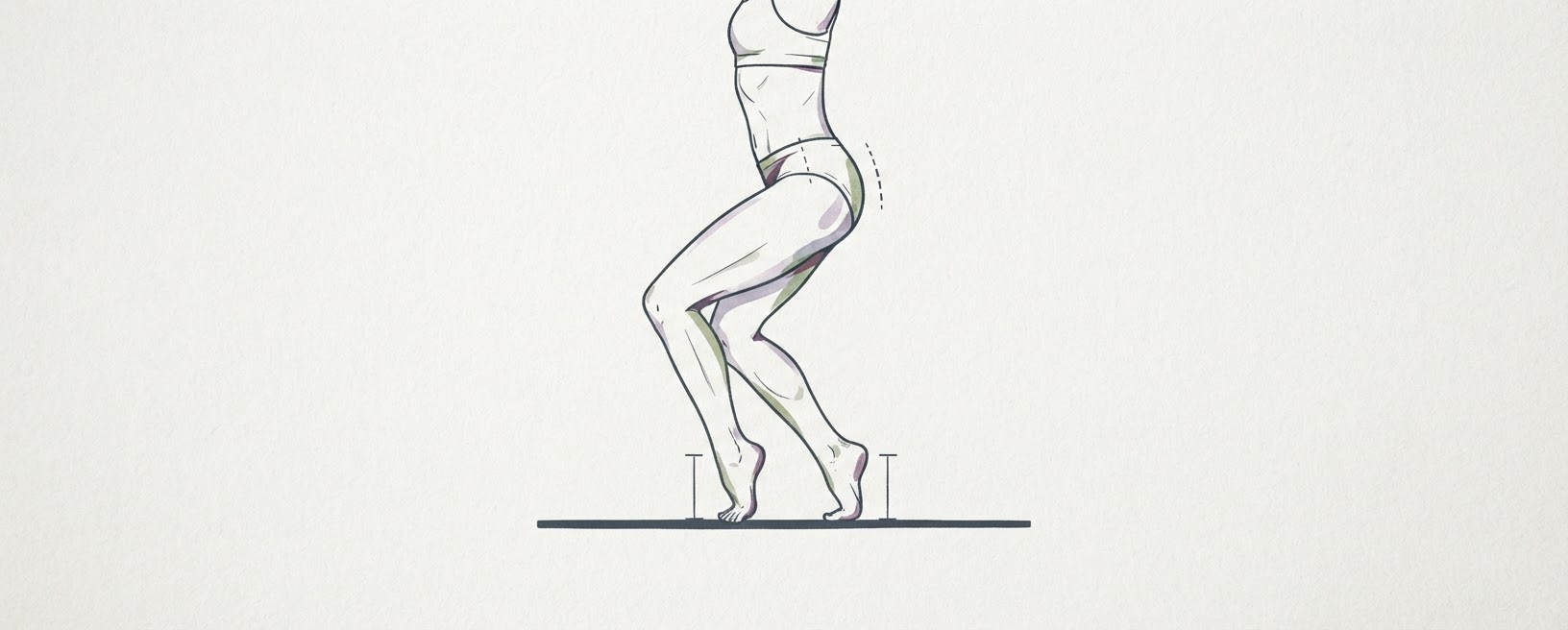
Stand facing a sturdy kitchen counter or the back of a heavy chair, resting light fingertips on top. Bring your heels together and toes about three inches apart into a narrow V, keeping your thighs rotated outward from the hips.
Lift your heels two inches off the floor to find a stable relevé. Press the balls of your feet down evenly, keeping weight across the base of your big toes rather than rolling outward.
Bend your knees three to four inches, sliding your torso down an imaginary vertical wall behind you. Keep your shoulders stacked directly over your hips and your pelvis neutral, avoiding any forward tipping.
Lower your hips one tiny inch, then lift them one inch. Keep the tempo steady at about one pulse per second. Inhale quietly through your nose for four pulses; exhale through slightly parted teeth for four pulses.
Complete 20 micro-pulses, then freeze at your lowest controlled depth for a 15-second isometric hold. Let the quadriceps shake without gripping in your jaw or neck.
Press through the balls of your feet to straighten your legs, lower your heels to the floor, and take three deep nasal breaths before starting the next round.