Daily movement
Loaded Carry: Zercher Carry
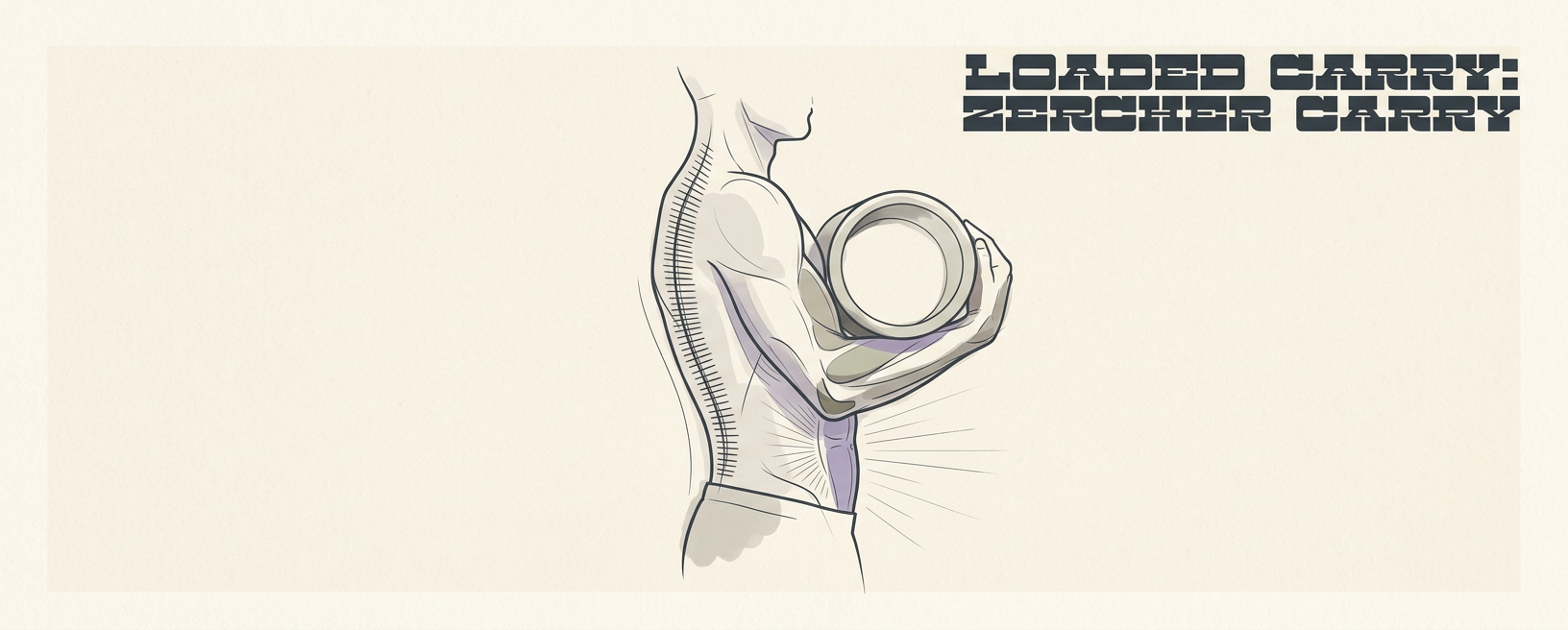
The Zercher Carry enhances spinal rigidity and core engagement by placing the load in the crook of the elbows, challenging the anterior chain and improving overall structural integrity under load.
The Zercher Carry enhances spinal rigidity and core engagement by placing the load in the crook of the elbows, challenging the anterior chain and improving overall structural integrity under load.
Powerlifting and Strength & Conditioning (Stuart McGill, Dan John) · The Zercher squat, from which this carry is derived, was popularized by strongman and powerlifter Ed Zercher in the 1930s. Its application to carries emphasizes similar benefits of thoracic bracing and anterior loading. · To develop resilient anterior and lateral core strength, improve thoracic brace mechanics, and enhance spinal stability under load, particularly for individuals who frequently lift or carry objects. · Perform 3-5 sets of carries for a distance of 20-40 meters (60-120 feet) or for a duration of 30-60 seconds. Rest 60-90 seconds between sets. Progress by increasing load, distance, or duration.
Why it works
The Zercher Carry places significant demand on the anterior core musculature, including the rectus abdominis and obliques, to resist spinal extension and lateral flexion. The mechanical placement of the load in the crook of the elbows forces activation of the upper back and biceps for support, promoting thoracic extension and scapular stability. This configuration significantly challenges the "pillar" of the body (shoulders, torso, hips) as a single unit, reinforcing the principles of spinal bracing advocated by McGill for injury prevention and performance. The isometric contraction across multiple muscle groups improves force transfer capabilities and proprioception under load.
How to practice
Load Placement: Position a barbell or heavy object (e.g., sandbag, log) in the crooks of your elbows, holding it securely against your torso. Your forearms should be roughly parallel to the floor, and your hands can be clasped together or interlocked for stability.
Stance and Posture: Stand tall with feet hip-width apart. Engage your glutes and brace your core as if preparing for a punch. Create a "big chest" and set your shoulders back and down. Maintain a neutral spine.
Initiate Walk: Take short, controlled steps. Avoid swaying or allowing the load to pull you forward. Focus on maintaining a rigid torso and stable pelvis.
Gaze: Keep your gaze fixed straight ahead, maintaining a neutral neck position relative to your spine.
Breath: Employ a "bracing" breath: inhale deeply into your belly, hold briefly while contracting your core, take a few steps, then exhale slowly. Re-brace with each subsequent inhale.
Load Placement: Position a barbell or heavy object (e.g., sandbag, log) in the crooks of your elbows, holding it securely against your torso. Your forearms should be roughly parallel to the floor, and your hands can be clasped together or interlocked for stability.
Stance and Posture: Stand tall with feet hip-width apart. Engage your glutes and brace your core as if preparing for a punch. Create a "big chest" and set your shoulders back and down. Maintain a neutral spine.
Initiate Walk: Take short, controlled steps. Avoid swaying or allowing the load to pull you forward. Focus on maintaining a rigid torso and stable pelvis.
Gaze: Keep your gaze fixed straight ahead, maintaining a neutral neck position relative to your spine.
Breath: Employ a "bracing" breath: inhale deeply into your belly, hold briefly while contracting your core, take a few steps, then exhale slowly. Re-brace with each subsequent inhale.