All movements
Loading…
Previous movements
Previous movements open for members. Today's movement is always free.
Daily movement
Loose rotational arm swings clear mental static and reset spinal proprioception.
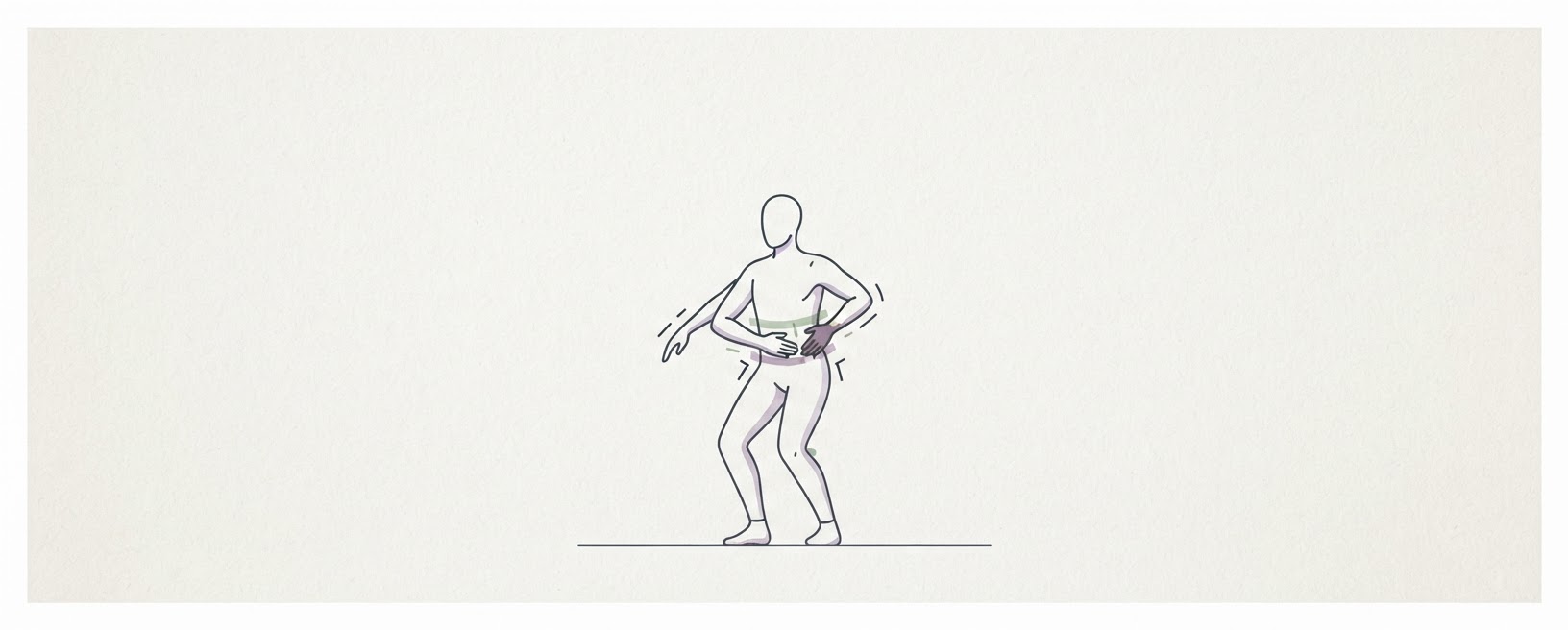
Loose rotational arm swings clear mental static and reset spinal proprioception.
qi gong · Lee Holden (Holden Qi Gong, lineage of Mantak Chia) · Midday mental static, persistent postural freezing, and shallow chest breathing caused by hours of seated screen lock. · 90 to 120 seconds of continuous rotation
I spent years trying to stretch my way out of desk-bound numbness before I realised my nervous system needed rhythm, not a static hold. Knocking on the Door of Life uses oscillatory transverse rotation to supply the brainstem with a surge of bilateral mechanoreceptive input from the facet joints of the spine. That rhythmic sensory feedback downregulates sympathetic tone while gently mobilising the thoracolumbar fascia. The soft, rhythmic contact of the hands across Ming Men (lumbar vertebra L2/L3) and the lower abdomen provides cutaneous tactile feedback that helps reset postural bracing patterns and encourages diaphragmatic descent. It cuts brain fog without caffeine. By circulating interstitial fluid through the paraspinal tissues, it frees up resting tissue shear in under two minutes.
Stand with your feet hip-width apart on a flat floor, barefoot or in flat shoes, and unlock both knees. Let your pelvis drop slightly toward the floor so your lower back softens out of an exaggerated arch.
Release your shoulders and let your arms dangle completely loose at your sides, like heavy pieces of wet rope. Keep your eyes open with a soft, level gaze on the horizon.
Begin turning your torso left and right, initiating every degree of the rotation from your hips and waist. Do not steer with your arms or lift from your shoulders.
Allow your limp arms to swing naturally across your body as your torso pivots, so the back of your trailing hand gently taps your lower back across your kidneys, while your front hand taps your lower abdomen.
Match the turn to a steady, unforced nasal rhythm: inhale over three turns, exhale smoothly over three turns. (If you hear your hands making loud slapping noises against your ribs, you are trying too hard; let the momentum do the swinging.)
After two minutes, stop driving the movement from your hips. Let your body bleed off the rotation gradually over ten seconds until you arrive at stillness, noticing the residual warmth humming through your palms and soles.