Daily movement
Elbow Controlled Articular Rotation (CAR)
Methodical, full-range articular rotation to enhance elbow joint health and neural control.
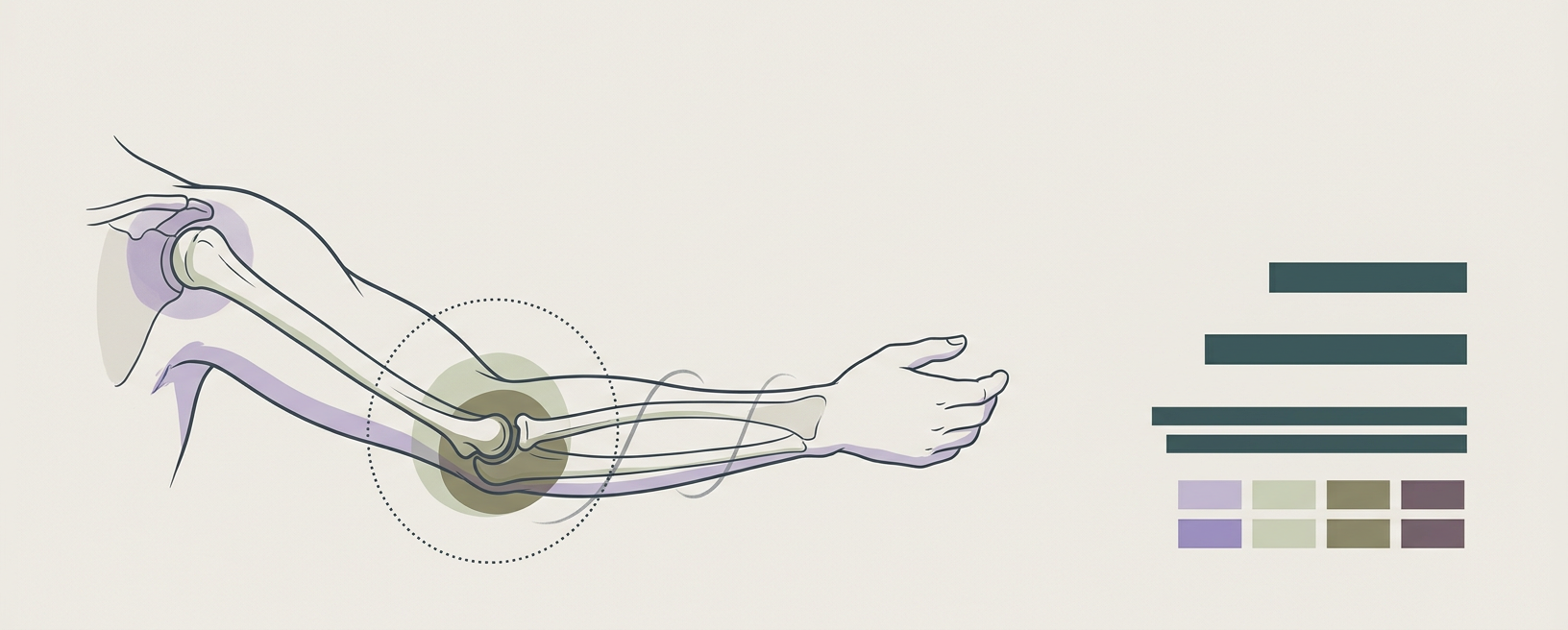
Methodical, full-range articular rotation to enhance elbow joint health and neural control.
Mobility / Joint CARs · Functional Range Conditioning (FRC®) system developed by Dr. Andreo Spina. · Individuals seeking to improve elbow joint integrity, mitigate stiffness, and optimize neurological input to the joint capsule. · Perform 2-3 repetitions per arm, 1-2 times daily, with each repetition lasting 15-30 seconds. Focus on continuous tension through the movement.
Why it works
Elbow CARs systematically articulate the joint through its maximum pain-free range of motion, providing afferent neurological feedback (proprioception) to the central nervous system. This signaling helps to optimize articular health by promoting synovial fluid distribution, cartilage nourishment, and tissue adaptation. The controlled, slow movement at end-ranges directly targets and progressively expands usable range of motion by improving the nervous system's tolerance for specific joint positions.
How to practice
Starting Position: Sit or stand with your arm extended straight forward at shoulder height, palm facing up. Ensure your shoulder is packed down and back, maintaining scapular stability. The elbow should be fully extended.
Flexion Phase: Slowly and with control, begin to bend your elbow, bringing your hand towards your shoulder. As you flex, actively attempt to rotate your forearm internally (pronation) then externally (supination), exploring the capsule at the end range.
Extension Phase: Once the elbow is fully flexed, begin to slowly extend it back to the starting position. Throughout the extension, continue to explore rotational ranges, paying attention to any specific sticky points or limitations.
Rotation Integration: Integrate pronation and supination throughout the entire range of motion, synchronizing it with the flexion and extension. Imagine you are drawing the largest possible circle with your forearm bone within your elbow joint capsule.
Starting Position: Sit or stand with your arm extended straight forward at shoulder height, palm facing up. Ensure your shoulder is packed down and back, maintaining scapular stability. The elbow should be fully extended.
Flexion Phase: Slowly and with control, begin to bend your elbow, bringing your hand towards your shoulder. As you flex, actively attempt to rotate your forearm internally (pronation) then externally (supination), exploring the capsule at the end range.
Extension Phase: Once the elbow is fully flexed, begin to slowly extend it back to the starting position. Throughout the extension, continue to explore rotational ranges, paying attention to any specific sticky points or limitations.
Rotation Integration: Integrate pronation and supination throughout the entire range of motion, synchronizing it with the flexion and extension. Imagine you are drawing the largest possible circle with your forearm bone within your elbow joint capsule.