Daily movement
Dynamic Tandem Walk
A linear gait pattern emphasizing single-file foot placement, challenging proprioception and balance.
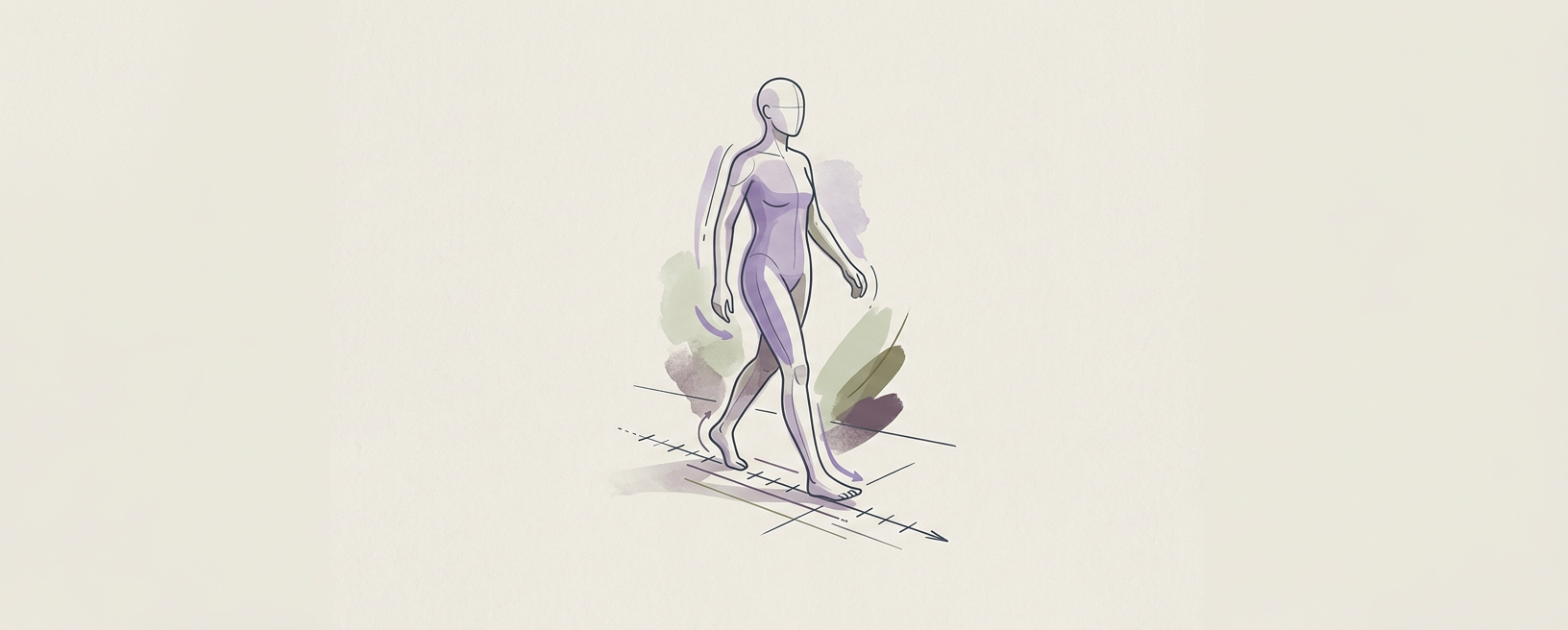
A linear gait pattern emphasizing single-file foot placement, challenging proprioception and balance.
Neuro-rehabilitation, fall prevention. · Rehabilitation sciences, adapted from neurological and geriatric physical therapy protocols. · To enhance proprioceptive awareness, refine gait stability, and improve balance reactions, particularly useful for individuals seeking to improve walking confidence or reduce fall risk. · Perform 3-5 repetitions of walking 5-10 meters, or for 30-60 seconds. Rest for 30-60 seconds between repetitions. Aim for 2-3 sets, 3-4 times per week.
Why it works
The tandem walk forces a narrow base of support, increasing the perturbation to the vestibular and somatosensory systems. This necessitates heightened engagement of core stabilizing musculature and refined coordination between the visual, vestibular, and proprioceptive inputs. The deliberate, controlled movement patterns stimulate mechanoreceptors in the joints and muscles, improving the brain's capacity to interpret and respond to changes in body position relative to gravity and the ground. This consistent neural challenge strengthens the pathways responsible for maintaining upright posture and dynamic balance.
How to practice
Starting Position: Stand with feet hip-width apart, looking straight ahead. Identify a straight line on the floor as your path.
Initiate Stance: Place the heel of one foot directly in front of the toes of the other foot, so they are touching or nearly touching along the line. Maintain an upright posture.
Step Forward: Slowly lift the back foot and place its heel directly in front of the toes of the lead foot. Aim for a continuous, controlled heel-to-toe pattern.
Maintain Gaze: Keep your gaze fixed on a point in front of you, approximately 2-3 meters away, to minimize visual input disruption.
Arm Position: Arms can be held out to the sides for balance, or crossed over the chest for an increased challenge.
Progression: Begin with eyes open. Once stable, progress to performing the walk with eyes closed, or on a softer, slightly unstable surface.
Starting Position: Stand with feet hip-width apart, looking straight ahead. Identify a straight line on the floor as your path.
Initiate Stance: Place the heel of one foot directly in front of the toes of the other foot, so they are touching or nearly touching along the line. Maintain an upright posture.
Step Forward: Slowly lift the back foot and place its heel directly in front of the toes of the lead foot. Aim for a continuous, controlled heel-to-toe pattern.
Maintain Gaze: Keep your gaze fixed on a point in front of you, approximately 2-3 meters away, to minimize visual input disruption.
Arm Position: Arms can be held out to the sides for balance, or crossed over the chest for an increased challenge.
Progression: Begin with eyes open. Once stable, progress to performing the walk with eyes closed, or on a softer, slightly unstable surface.