Daily movement
Constructive Rest (Semi-Supine) with Directional Thinking
A foundational Alexander Technique practice for releasing undue muscular tension and re-educating postural reflexes.
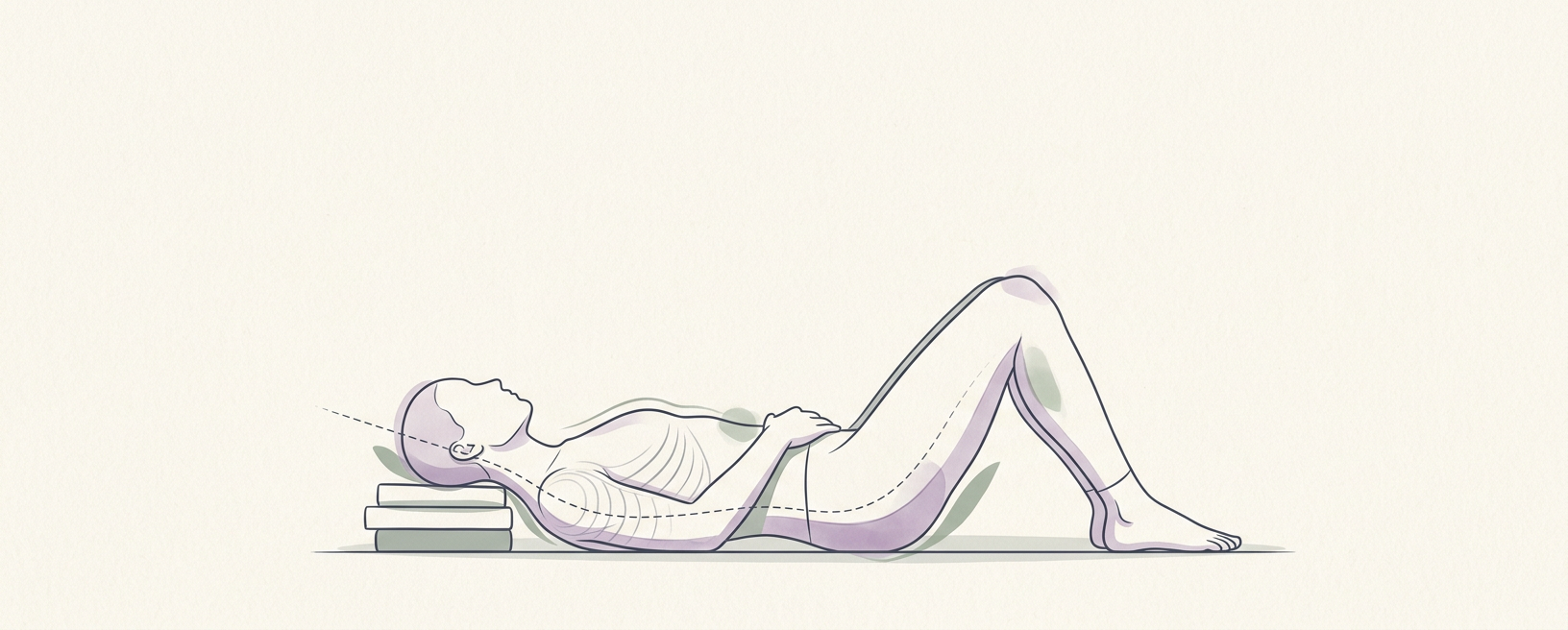
A foundational Alexander Technique practice for releasing undue muscular tension and re-educating postural reflexes.
Alexander Technique · Developed by F.M. Alexander as a primary means of inhibiting habitual patterns of tension and facilitating improved poise and coordination. · Excessive muscular tension, chronic stiffness, poor postural habits, mental overwhelm. · 10-20 minutes daily, or whenever a reset from muscular tension or mental strain is desired.
Why it works
By lying in a specific semi-supine position, the spine is supported, reducing the influence of gravity on habitual compression patterns. Directional thinking ("neck free, head forward and up, back lengthens and widens") inhibits old tension patterns and encourages a psycho-physical release. This re-establishes a more optimal relationship between the head, neck, and torso, which is central to the Alexander Technique. The conscious inhibition of ingrained responses ("end-gaining") allows the nervous system to re-pattern more efficient and integrated movement.
How to practice
Lie on your back on a firm but comfortable surface (e.g., a yoga mat on the floor).
Place several paperback books under your head so that your head is balanced and your nose is pointing towards the ceiling, without tucking or extending your chin. The height should allow your neck muscles to release.
Bend your knees, keeping your feet flat on the floor, about hip-width apart. Allow your knees to point towards the ceiling.
Place your arms comfortably by your sides, palms resting on your abdomen or the floor, elbows slightly bent.
Bring your awareness to your breath, allowing it to be soft and spacious without forcing.
Begin to think specific directions, without "doing" them:
- "My neck is free."
- "My head is forward and up."
- "My back is lengthening and widening."
- "My knees are releasing away from my hips."
Repeat these thoughts gently, allowing time for your nervous system to respond, rather than trying to force a physical change. Observe any changes in sensation without judgment.
Allow your eyes to be open and soft, or gently closed, whichever feels more restful. Keep your jaw soft and lips lightly touching, teeth slightly apart.
Lie on your back on a firm but comfortable surface (e.g., a yoga mat on the floor).
Place several paperback books under your head so that your head is balanced and your nose is pointing towards the ceiling, without tucking or extending your chin. The height should allow your neck muscles to release.
Bend your knees, keeping your feet flat on the floor, about hip-width apart. Allow your knees to point towards the ceiling.
Place your arms comfortably by your sides, palms resting on your abdomen or the floor, elbows slightly bent.
Bring your awareness to your breath, allowing it to be soft and spacious without forcing.
Begin to think specific directions, without "doing" them:
- "My neck is free."
- "My head is forward and up."
- "My back is lengthening and widening."
- "My knees are releasing away from my hips."
Repeat these thoughts gently, allowing time for your nervous system to respond, rather than trying to force a physical change. Observe any changes in sensation without judgment.
Allow your eyes to be open and soft, or gently closed, whichever feels more restful. Keep your jaw soft and lips lightly touching, teeth slightly apart.