Daily movement
Constructive Rest (Semi-Supine)
A foundational Alexander Technique practice for postural reorganization and nervous system regulation, promoting release of habitual tension.
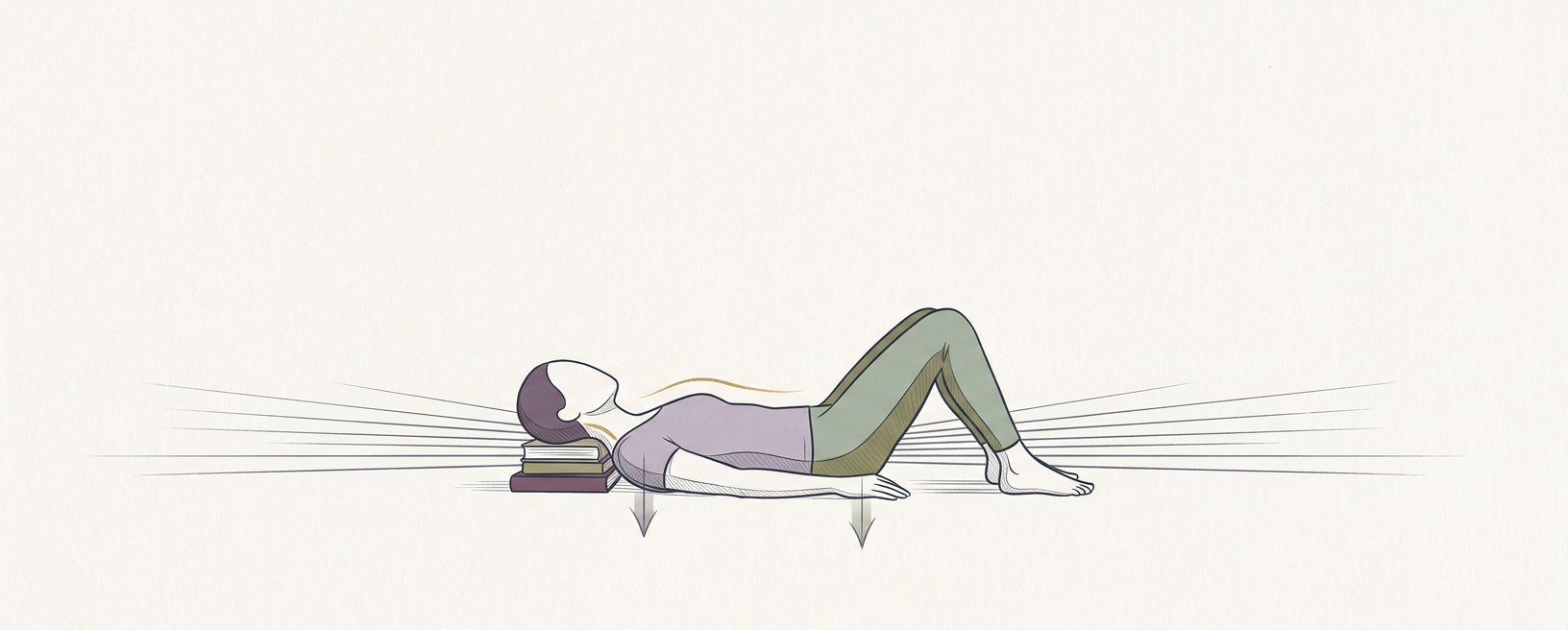
A foundational Alexander Technique practice for postural reorganization and nervous system regulation, promoting release of habitual tension.
Alexander Technique · Developed by F. Matthias Alexander (1869-1955) as a core component of his educational method for improving psychophysical functioning. · Chronic muscular tension, postural strain, mental overwhelm, difficulty initiating movement with ease. · 10-20 minutes, 1-3 times daily, especially before or after activities that induce tension, or as a regular reset.
Why it works
The semi-supine position minimizes gravitational strain on the spine, allowing the nervous system to release deep postural holding patterns. Conscious "directional" thoughts (
How to practice
Setup: Lie on your back on a firm, flat surface (e.g., floor, yoga mat). Bend your knees so your feet are flat on the floor, about hip-width apart. Ensure your heels are close enough to your buttocks to allow your lower back to release naturally without excessive arching or flattening. Place a small stack of books (1-3 inches thick) under your head to support the natural curve of your neck, allowing your chin to be level or slightly tucked. Your eyes can be open or closed, gaze soft.
Arm Placement: Rest your hands gently on your torso (e.g., abdomen or lower ribs) or place them by your sides, palms up, with elbows slightly bent. Ensure your shoulders are broad and heavy.
Observation (Initial Release): Take a few gentle breaths. Notice the points of contact between your body and the floor. Observe where you might be holding tension. Without actively trying to change anything, allow your body to simply be supported by the surface.
Directional Thinking (Inhibition and Direction): Begin to gently and repeatedly direct the following thoughts, without effort or "doing" anything physically:
- "Allow my neck to be free, so that my head can go forward and up." (This is not a physical movement, but a mental release and expansion.)
- "Allow my back to lengthen and widen."
- "Allow my knees to go forward and away from my hips."
- "Allow my breathing to be easy and quiet."
- "Allow my body to release into the support of the floor."
Breath Synchronization: Allow your breath to remain soft and natural. As you exhale, imagine the release of tension, particularly in your neck and jaw. As you inhale, imagine a gentle widening across your collarbones and a lengthening of your spine.
Sustained Practice: Maintain these gentle, non-forcing directional thoughts for the duration of the practice. If your mind wanders, gently bring it back to the directions. The goal is a quiet, internal process of release and expansion.
Exiting the Position: To come out, gently roll onto your side, pause for a moment, and then slowly push yourself up to a seated position, using your hands for support. Take your time to reorient before standing.
Setup: Lie on your back on a firm, flat surface (e.g., floor, yoga mat). Bend your knees so your feet are flat on the floor, about hip-width apart. Ensure your heels are close enough to your buttocks to allow your lower back to release naturally without excessive arching or flattening. Place a small stack of books (1-3 inches thick) under your head to support the natural curve of your neck, allowing your chin to be level or slightly tucked. Your eyes can be open or closed, gaze soft.
Arm Placement: Rest your hands gently on your torso (e.g., abdomen or lower ribs) or place them by your sides, palms up, with elbows slightly bent. Ensure your shoulders are broad and heavy.
Observation (Initial Release): Take a few gentle breaths. Notice the points of contact between your body and the floor. Observe where you might be holding tension. Without actively trying to change anything, allow your body to simply be supported by the surface.
Directional Thinking (Inhibition and Direction): Begin to gently and repeatedly direct the following thoughts, without effort or "doing" anything physically:
- "Allow my neck to be free, so that my head can go forward and up." (This is not a physical movement, but a mental release and expansion.)
- "Allow my back to lengthen and widen."
- "Allow my knees to go forward and away from my hips."
- "Allow my breathing to be easy and quiet."
- "Allow my body to release into the support of the floor."
Breath Synchronization: Allow your breath to remain soft and natural. As you exhale, imagine the release of tension, particularly in your neck and jaw. As you inhale, imagine a gentle widening across your collarbones and a lengthening of your spine.
Sustained Practice: Maintain these gentle, non-forcing directional thoughts for the duration of the practice. If your mind wanders, gently bring it back to the directions. The goal is a quiet, internal process of release and expansion.
Exiting the Position: To come out, gently roll onto your side, pause for a moment, and then slowly push yourself up to a seated position, using your hands for support. Take your time to reorient before standing.