Daily movement
Calf Jump with Controlled Landing
A foundational low-impact plyometric exercise designed to enhance Achilles tendon stiffness and explosive power, focusing on precise force absorption.
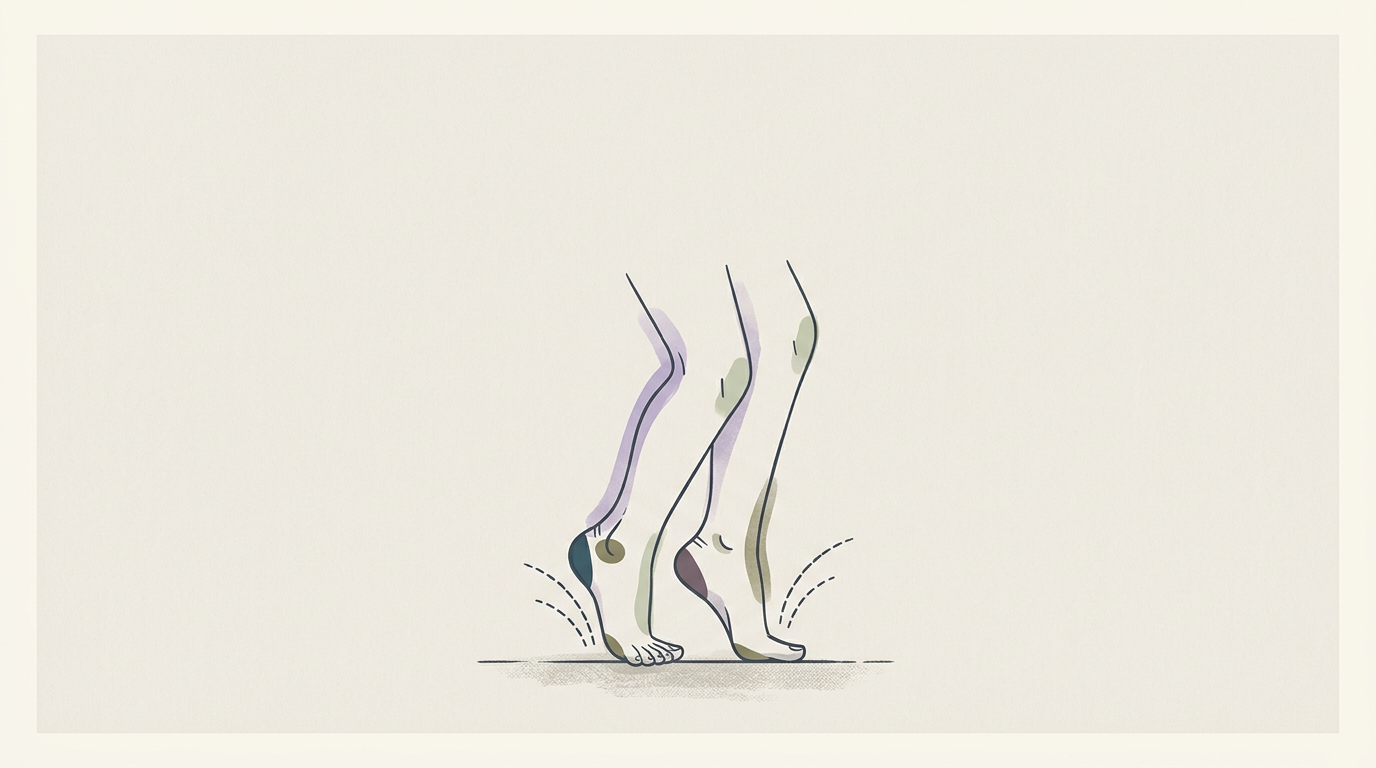
A foundational low-impact plyometric exercise designed to enhance Achilles tendon stiffness and explosive power, focusing on precise force absorption.
Athletic Performance Training; specifically, principles from Vertimax and other plyometric training methodologies. · Developed within sports performance and rehabilitation contexts to progressively load the lower limb kinetic chain. · Individuals seeking to improve lower limb power, Achilles tendon resilience, and efficient landing mechanics, particularly in preparation for higher impact activities or to address mild reductions in elastic energy return. · Perform 3-5 sets of 8-12 repetitions. Focus on perfect form and controlled landings. Rest for 60-90 seconds between sets. Implement 2-3 times per week on non-consecutive days.
Why it works
This movement trains the stretch-shortening cycle (SSC) of the calf muscles and Achilles tendon. The rapid eccentric loading followed by an immediate concentric contraction, when performed with control, increases tendon stiffness over time. Stiffer tendons store and release elastic energy more efficiently, improving power output and reducing metabolic cost. The controlled landing emphasizes eccentric strength and proprioceptive feedback, which are crucial for injury prevention and efficient athletic movement.
How to practice
Starting Position: Stand tall with feet hip-width apart, knees slightly bent, and arms relaxed at your sides. Maintain a neutral spine and gaze straight ahead.
Initiate Jump: Drive through the balls of your feet, extending ankles, knees, and hips simultaneously to jump vertically a few inches off the ground. Keep shins relatively vertical.
Mid-Air: Maintain a slight flexion in knees and hips. The jump should be minimal, prioritizing quickness over height.
Controlled Landing: Absorb the landing softly, primarily through the balls of the feet, allowing the heels to briefly kiss or lightly touch the ground. Immediately allow a slight bend in the ankles, knees, and hips to absorb impact, aiming for a "springy" landing rather than a "thudding" one.
Reset: Quickly, but without rushing, return to the starting position for the next repetition. Ensure complete stability before initiating the subsequent jump.
Starting Position: Stand tall with feet hip-width apart, knees slightly bent, and arms relaxed at your sides. Maintain a neutral spine and gaze straight ahead.
Initiate Jump: Drive through the balls of your feet, extending ankles, knees, and hips simultaneously to jump vertically a few inches off the ground. Keep shins relatively vertical.
Mid-Air: Maintain a slight flexion in knees and hips. The jump should be minimal, prioritizing quickness over height.
Controlled Landing: Absorb the landing softly, primarily through the balls of the feet, allowing the heels to briefly kiss or lightly touch the ground. Immediately allow a slight bend in the ankles, knees, and hips to absorb impact, aiming for a "springy" landing rather than a "thudding" one.
Reset: Quickly, but without rushing, return to the starting position for the next repetition. Ensure complete stability before initiating the subsequent jump.