All movements
Loading…
Previous movements
Previous movements open for members. Today's movement is always free.
Daily movement
A foundational plyometric movement enhancing lower body power and Achilles tendon stiffness through elastic energy storage and release.
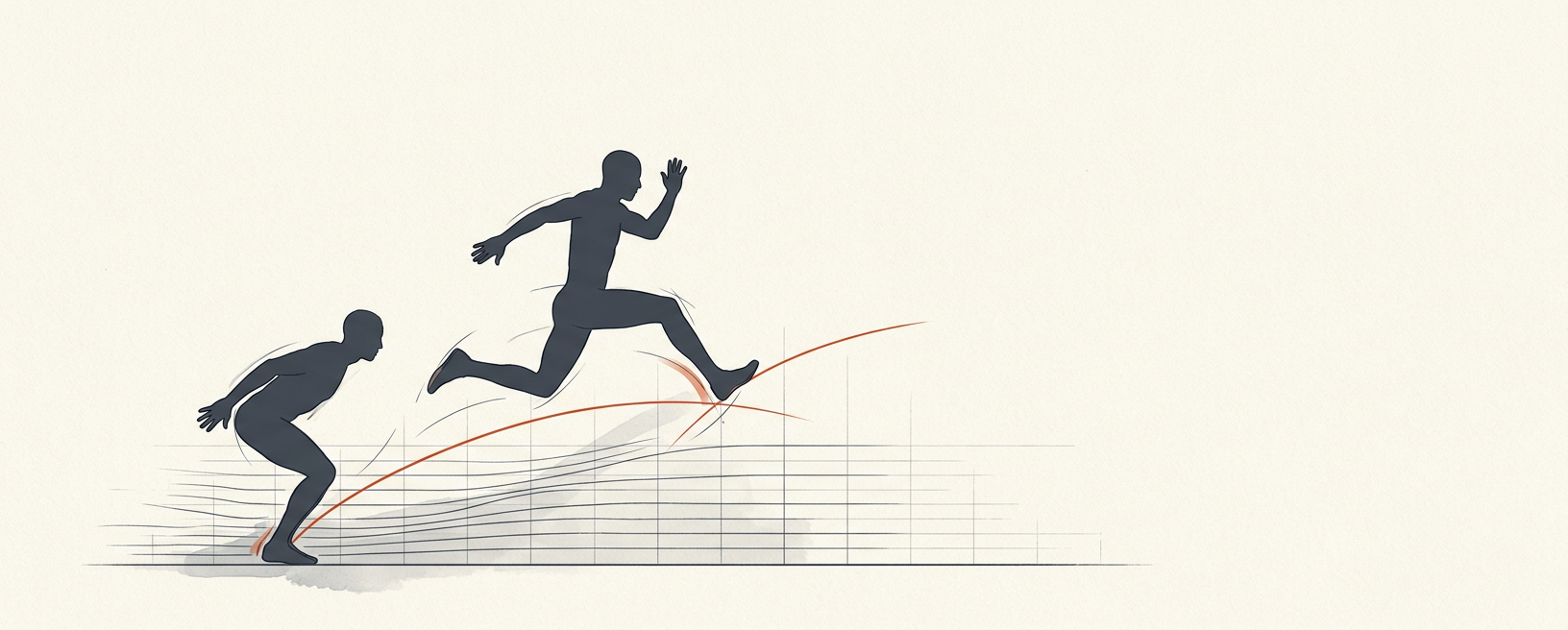
A foundational plyometric movement enhancing lower body power and Achilles tendon stiffness through elastic energy storage and release.
Plyometrics (originally Plyometric Training) · Track and Field training, developed to improve explosive power for jumping and sprinting. · To develop explosive lower body power, improve reactive strength, and increase Achilles tendon stiffness for enhanced athletic performance and injury resilience. · 2-4 sets of 3-5 repetitions. Allow 90-180 seconds of complete rest between sets to ensure maximal effort and recovery for each jump. Begin with conservative distances and focus on landing mechanics.
The broad jump utilizes the stretch-shortening cycle (SSC) to amplify muscle force production. During the eccentric (loading) phase, the leg muscles and Achilles tendon are rapidly stretched, storing elastic energy. This stored energy is then efficiently released during the concentric (propulsive) phase, resulting in a more powerful jump. This repetitive loading and unloading helps to stiffen the Achilles tendon, making it more efficient at transmitting force and reducing energy wasted as heat, ultimately improving power output and shock absorption.
Stand with feet hip-width apart, toes pointing forward. Maintain a tall stance with a neutral spine, and arms relaxed at your sides.
Initiate the movement by hinging at the hips and bending the knees simultaneously, as if preparing to sit in a chair. Swing your arms backward. Ensure your chest remains lifted and your gaze is forward. Control this eccentric loading phase.
Explosively extend your hips, knees, and ankles (triple extension) while swinging your arms forward and upward. Drive off the balls of your feet, propelling your body horizontally as far as possible.
Land softly with both feet simultaneously, absorbing the impact by bending at the knees and hips, similar to the wind-up position. Allow your arms to swing backward for balance. Control the landing to prevent excessive forward momentum or falling backward. Maintain a stable, upright posture upon landing.