Daily movement
Bodyweight Squat to Build Foundational Strength
A foundational movement pattern for lower body strength, balance, and nervous system resilience.
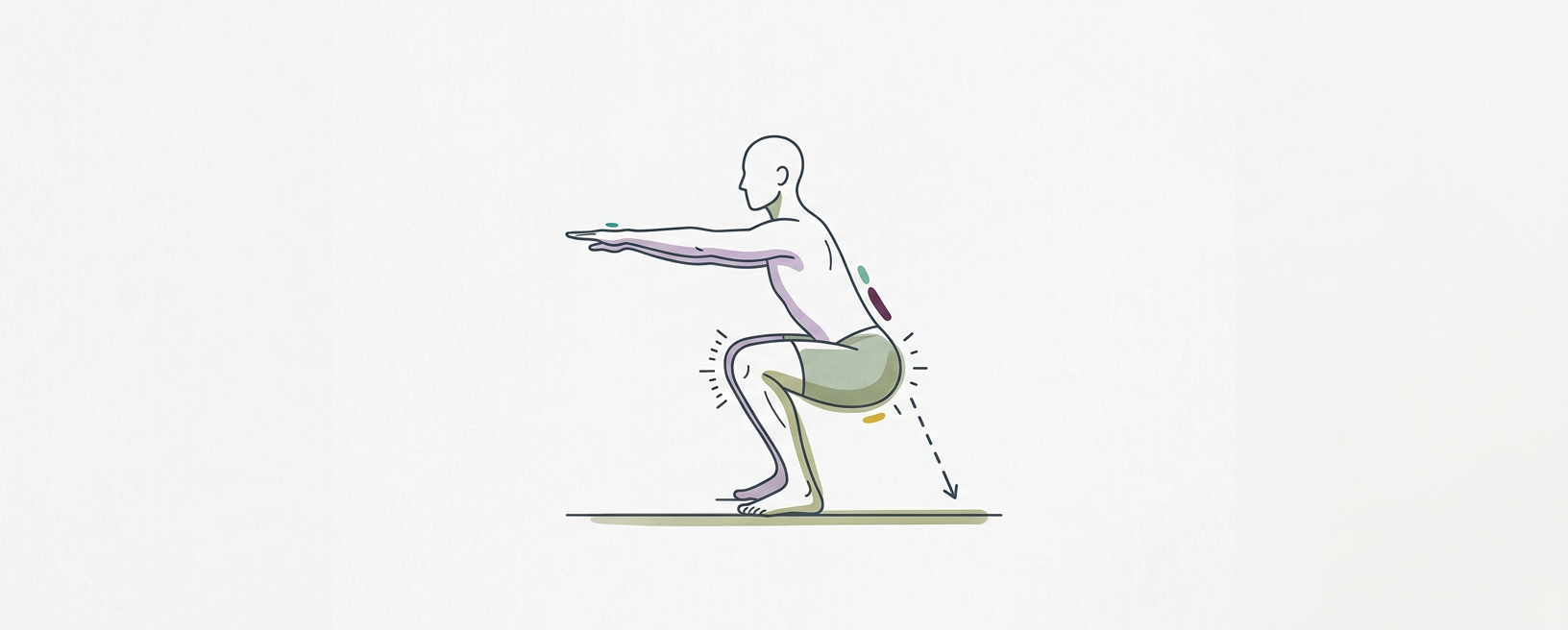
A foundational movement pattern for lower body strength, balance, and nervous system resilience.
functional strength · StrongFirst (Pavel Tsatsouline) · This meets the feeling of being physically weak or unstable, supporting a baseline capacity for daily tasks and managing stress load. · 3 sets of 5 repetitions with 60 seconds rest between sets.
Why it works
The bodyweight squat, when executed with conscious breath and bracing, powerfully engages the nervous system by requiring full-body coordination and stability. It recruits large muscle groups—quadriceps, hamstrings, glutes, and core—signaling to the brain a state of controlled exertion rather than fight-or-flight. The bracing, or 'irradiation,' during the descent and ascent increases intra-abdominal pressure, which acts as an internal hydraulic support for the spine. This mechanism not only protects the spinal column but also contributes to vagal nerve stimulation through pressure changes, promoting a more regulated nervous system state. This also mobilises the hips, knees, and ankles, improving tissue elasticity and proprioception.
How to practice
Stance: Stand with your feet roughly shoulder-width apart, toes pointing slightly out. Keep your gaze neutral, looking straight ahead or slightly down.
Brace: Take a deep breath into your belly, feeling your diaphragm expand. Brace your core as if preparing for a punch—this creates intra-abdominal pressure.
Initiate: Begin by pushing your hips back as if sitting into a chair. Simultaneously, bend at your knees, keeping your chest lifted and back straight. Maintain your core brace.
Descent: Descend until your hip crease is below your knees, or as far as your mobility allows without losing form. Keep your knees tracking over your toes. Maintain tension through your braced core.
Ascent: Drive through your heels and the midfoot to return to the starting position. Exhale forcefully as you stand, maintaining tension, like you're pushing the floor away. Avoid relaxing completely at the top; stay "stacked."
Repeat: Control each repetition, focusing on the breath and the feeling of stability.
Stance: Stand with your feet roughly shoulder-width apart, toes pointing slightly out. Keep your gaze neutral, looking straight ahead or slightly down.
Brace: Take a deep breath into your belly, feeling your diaphragm expand. Brace your core as if preparing for a punch—this creates intra-abdominal pressure.
Initiate: Begin by pushing your hips back as if sitting into a chair. Simultaneously, bend at your knees, keeping your chest lifted and back straight. Maintain your core brace.
Descent: Descend until your hip crease is below your knees, or as far as your mobility allows without losing form. Keep your knees tracking over your toes. Maintain tension through your braced core.
Ascent: Drive through your heels and the midfoot to return to the starting position. Exhale forcefully as you stand, maintaining tension, like you're pushing the floor away. Avoid relaxing completely at the top; stay "stacked."
Repeat: Control each repetition, focusing on the breath and the feeling of stability.