Daily movement
Anterior Shin Release for Dorsiflexion Improvement
Unlock ankle mobility through targeted release of the anterior shin muscles, crucial for efficient gait and squat mechanics.
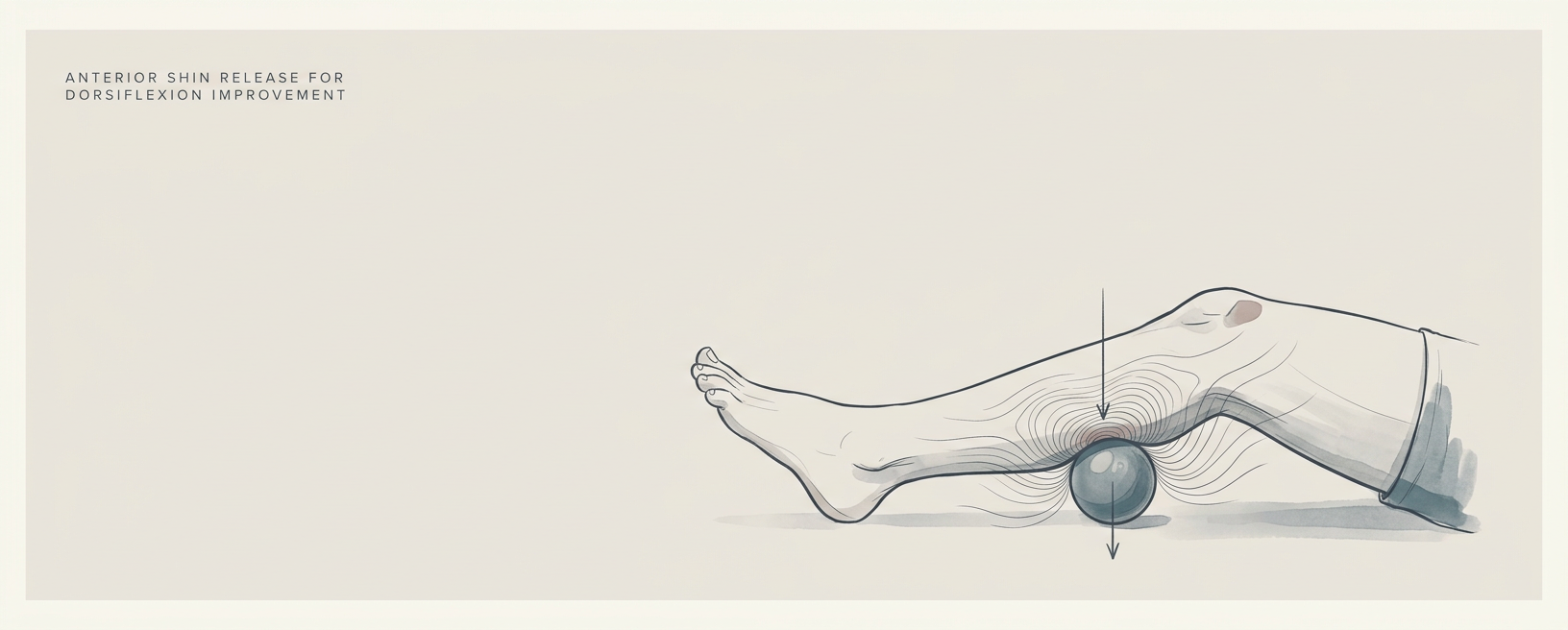
Unlock ankle mobility through targeted release of the anterior shin muscles, crucial for efficient gait and squat mechanics.
Myofascial Release / Fascial Fitness · This approach aligns with principles outlined by Tom Myers in "Anatomy Trains" regarding myofascial continuities, particularly the superficial front line, and Robert Schleip's research on fascial elasticity and mechanoreception. The specific application to the tibialis anterior and associated shin musculature addresses common restrictions impacting ankle dorsiflexion. · Restricted ankle dorsiflexion, shin splints, anterior compartment tension, compromised squat depth, inefficient gait cycle. · Perform 2-3 times per week, or as needed. Spend 1-3 minutes per leg, per session. Focus on areas of palpable tension or tenderness, holding sustained pressure for 30-90 seconds at each point until a release is felt or discomfort diminishes.
Why it works
The anterior shin muscles, primarily the tibialis anterior, often become hypertonic and adhered due to repetitive impacts, footwear, or compensatory patterns. Applying sustained compression and shear forces with a therapy ball addresses fascial restrictions, reduces localized intramuscular tension, and increases tissue compliance. This mechanical intervention directly influences mechanoreceptors within the fascia, potentially modulating muscle tone via the nervous system (Schleip et al.). Improved tissue hydration and blood flow to the area further enhance fascial glide and extensibility, leading to increased range of motion at the talocrural joint and reduced discomfort.
How to practice
Setup: Sit on the floor with legs extended. Place a therapy ball (approx. 2.5-3 inches in diameter, e.g., lacrosse ball or firm rubber ball) on the floor beside one shin.
Positioning: Gently lift the leg and place the anterior aspect of the shin onto the therapy ball. Begin just below the knee joint, on the tibialis anterior muscle belly. The other leg can be bent for support or extended.
Application: Apply direct, sustained pressure to the muscle. This may be intense. Allow the tissue to yield. If discomfort is too high, shift weight off the ball slightly.
Explore: Slowly roll the ball down the shin towards the ankle, pausing at tender or restricted areas. Explore the entire anterior compartment, including the lateral aspects of the tibialis anterior and the extensors of the toes.
Cross-Fiber (Optional): At a particularly restricted point, you may gently move the foot up and down (dorsiflexion/plantarflexion) or side to side (inversion/eversion) to create a cross-fiber shearing effect over the ball.
Breath Integration: Maintain slow, deep diaphragmatic breathing throughout the process. On exhalation, encourage the tissue to soften and release into the pressure.
Setup: Sit on the floor with legs extended. Place a therapy ball (approx. 2.5-3 inches in diameter, e.g., lacrosse ball or firm rubber ball) on the floor beside one shin.
Positioning: Gently lift the leg and place the anterior aspect of the shin onto the therapy ball. Begin just below the knee joint, on the tibialis anterior muscle belly. The other leg can be bent for support or extended.
Application: Apply direct, sustained pressure to the muscle. This may be intense. Allow the tissue to yield. If discomfort is too high, shift weight off the ball slightly.
Explore: Slowly roll the ball down the shin towards the ankle, pausing at tender or restricted areas. Explore the entire anterior compartment, including the lateral aspects of the tibialis anterior and the extensors of the toes.
Cross-Fiber (Optional): At a particularly restricted point, you may gently move the foot up and down (dorsiflexion/plantarflexion) or side to side (inversion/eversion) to create a cross-fiber shearing effect over the ball.
Breath Integration: Maintain slow, deep diaphragmatic breathing throughout the process. On exhalation, encourage the tissue to soften and release into the pressure.