Daily movement
Pelvic Clock for Spinal Freedom
Explore subtle shifts in pelvic movement to clarify spinal articulation and reduce lower back static.
Explore subtle shifts in pelvic movement to clarify spinal articulation and reduce lower back static.
Feldenkrais · Feldenkrais Awareness Through Movement (Moshé Feldenkrais) · This meets a state of stiffness or dullness in the lower back and pelvis, often presenting as restricted movement or mild discomfort without acute pain. · 3-5 minutes per direction (12-6, 3-9, full circle) with rests
Why it works
The Pelvic Clock, a core Feldenkrais Awareness Through Movement lesson, gently mobilizes the sacrum and lumbar spine. Neurologically, it leverages sensory-motor learning by directing conscious attention to small, slow movements. This refines proprioception, teaching the brain new, more efficient patterns for pelvic tilt and rotation, reducing unnecessary muscle guarding. It activates the parasympathetic nervous system through its slow, non-striving nature, lowering baseline muscle tension. Mechanically, the subtle rocking movements articulate the sacroiliac joints and lumbar vertebrae, encouraging fluid movement in the fascia and intrinsic muscles surrounding these areas. This helps release fascial restrictions, improve synovial fluid distribution in the small spinal joints, and foster a sense of integrated movement between the pelvis and rib cage.
How to practice
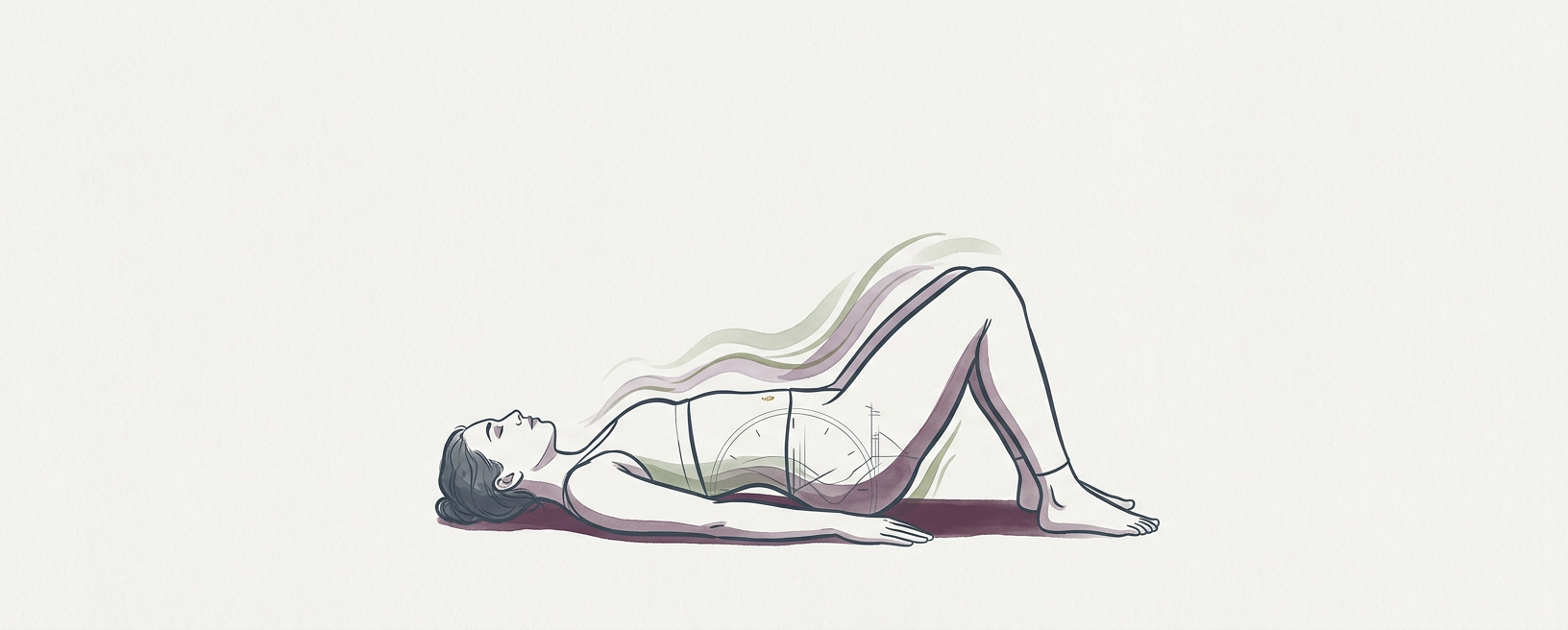
Lie on your back on a firm but comfortable surface. Your knees are bent, feet flat on the floor, about hip-width apart. Let your arms rest comfortably by your sides, palms up or down. Close your eyes or soften your gaze.
Imagine a clock face painted flat on your belly, with your navel at the center. Twelve o'clock is towards your head, six o'clock towards your feet. Three o'clock is your right hip bone, nine o'clock your left.
Gently, slowly, without force, roll your pelvis so that the weight shifts towards twelve o'clock. This will likely flatten your lower back slightly against the floor. As you do this, exhale softly. Notice how your spine responds.
Return to center. Now, shift your weight towards six o'clock. This will create a small arch in your lower back. Inhale gently here. Observe how the pressure under your sacrum changes. Move only as far as feels easy and pleasant.
Continue slowly, exploring the movement between twelve and six o'clock, like a pendulum. Repeat this rocking 5-7 times, noticing the process of movement, not just the end points. Then rest.
After a rest, explore moving from the center towards three o'clock (right hip) and then nine o'clock (left hip). Allow the movement to be small and curious, sensing how your waist and ribs shift. Breathe easily.
Finally, combine these movements, drawing small circles with your pelvis around the clock face, first clockwise, then counter-clockwise. Let the movement be effortless, like stirring a pot with your tailbone.
Lie on your back on a firm but comfortable surface. Your knees are bent, feet flat on the floor, about hip-width apart. Let your arms rest comfortably by your sides, palms up or down. Close your eyes or soften your gaze.
Imagine a clock face painted flat on your belly, with your navel at the center. Twelve o'clock is towards your head, six o'clock towards your feet. Three o'clock is your right hip bone, nine o'clock your left.
Gently, slowly, without force, roll your pelvis so that the weight shifts towards twelve o'clock. This will likely flatten your lower back slightly against the floor. As you do this, exhale softly. Notice how your spine responds.
Return to center. Now, shift your weight towards six o'clock. This will create a small arch in your lower back. Inhale gently here. Observe how the pressure under your sacrum changes. Move only as far as feels easy and pleasant.
Continue slowly, exploring the movement between twelve and six o'clock, like a pendulum. Repeat this rocking 5-7 times, noticing the process of movement, not just the end points. Then rest.
After a rest, explore moving from the center towards three o'clock (right hip) and then nine o'clock (left hip). Allow the movement to be small and curious, sensing how your waist and ribs shift. Breathe easily.
Finally, combine these movements, drawing small circles with your pelvis around the clock face, first clockwise, then counter-clockwise. Let the movement be effortless, like stirring a pot with your tailbone.