Finance Executive · Singapore
How Autonomic Recovery Restored Sleep in Singapore
A Singapore finance executive used autonomic recovery pacing to shift sleep quality from 4.2 to 8.8 while lifting daily activity tolerance by 65 percent.
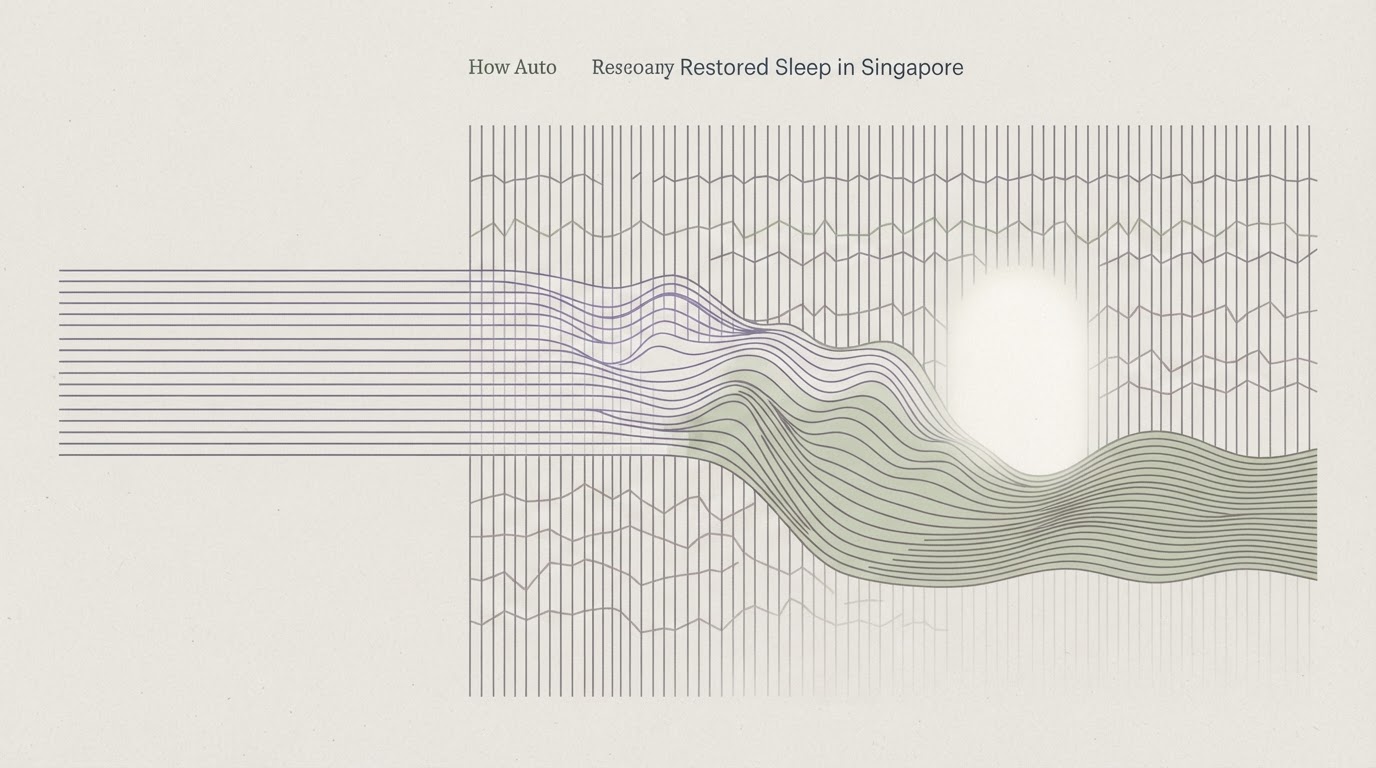
Autonomic recovery after long-COVID: from broken sleep to baseline
A 46-year-old finance director in Singapore moved his sleep quality score from 4.2 to 8.8 over twelve weeks by using structured pacing to rebuild autonomic recovery. The protocol lifted his daily activity tolerance by 65 percent without triggering post-exertional crashes. Colleagues in Raffles Place blamed twelve-hour trading desk shifts and tropical humidity for his physical crash, yet his issues began after a mild SARS-CoV-2 infection six months prior.
The presenting state
Corporate wellness programmes treat prolonged fatigue like laziness in disguise. This client spent months attempting to sweat out his exhaustion with 6:00 a.m. rowing intervals, only to end up stranded on his sofa for the entire weekend. His sympathetic branch—the fight-or-flight division of the nervous system—remained locked on high alert, meaning his body reacted as though he were sprinting even while seated in quiet boardrooms. That ongoing activation kept his allostatic load, the cumulative physiological wear of prolonged demand, at breaking point.
As Davis et al., 2023 documented in their review of long-COVID pathology, post-viral dysautonomia routinely disrupts orthostatic control and sleep architecture without showing up on standard blood panels. By the time he contacted me, his resting heart rate sat at 78 beats per minute, his nocturnal root mean square of successive differences (rMSSD) hovered at 18 milliseconds, and he woke up drenched in sweat at 3:15 a.m. every night. He felt tired but wired. I admitted to him early on that I had misjudged similar post-viral timelines in the past by allowing clients to increase their physical loads too early.
The autonomic recovery protocol
We did not touch traditional cardiovascular training. When the autonomic nervous system is destabilised, pushing through physical fatigue only compounds the static in the system. Our single focus was restoring parasympathetic regulation so his heart rate variability (HRV)—the millisecond differences between successive heartbeats that signal systemic flexibility—could rebound overnight. As Thayer et al., 2012 showed, neurovisceral integration requires sufficient vagal tone to quiet subcortical threat responses, especially during rest.
- Capped exertion at an absolute ceiling of 105 beats per minute across all daily tasks to keep him well clear of post-exertional symptom flare-ups.
- Moved midday analytical work from a standing desk to a reclined posture to reduce orthostatic strain on the gut-vagal axis.
- Introduced ten minutes of resonance breathing at 0.1 Hertz twice daily to support baseline HRV stability.
- Delayed his morning espresso until ninety minutes after waking to allow natural adenosine clearance to occur without interference.
- Cooled his bedroom to a constant 19 degrees Celsius and instituted a strict screen cut-off at 9:30 p.m.
What changed
Over twelve weeks, his daily activity tolerance expanded by 65 percent, measured by functional hours completed without next-day fatigue. His subjective sleep quality rose from 4.2 to 8.8 out of 10, and his night awakenings dropped from four times per night to zero. He stopped having the mid-afternoon cognitive stalls that previously left him staring blankly at earnings reports.
The metric that caught my eye appeared inside his nocturnal data. Most trackers display a single overnight HRV average, which hides intermittent distress. In week one, his low-frequency power spiked sharply forty minutes into sleep, signaling an abrupt sympathetic surge that fractured his slow-wave cycles. By week eight, that early-night spike flattened out, allowing uninterrupted delta sleep to return.
Pacing is not surrender; it is simply learning how to stop arguing with your own physiology.
TL;DR
A 46-year-old finance executive in Singapore resolved severe post-viral insomnia and exercise intolerance through a structured autonomic recovery protocol. By capping exertion below his symptom threshold, stabilising baseline vagal tone, and managing orthostatic strain, he raised his sleep quality score from 4.2 to 8.8 and increased his daily activity tolerance by 65 percent over twelve weeks without suffering post-exertional crashes.
Where to take this next
If you find yourself stuck in a post-viral plateau, stop trying to force your way back to performance through sheer effort. Nervous systems under persistent strain do not respond to grit; they respond to biological safety and careful boundary control.
You can begin on your own with our free 7-Day Reset at /reset. When you want a targeted plan for autonomic pacing, explore the relevant Anchor at /anchors. If you need personalised support to rebuild your capacity, apply for 1:1 coaching at /coaching.
Sources
- Davis et al., 2023 — Nature Reviews Microbiology https://pubmed.ncbi.nlm.nih.gov/36639608/
- Thayer et al., 2012 — Neuroscience & Biobehavioral Reviews https://pubmed.ncbi.nlm.nih.gov/22305965/