All movements
Loading…
Previous movements
Previous movements open for members. Today's movement is always free.
Daily movement
Rhythmic torso rotation with passive arm tapping to drain postural bracing and clear sympathetic static.
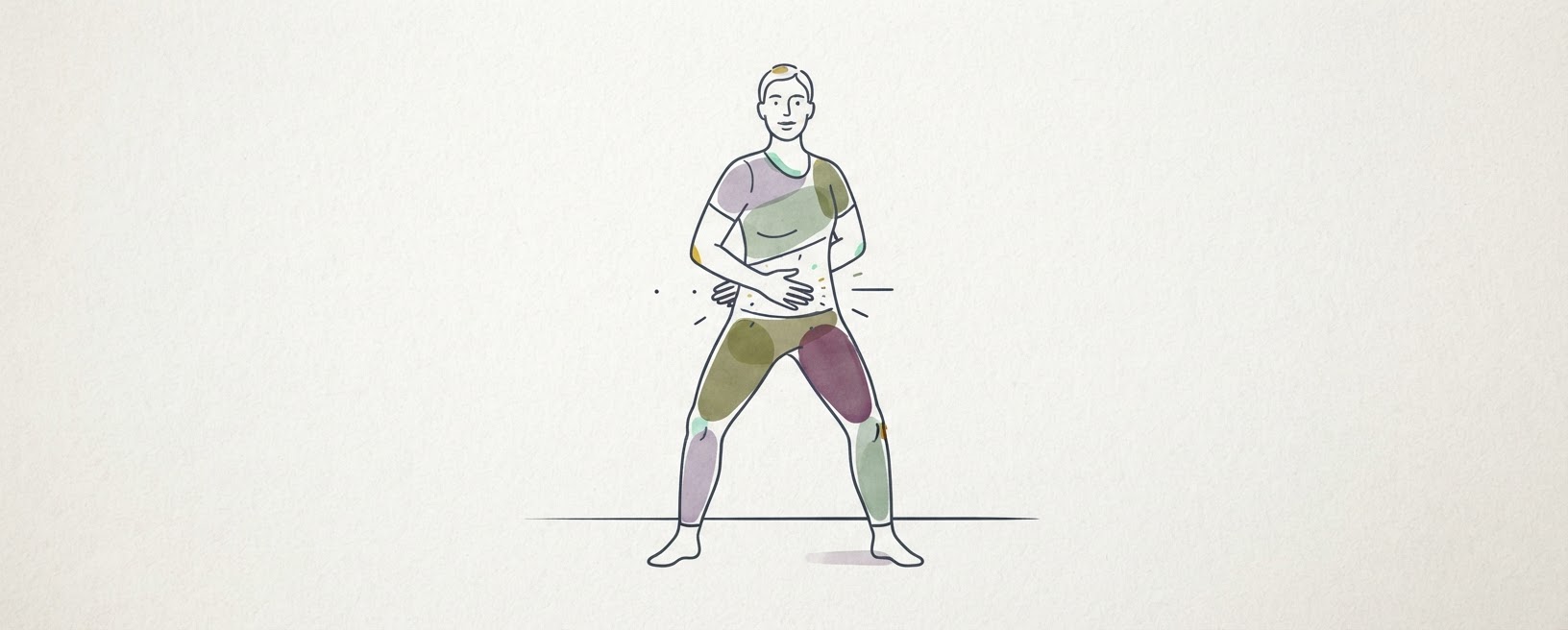
Rhythmic torso rotation with passive arm tapping to drain postural bracing and clear sympathetic static.
qi gong · Medical Qi Gong (Lee Holden) · Tired but wired mental fog with stubborn spinal rigidity after three uninterrupted hours at a desk. · 3 minutes continuous, roughly 60 full torso oscillations
I spent years trying to stretch my way out of afternoon desk stiffness, which usually just aggravated my hip flexors. Lee Holden taught this movement as Knocking on the Door of Life, and the physiology behind it is clean. The loose, rhythmic rotation introduces low-velocity axial shear through the thoracolumbar fascia and paraspinal muscles, shearing the interstitial planes and redistributing fluid through dehydrated posterior back tissue. Simultaneously, the passive mechanical tapping against the lower belly and the lumbar spine stimulates cutaneous and proprioceptive mechanoreceptors over the T12 to L2 dermatomes. This repetitive, low-threat tactile feedback downregulates high baseline motor tone. The vestibular system recalibrates through the slow horizontal head drift, nudging heart rate variability upward and taking the edge off persistent sympathetic vigilance without making you drowsy.
Stand with your feet slightly wider than hip-width, toes pointing forward or angled slightly outward. Keep your knees unlocked with an easy micro-bend so your pelvis can rotate without torque on your joints.
Rest your gaze softly on the horizon at eye level. Begin rotating your torso from your hips and waist, allowing your shoulders and ribcage to follow naturally.
Let your arms hang loose and heavy. As your torso turns left, let your right hand swing across to slap gently against your lower abdomen (the lower dantian, about two inches below your navel), while the back of your left hand taps the small of your back against your sacrum.
Reverse the momentum smoothly to the right side, so your left hand taps your lower belly and your right hand taps your lower back. Your arms do not do the swinging; your waist initiates every turn.
Match the turn to an unforced breath. Inhale through your nose for two complete rotations (left and right), then exhale through softly parted lips for two rotations, making a quiet sighing sound if your jaw holds tension.
Let your back heel peel off the floor naturally as you turn away from it, transferring roughly 70 percent of your weight to the front foot to protect your knees.
After three minutes, gradually slow the rotation across 15 seconds rather than stopping abruptly. Stand still with your eyes half-closed and feel the tingling in your palms.