Daily movement
Stair Sprint for Metabolic Boost and Cognitive Clarity
Integrate short, intense bursts of physical activity throughout your day to enhance metabolic health and sharpen focus.
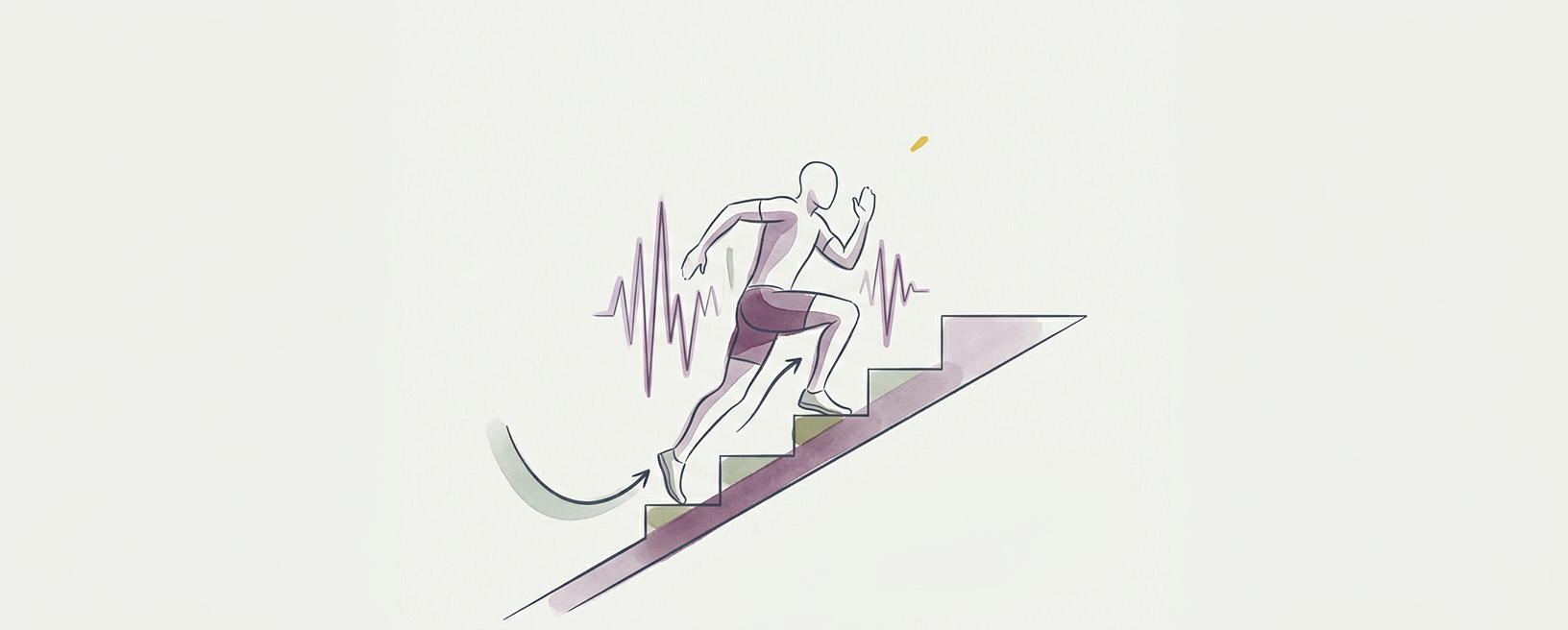
Integrate short, intense bursts of physical activity throughout your day to enhance metabolic health and sharpen focus.
VILPA / cardio burst · VILPA (Vigorous Intermittent Lifestyle Physical Activity) research by Emmanuel Stamatakis · This meets the state of feeling sluggish, mentally foggy, or metabolically stagnant, providing a rapid physiological reset. · 1-2 bursts per day, followed by full recovery.
Why it works
A stair sprint, or any VILPA, functions by triggering a rapid increase in heart rate and oxygen consumption, engaging the anaerobic energy system. This acute physiological stress, followed by recovery, improves cardiorespiratory fitness and glucose metabolism over time, a mechanism explored by researchers like Emmanuel Stamatakis. On a nervous system level, these short, intense bursts create a controlled fight-or-flight response, upregulating sympathetic activity. The subsequent recovery phase, with deep breathing, signals safety, enhancing vagal tone and parasympathetic regulation. Tissue-wise, the impact loading and muscular exertion stimulate bone density, tendon resilience, and muscle fiber recruitment, particularly fast-twitch fibers, without the prolonged wear of continuous, moderate-intensity exercise. It's a quick, potent dose of beneficial stress.
How to practice
Finding Your VILPA
Find a set of stairs, a steep incline, or a clear path for a brisk carry—something that allows for a safe, maximal effort for a short duration. I often use the three flights in my building’s stairwell; it’s convenient.
- Preparation: Stand at the base, feet hip-width apart. Take a few deep, diaphragmatic breaths, exhaling fully to clear residual air. Scan your body for any pre-existing tension. Your gaze should be slightly upward, maintaining a neutral neck.
- The Burst: On an inhale, initiate a rapid ascent or sprint. Drive with your legs, pumping your arms. Aim for a perceived exertion of 8-9 out of 10, where you can speak only 1–2 words. The goal isn’t speed, but intensity. Go hard, but stay in control.
- Duration: Continue this maximal effort for 30–60 seconds. You’ll feel a sharp rise in heart rate and breathing rate. Don't push into pain, but embrace the uncomfortable effort. This isn't for comfort.
- Active Recovery: Immediately transition to gentle walking or standing still. Place one hand on your heart, one on your belly. Begin deep nasal inhales and long, slow oral exhales. Let your breath deepen and slow, signalling safety.
- Full Recovery: Continue walking and breathing until your heart rate noticeably decreases and you can comfortably hold a conversation. This typically takes 2–3 minutes. Don’t rush this phase; it’s as crucial as the burst itself.
Finding Your VILPA
Find a set of stairs, a steep incline, or a clear path for a brisk carry—something that allows for a safe, maximal effort for a short duration. I often use the three flights in my building’s stairwell; it’s convenient.
- Preparation: Stand at the base, feet hip-width apart. Take a few deep, diaphragmatic breaths, exhaling fully to clear residual air. Scan your body for any pre-existing tension. Your gaze should be slightly upward, maintaining a neutral neck.
- The Burst: On an inhale, initiate a rapid ascent or sprint. Drive with your legs, pumping your arms. Aim for a perceived exertion of 8-9 out of 10, where you can speak only 1–2 words. The goal isn’t speed, but intensity. Go hard, but stay in control.
- Duration: Continue this maximal effort for 30–60 seconds. You’ll feel a sharp rise in heart rate and breathing rate. Don't push into pain, but embrace the uncomfortable effort. This isn't for comfort.
- Active Recovery: Immediately transition to gentle walking or standing still. Place one hand on your heart, one on your belly. Begin deep nasal inhales and long, slow oral exhales. Let your breath deepen and slow, signalling safety.
- Full Recovery: Continue walking and breathing until your heart rate noticeably decreases and you can comfortably hold a conversation. This typically takes 2–3 minutes. Don’t rush this phase; it’s as crucial as the burst itself.