EDITION 5 |
The Nervous State
I
|
Your Body Isn't Broken
Your morning energy surge and your post-holiday slump are not faults. They are the system doing its job.
|  |
|
A note for this week
II
| A note for this week |  | Wellness has become remarkably good at finding faults in ordinary life. A change in energy, a less impressive day, an inconvenient feeling: all potential candidates for correction. Reading for this edition, I kept returning to the possibility that some of what gets marketed as malfunction belongs to being a living body. An unoptimised afternoon is not automatically a medical event.
That doesn't make every symptom harmless. The title needs that qualification, and I want it visible rather than hidden beneath reassurance. Persistent or unexplained changes deserve care. The point is to avoid jumping straight from discomfort to a verdict about the person experiencing it.
The natural-fibre workout review makes a smaller version of the same argument. 'Natural' sounds reassuring; performance still needs examining. My weekly update is an attempt to keep those distinctions intact, then share them with you. Normal physiology and a health problem aren't the same thing. Neither are a comforting label and a useful product. I'd rather leave a question open than close it with something that merely sounds kind.
— Sabin |
|
The Masthead
III
| Kokorology | | What Kokorology means
Kokoro is Japanese for the alignment of heart, mind, body and soul. The -logy is the ambition: that wellness stops being a lifestyle aisle and becomes a school subject.
Who writes this
I'm Sabin — founder, builder and writer, working across wellness, AI, design and independent media. Kokorology brings my reading on the nervous system together with practices, protocols and tools for everyday life.
I update my understanding as I read. This magazine is where I share the threads worth following: research, daily reads, movement, routines and the questions behind them. | |
More about Kokorology and Sabin
kokorology.com/about
|
|
Contents
V
| Week of Monday 10 August |  | |
A note for this week
From Sabin
| |
The Masthead
Kokorology and who writes this
| |
Keep in touch
The conversation continues
| |
The Read
Your Body Isn't Malfunctioning, It's Just Being Normal
| |
The Week in Briefs
1 daily reads, one page each.
| |
Signals
Here’s what the system is telling us.
| |
The Verdict
Workout Gear: Natural Fibers Aren't a Miracle
| |
Evidence
Research that re-calibrates our understanding of optimal function.
| |
The Practice
Boundary Trace for Focused Attention
| |
The Movement
Semi-Supine Rest for Spinal Ease
| |
The Routine
Anchoring for Articulating Your Limits
| |
Also this week
23 pieces recapped.
| |
Correspondence
Where to go next.
|
|
The Read
VI
| Your Body Isn't Malfunctioning, It's Just Being Normal | The relentless quest for optimisation often mislabels healthy physiological responses as problems. Let's talk about what's actually going on. | We live in an age that loves to fix things. And while that’s great for broken appliances, it’s not always the best approach for our own biology. I see a lot of people convinced their bodies are malfunctioning when, in fact, they’re just experiencing perfectly normal, adaptive processes.
Take the morning cortisol spike, for instance. I wrote about this in an article for Kokorology. It's often framed as something to 'combat' or 'reduce' for better calm and less stress. But this isn't some rogue stress hormone running wild. It’s your body flipping the switch, a natural wake-up call to get you moving.
Cortisol, early in the day, is preparing you for the demands ahead. It's mobilising glucose, sharpening focus. It's not a sign of dysfunction; it’s a necessary part of your daily rhythm. Trying to suppress this can actually interfere with your natural energy cycles. Instead, acknowledge it for what it is: your system getting regulated for the day.
Another common misinterpretation comes after a break. You’ve just had a great holiday, but returning to work feels like a jolt. This isn’t a sign you ‘failed at vacation’ or that your work is inherently toxic. Your nervous system simply had to adapt to a slower tempo, a reduced load. Then, suddenly, it’s thrust back into a higher state of demand. It’s sympathetic whiplash.
Dr. Stephen Porges, with his Polyvagal Theory, often discusses how our autonomic state shifts to match our environment. During a relaxing holiday, your ventral vagal pathways are likely quite active, promoting social engagement and calm. The abrupt return to a high-demand environment requires a rapid shift. This transition is naturally unsettling. It doesn’t mean your vacation was a waste; it means your system is working to re-regulate. This isn't a willpower problem.
Understanding these mechanisms can shift our perspective from 'I need to fix this' to 'this is my body doing what it's supposed to do.' It’s not about suppressing these natural states, but understanding their function and gently supporting the system through transitions. This recognition can significantly reduce self-blame and the static it creates.
So, before you embark on another 'fix,' ask yourself: is this truly a problem, or is it just the rhythm of a healthy, adaptive body? Often, the felt state is just that. It's your body's feedback, not a bug. | |
Often, what we perceive as a ‘reaction’ or ‘problem’ is actually just the system’s baseline, operating exactly as it should.
| |
Read the original
www.kokorology.com/r/teymj8c
|
|
The Week in Briefs
VII
| Climate Stressors Hit Body & Infrastructure | Extreme weather impacts human physiology and critical systems. | | Today’s news highlights a growing concern: climate impacts aren't just an environmental issue; they’re a direct physiological and systemic stressor. From heatwaves impacting baseline capacity for daily tasks to extreme weather events disrupting critical infrastructure, the load is increasing. Market players are quickly pivoting to integrate climate resilience into their operations. This shift points to a future where managing external environmental stress will be as crucial as managing internal physiological load. We need to watch how health systems adapt, not just for patients, but for the entire support framework. | |
Climate adds physiological load.
| |
Infrastructure adapts fast.
| |
Health systems face new stressors.
| |
Read the full daily read
www.kokorology.com/r/azydzi2
|
|
Signals
VIII
| What moved, and what it means | Here’s what the system is telling us. |  |
|
Kokorology product
IX
| Start with whatever is costing you most this week. Each protocol is €40; stacking more lowers the price. |  |
|
The Verdict
X
| Workout Gear: Natural Fibers Aren't a Miracle | Mycelium, merino, hemp – the promises of natural textiles often fall short when you're actually sweating. | 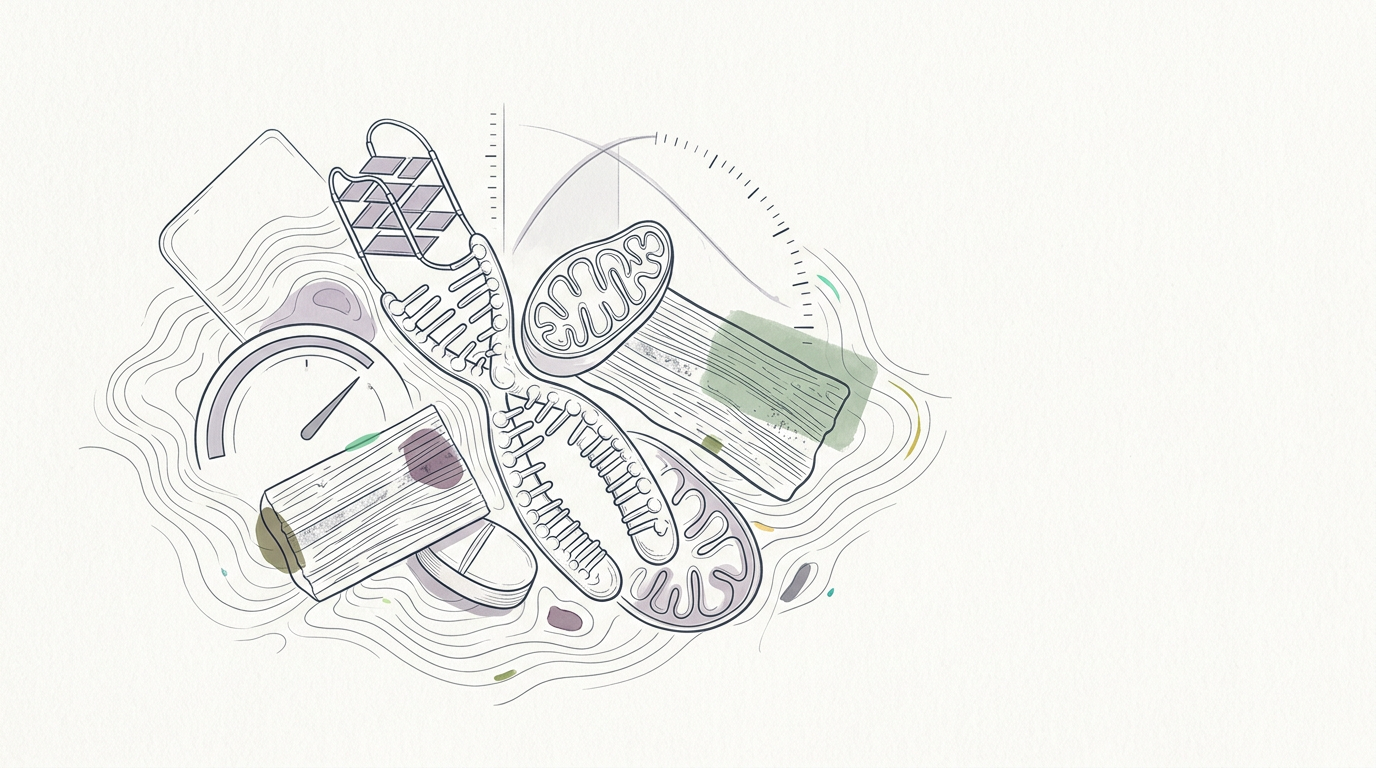 | I've reviewed the latest batch of natural textiles marketed for working out, and the verdict is pretty consistent: many of these materials don't live up to the hype when you're actually sweating hard. While the eco-credentials of mycelium, hemp, or bamboo are appealing, their performance under load is often just 'use-with-care 6/10.'
Take merino wool, for example. It's great for temperature regulation and odour resistance at lower intensities, but for high-output, prolonged sweat sessions, it can become saturated and heavy, losing its comfort. Many newer mushroom-based fabrics like Mylo or Ephea, while innovative, struggle with durability or efficient moisture wicking during vigorous exercise.
It’s a classic case of marketing getting ahead of mechanics. While I appreciate the effort towards sustainability, for serious training where performance and comfort directly impact your capacity, the current generation of natural activewear often presents more compromises than solutions. It’s not about the material’s story; it’s about what it does on a 10km run on a warm day. | |
Adidas
use with care · 6/10
| |
Ephea
use with care · 6/10
| |
estroni
use with care · 6/10
| |
Free Fly
use with care · 6/10
| |
Icebreaker
use with care · 6/10
| |
Isobaa
use with care · 6/10
| |
Moea
use with care · 6/10
| |
Mylo
use with care · 6/10
| |
Read the full review
kokorology.com/product-reviews/natural-textiles-workout-2026-mycelium-merino-hemp-tencel-bamboo-review
|
|
Kokorology product
XI
| A daily record of what your system is actually doing. Includes the complete hacks library. €25/mo. |  |
|
Evidence
XII
| The studies underneath | Research that re-calibrates our understanding of optimal function. |  | |
Brief Structured Respiration Practices Enhance Mood and Reduce Physiological Arousal
Kokorology Research Library
A Stanford trial (NCT05304000) showed cyclic sighing, practiced for 5 minutes daily, significantly improved mood and reduced respiratory rate. The mechanism is a longer exhale increasing parasympathetic tone, which lengthens the vagal brake for rapid down-regulation, as described by Jeremy Pollack.
| |
A Gradient of Childhood Self-Control Predicts Health, Wealth, and Public Safety
Kokorology Research Library
Moffitt, Caspi, and the Dunedin team's longitudinal study found a clear gradient: higher childhood self-control predicted better health, wealth, and public safety outcomes at age 32. This effect held even after controlling for IQ and family background, showing the impact isn't just about 'disorder' but a spectrum of capacity.
| |
Chronic Psychological Stress Increases Transepidermal Water Loss and Impairs Skin Barrier Recovery
Kokorology Research Library
Chronic psychological stress significantly impairs skin barrier recovery, increasing transepidermal water loss by 37% and suppressing ceramide synthesis. Salivary cortisol levels correlated linearly with recovery time, illustrating a direct physiological load from perceived stress.
|
|
The Practice
13
| Boundary Trace for Focused Attention | A simple physical act to ground your attention and reduce internal static. | 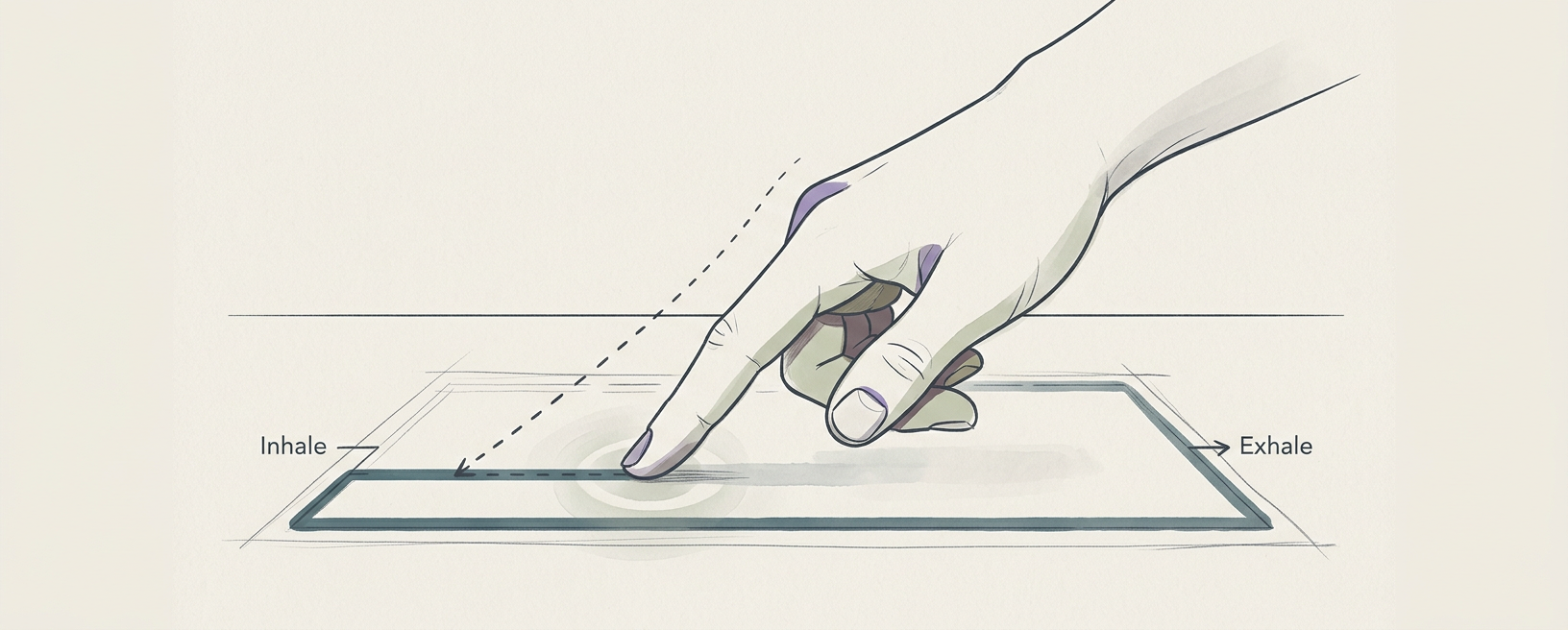 | When your thoughts feel like a scattered mess, and your focus keeps drifting, a small, tangible anchor can help. This practice uses a physical boundary to bring your attention back into the room and to the task at hand.
- Find a flat surface near you. It could be your desk, a table, or even your leg.
- Extend one hand, palm down. Gently trace a distinct line or shape on the surface with your fingertip. Make it definite, like the edge of a box or a circle.
- Keep consistent, light pressure as you trace for 30 to 60 seconds. Coordinate the tracing with your breath: trace during your inhale on one side of the boundary, and during your exhale on the other.
- Focus solely on the feeling of your fingertip moving across the surface and the visual of the line being formed. This isn't complicated.
- Notice any shift in your ability to direct your attention. The quiet focus brings your capacity back online.
| |
Practise it in full
www.kokorology.com/r/9da5jwh
| |
Log this in your Nervous System Journal →
|
|
The Movement
14
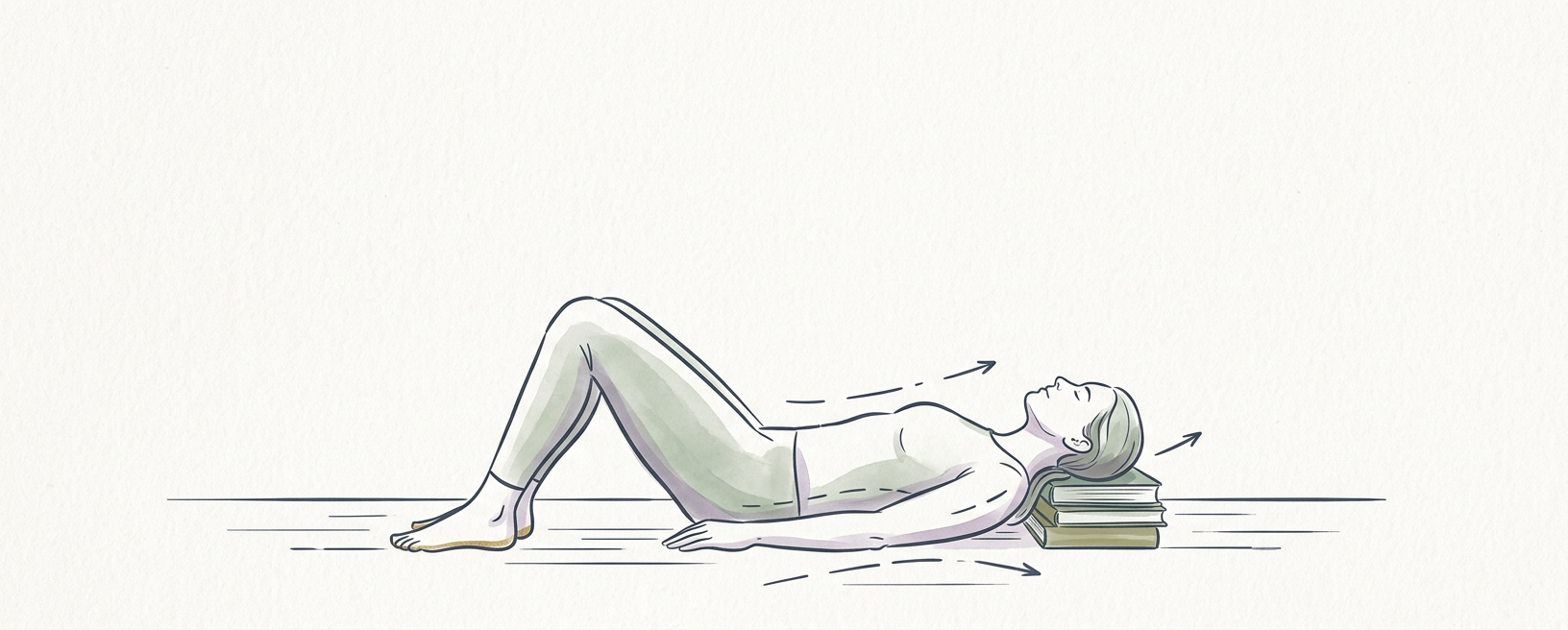
| Semi-Supine Rest for Spinal Ease | Release tension and find spinal freedom by letting gravity do the work. | 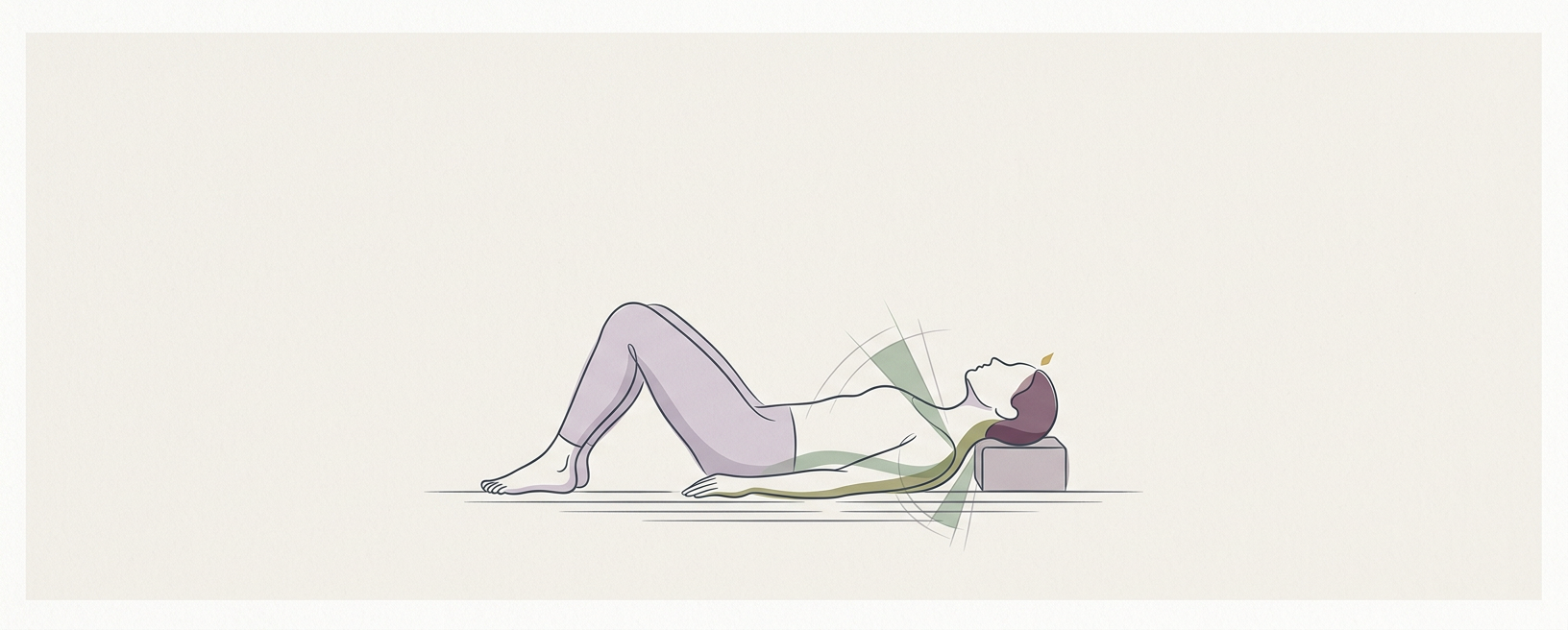 | The default state for many of us is often one of held tension, especially through the back and neck. This simple position, inspired by the Alexander Technique, helps you release that habitual load and allow your spine to decompress naturally.
- Lie on your back. Choose a firm, flat surface — the floor is ideal. Place a few paperback books under your head so your nose points gently to the ceiling. Bend your knees, feet flat on the floor, about hip-width apart. Position your feet far enough from your body that your knees can stand upright without effort. Let your hands rest comfortably on your abdomen or by your sides.
- Allow the surface to support you. For several minutes, bring your attention to all the points of contact between your body and the floor. Notice the weight of your head on the books, your shoulders, your pelvis, and the soles of your feet. Let gravity work. Resist any urge to adjust or 'correct' your posture. Just observe the pressure points.
- Think 'neck free.' Gently give yourself non-striving mental directions. Start with the thought, 'My neck is free to allow my head to go forward and up.' This isn’t about muscular effort; it’s a mental cue to release habitual tension and allow the natural lengthening of your spine.
| |
See the movement in full
www.kokorology.com/r/vkpdtf7
| |
Log this in your Nervous System Journal →
|
|
The Routine
15
| Anchoring for Articulating Your Limits | A quick routine to find your internal baseline before setting boundaries. |  | When you need to articulate a boundary or say no, it’s critical to start from a regulated state. This routine helps ground you quickly, so your words come from a place of capacity, not depletion.
- Hydrate and Mineralize — Take 3-4 slow sips of cool water with a pinch of sea salt. Feel the liquid moving down your throat and reaching your stomach. This small intake supports neural conductivity and cellular hydration, bringing you back to baseline.
- Masseter and Jaw Release — Gently massage your masseter muscles with your fingertips for 90 seconds per side. Slowly open and close your jaw, noticing any restriction. Let your tongue rest lightly on the roof of your mouth, just behind your front teeth. This releases unconscious tension held in anticipation.
- Use Your Nervous System Journal — Turn to today's hack in your Nervous System Journal. If you don’t have one, just interlock your fingers, press your palms together, and stretch your arms out and up, lengthening through your spine. Focus on the grounded sensation through your sit bones and the active lengthening through your crown, creating internal spaciousness.
- Shoulder Blade Awareness — Gently draw your shoulder blades down your back, feeling them settle. There’s no strain. This subtly broadens your chest and opens your posture, supporting a clear voice.
| |
Follow the routine in full
www.kokorology.com/r/ioeqvs5
| |
Log this in your Nervous System Journal →
|
|
Kokorology product
16
| Every Anchor and every care package, without making your symptoms audition for separate subscriptions. |  |
|
Kokorology product
18
| Twenty packages, one per load: cortisol, sleep, recovery, hydration, peptides, cycle, immunity. |  |
|
Kokorology product
20
| Level 1 through certification. The mechanism, then the practice, then the proof you can teach it. |  |
|
Kokorology product
22
| The studies underneath every claim on this site, in plain English, with the numbers left in. | 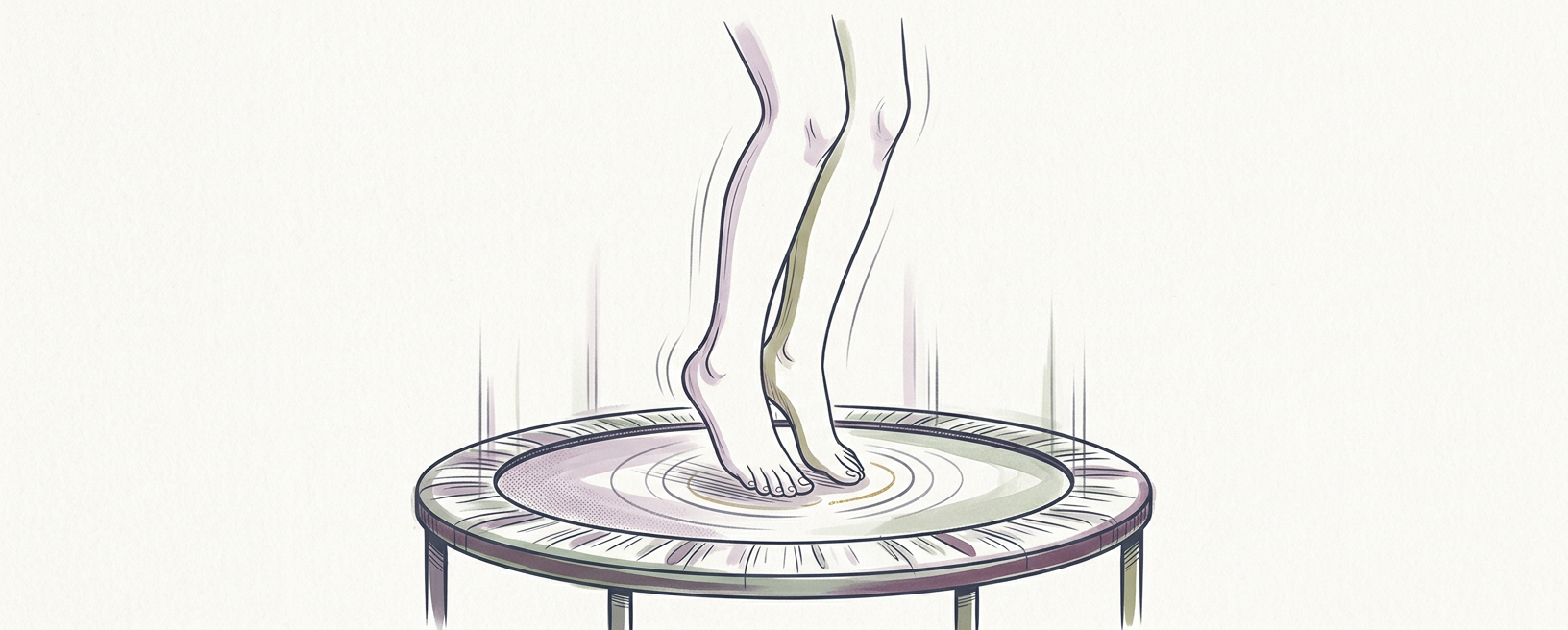 |
|
Kokorology product
24
| One eight-minute repair a day. Free to read; included with the Nervous System Journal. |  |
|
Kokorology product
25
| For teams whose output keeps outrunning their recovery. Capacity, measured — not vibes. |  |
|
From the house
26
| Two prompts in the morning, three at night, and the whole hacks library alongside them. €25/mo, cancel whenever. |  |
|
Correspondence
27
| Finding Your Baseline |  | This week was about challenging assumptions. It's easy to pathologise normal biological responses when we’re constantly told to optimise every part of ourselves. But sometimes, what feels like a problem is just your system doing what it’s meant to do. Recognising this can dramatically reduce your internal static. It changes your capacity.
Before you try to 'fix' a feeling, consider its function. Is it a signal, or is it just the rhythm of a healthy body? Pay attention to how this perspective shift changes your felt state. Your Nervous System Journal is a good place to note these observations.
Until next week, Sabin. | |
The Nervous System Journal — €25/mo
Two prompts in the morning, three at night. Includes the full hacks library.
| |
All Access — every anchor and care package
The whole system, one pass.
| |
Anchor protocols — €40 each
One protocol for the season you are actually in.
|
|