For Coaches
The Three State Model for Coaches Who Skipped Polyvagal
You’ve seen the three-circle diagram. Safe, Fight/Flight, Freeze. You’ve probably taught some version of it. But for many coaches, the intellectual leap from that simple drawing to the dense thicket of Polyvagal Theory f
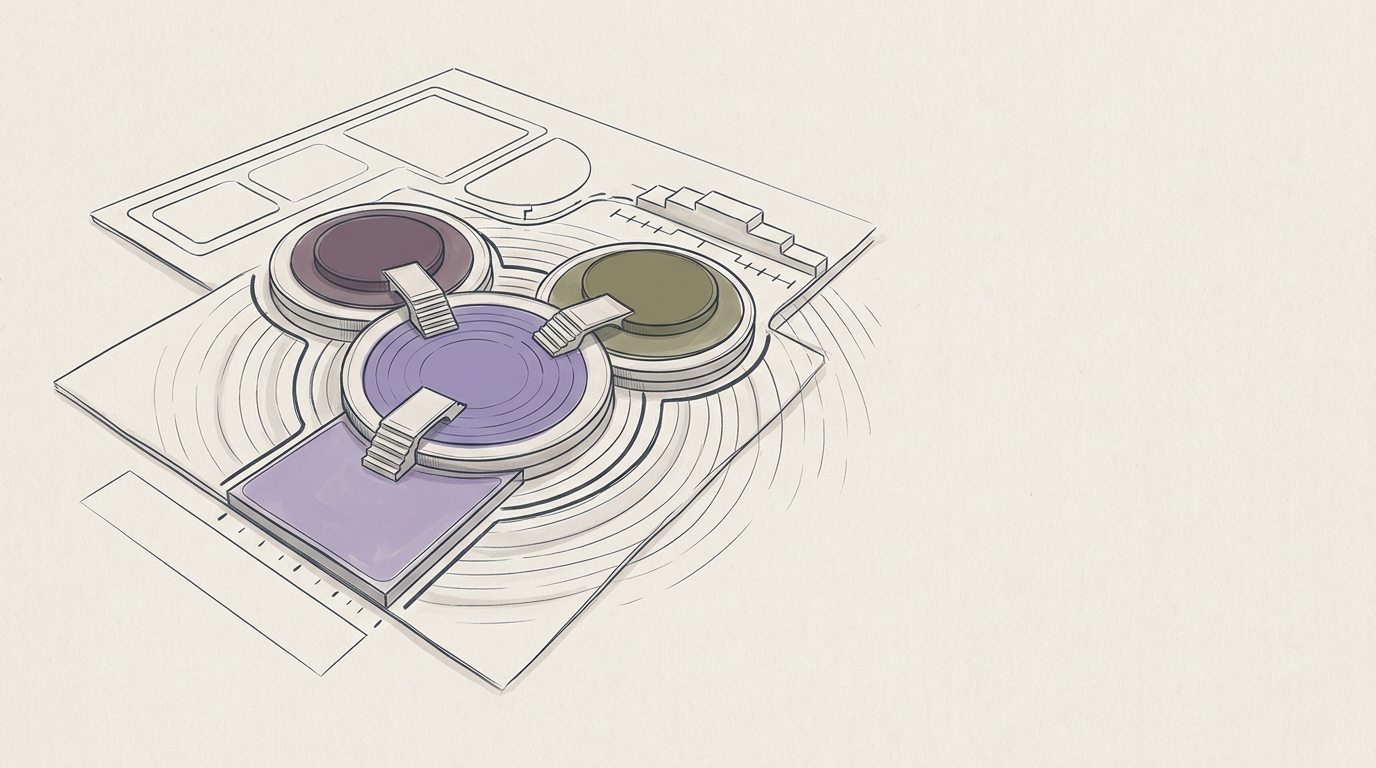
You’ve seen the three-circle diagram. Safe, Fight/Flight, Freeze. You’ve probably taught some version of it. But for many coaches, the intellectual leap from that simple drawing to the dense thicket of Polyvagal Theory feels…aspirational. It’s become a kind of prerequisite, a shibboleth for entry into serious somatic work. Many practitioners feel they either have to master Stephen Porges’ entire oeuvre or they’re not qualified to speak about the nervous system at all.
This is nonsense. Your job as a coach isn’t to lecture on unmyelinated vagal pathways. It’s to give your client a map that is useful now. That’s where the Kokorology Three-State Model comes in. It’s a teachable framework for nervous system states, built for coaches who care more about practical application than academic purity. It’s not a replacement for deep study, but it's a far better place to start.
Common Questions
Isn't this just a simplified version of Polyvagal Theory?
Yes and no. It uses the same basic physiological states—safe/social, mobilised, and immobilised—but frames them as an architectural model for teaching and practice. It prioritises the felt sense and practical handles for your clients over the complex neuroanatomy, making the work of nervous system regulation more accessible from day one.
Why is this model better for coaching?
Because it's immediately useful. A client doesn't need to understand the Nucleus Ambiguus to recognise the feeling of a racing heart versus a sense of heavy shutdown. The Three-State Model gives them a language for their internal experience that they can start using today, which is the entire point of tracking your states in something like the Kokorology Journal.
What are the three states?
- Safe & Connected: The state of optimal function, connection, and recovery.
- Mobilised: The state of activation and energy output; stress, but also focus and drive.
- Immobilised: The state of shutdown, conservation, and disconnection. Collapse, but also deep rest. The model focuses on the function of each state, not just its pathology.
Related anchors: vagal tone anchor · sleep anchor · burnt-out anchor
The Mobilised State: More Than Just Fight-or-Flight
We’re taught that the sympathetic nervous system is the body’s alarm bell, the primal urge to fight a predator or flee from danger. And it is. But in modern life, it’s also the engine that gets you through a quarterly review, powers a hard workout, or helps you meet a deadline. It's the physiological state of mobilising energy. The problem isn’t the state itself; the problem is getting stuck in it.
When your HPA axis (the hypothalamic-pituitary-adrenal system, your central stress response circuit) is chronically engaged, it floods your system with cortisol. As Robert Sapolsky has detailed extensively, prolonged cortisol exposure is corrosive. It impairs digestion, suppresses the immune system, and disrupts sleep. Your client experiencing this might feel wired and tired, perpetually anxious, or notice their fuse is getting shorter. This isn't a personality flaw; it's the signature of a system that can't find the off-switch. It’s what makes that August holiday in Europe feel less like a luxury and more like a statutory requirement for survival, versus the endemic PTO guilt of the US.
The Immobilised State: Not Just Freeze, But Shutdown
When the mobilised state becomes overwhelming or feels inescapable, the body has an older, more primitive emergency brake: the dorsal vagal complex. This is the Immobilised state. Peter Levine's work on the freeze response shows this isn't a passive state, but a highly active one of profound metabolic shutdown. It's the body's last-ditch effort to conserve resources and survive what feels like an unsurvivable threat.
A model isn't the truth. A model is a map. Its only job is to be useful.
For your clients, this rarely looks like a dramatic, cinematic freeze. It looks like burnout. It looks like depression, dissociation, brain fog, and a feeling of being heavy and numb. It's the client who says, "I know I should care, but I just can't." This isn't laziness. It's a physiological shutdown. They haven't given up; their body has pulled the plug to prevent a catastrophic system failure. Understanding this is key to offering interventions that don't feel like another demand on an already depleted system.
The Safe & Connected State: The Foundation for Everything
This is the state everyone is trying to sell you in a smoothie or a meditation app. The ventral vagal state of safety, connection, and social engagement is our biological home base. It’s where digestion, recovery, creativity, and genuine connection happen. It’s characterised by high vagal tone (think of it as the 'strength' of your relaxation response) and a calm, open posture toward the world.
But you can’t “hack” your way here. This state is built on signals of safety, both internal and external. According to recent research from Julianne Holt-Lunstad, a sense of social connection is one of the most powerful predictors of health and longevity. Your ability to co-regulate with others—to feel seen and settled in the presence of a safe other person—is a biological necessity, not a nice-to-have. This is why so many purely individualistic wellness practices fail; they ignore the fact that our nervous systems are designed to regulate in community. For a deeper dive on the research, the Kokorology Library is a good place to start.
The Nerd-Out: Your Brain's Gear Shifter
So how does the body switch between these states? The classic diagram makes it look like a neat flowchart, but the reality is messier and far more interesting. A key player in these state transitions is a tiny region in the brainstem called the locus coeruleus (LC). Think of the LC as your brain's arousal headquarters and master gear shifter.
Work by researchers like Mara Mather shows the LC is the primary source of norepinephrine in the brain, a neurotransmitter that dials up or down your alertness and focus. In the Safe state, the LC fires in a steady, rhythmic pattern (phasic mode), promoting calm focus. When a threat or a challenge appears, it switches to a high-output, erratic pattern (tonic mode), flooding the brain with norepinephrine to power the Mobilised state. If that state becomes too intense or prolonged, the LC can effectively burn out, leading to norepinephrine depletion and a system-wide shift toward the Immobilised, low-energy shutdown state. For coaches, this means that "building capacity" is, in part, the work of restoring the health and flexibility of the locus coeruleus, so it can shift gears smoothly without getting stuck.
What to do this week
As a coach, try this with your own system first. Don't teach it until you've felt it.
- Map Your Own States: For three days, use a simple journal to track when you feel mobilised, immobilised, or safe/connected. Don't judge it. Just notice the triggers and the felt sense. Use the Kokorology Journal if you need a template.
- Identify Your "Tells": What is your body's first signal that you're moving into Mobilisation? (e.g., shallow breath, tight jaw, cold hands). What's the first signal of Immobilisation? (e.g., heavy eyes, desire to scroll, flat tone of voice).
- Practice State Shifting: When you feel mobilised, try a 5-minute grounding practice (feet on the floor, slow exhale). When you feel immobilised, try introducing a small amount of gentle movement (a short walk, stretching). The goal isn't to force a change, but to introduce a different possibility to your nervous system. Learn the fundamentals inside our Regulation L1 course.
- Teach the Language: Introduce the three state names to a trusted client. Ask them where they feel they are on the map right now. You might be surprised how quickly they grasp it.
TL;DR
Stop feeling like you need a PhD in neuroscience to coach the nervous system. The Three-State Model—Mobilised, Immobilised, and Safe/Connected—is a practical, teachable framework that prioritises a client's felt sense. It bypasses academic complexity to give them a useful map of their internal world. Each state corresponds to a physiological reality dominated by either the sympathetic system (Mobilised), the dorsal vagal complex (Immobilised), or the ventral vagal complex (Safe). The goal isn't to eliminate the stress states but to build the capacity to move between them fluidly.
Where this fits in the Kokorology system
This model is a core teaching tool for understanding your internal architecture. It forms the practical foundation of the entire Nervous System Regulation pillar and is a key concept in building Anchors like the Cortisol Anchor to manage the Mobilised state.
Closing
The goal of a good model is to make the invisible visible. The Three-State Model gives you and your clients a shared language to map the territory of the nervous system. It’s a starting point for the real work: renovating the architecture of your own capacity. For coaches ready to integrate this into their practice, we’ve created a detailed PDF of this model, designed for you to use with your clients. It’s part of our commitment to supporting the practitioners on the front lines, and it’s one of the many tools you'll find inside our certifications.
- Continue with the Kokorology Coach Certification.
- Build your foundation inside Regulation L1.
- Get weekly insights from the Kokorology newsletter.
Sources
- Holt-Lunstad, J. et al. (2010). PLoS Medicine.
- Levine, P. A. (2010). In an Unspoken Voice: How the Body Releases Trauma and Restores Goodness.
- Mather, M., & Harley, C. W. (2016). Trends in Cognitive Sciences.
- Sapolsky, R. M. (2004). Why Zebras Don't Get Ulcers.
- Porges, S. W. (2011). The Polyvagal Theory: Neurophysiological Foundations of Emotions, Attachment, Communication, and Self-regulation.