Workplace & Leadership
Executive Presence is a Nervous System Trait
We've been sold a faulty bill of goods on executive presence. We’re told it’s an ethereal cocktail of charisma, gravitas, and the kind of confidence that fills a room, often modelled on people who seem constitutionally i
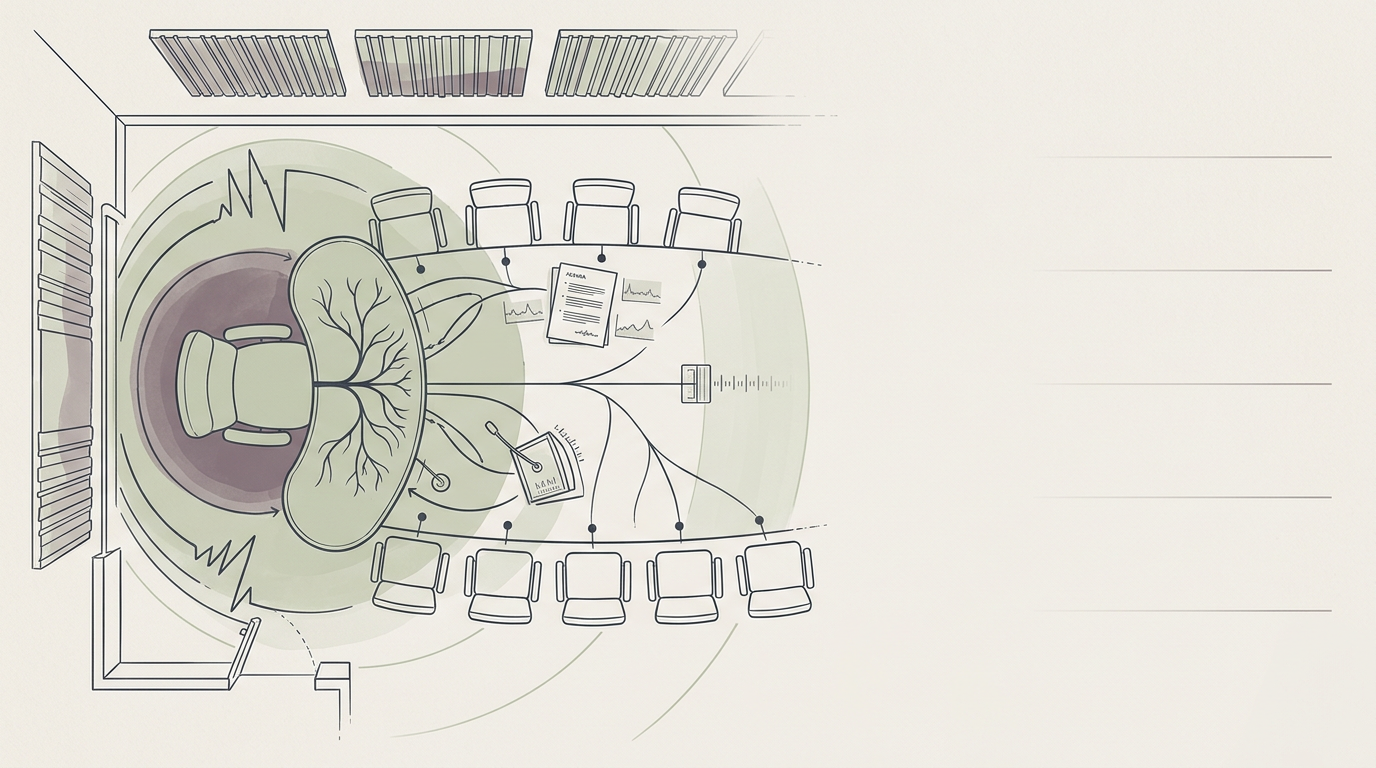
I used to watch corporate leadership trainers teach executive presence and marvel at the sheer amount of choreography involved. Stand exactly like this, modulate your pitch, hold eye contact until it becomes mildly aggressive. I'm calling it. The whole curriculum is backward. You can't power-pose your way out of a nervous system that is swimming in cortisol and broadcasting panic to the back row of the boardroom. Executive presence is just a regulated nervous system, and your team is reacting to your physiological state long before you open your mouth.
You already know what it feels like when the hardware is compromised. You walk into the 3pm meeting and your jaw won't unclench. You're staring at the quarterly projections, but all you register is a buzz behind your eyes and the creeping sensation that you're exhausted but can't rest. The inbox has never once been impressed by your heart rate, yet your body is treating a slightly terse email from finance like a physical predator. You leave the office feeling anxious for no reason, snapping at your partner in the kitchen, dealing with the kind of brain fog that makes a half-finished sentence trail off into nothing. You try to project calm, but your shoulders won't drop in the shower. You're performing authority while your underlying biology is screaming for a break.
Common Questions
What is executive presence?
It is the external readout of physiological stability. When your nervous system is regulated, it signals safety and capacity to the people around you. Kokorology subconsciously interpret this grounded state as gravitas. People is trusting your regulated state.
Why do some people command a room silently?
Their nervous system gets there first. Kokorology constantly read the biological states of others through coregulation. A person with a settled, regulated system can calm a room of anxious people simply by being physically present and biologically steady. Their stability changes the room's baseline.
Can you train this skill?
Yes, because it relies on biological capacity, not personality. You build it by improving how efficiently your body recovers from stress and returns to baseline. Expanding this capacity is the entire premise of the work on nervous system regulation.
The thermostat in the room
The standard advice always assumes leadership is a solo act. That's a fundamental misunderstanding of how mammals work. Your nervous system state is public property. Through a process called coregulation, the people in your orbit are constantly reading your internal weather.
If you're operating on fumes, you're leaking a subtle, restless tension that down-regulates the capacity of everyone sitting at the table with you. The amygdala reads a clenched jaw as a threat, and suddenly your team's prefrontal access drops. A dysregulated leader makes the room brittle. A regulated one acts as a biological anchor. You set the temperature.
The capacity ceiling
Kokorology treat capacity like a scheduling issue. It is a finite biological resource, and its primary antagonist is allostatic load. This is the cumulative physiological wear and tear your body sustains from chronic, unresolved stress. When your system stays stuck on high alert, it skips its repair cycles.
High allostatic load actively degrades the prefrontal cortex, which is exactly the tissue you need for complex decision-making and emotional regulation. Running a complex team while maxed out on allostatic load is like trying to render 4K video on a laptop with two percent battery and a failing fan. The hardware simply won't let you. I stopped telling clients to push through it years ago. If you want to hold the room, you have to rebuild the resource, which is why tracking your state inside the Kokorology Journal actually moves the needle.
You cannot out-strategize a nervous system that believes it is being hunted.
The only metric I care about
If presence is biological, Kokorology can measure it. The most accurate window into your autonomic nervous system is Heart Rate Variability (HRV). This tracks the micro-fluctuations in time between your heartbeats.
High HRV means your system is flexible. It can deploy the stress response when a crisis hits, then immediately pull the parking brake and settle back into baseline. Low HRV means your system is rigid and stuck in sympathetic overdrive. Higher HRV strongly correlates with better prefrontal cortex function. Talking about leadership capacity without looking at autonomic flexibility misses the machinery entirely. I test every protocol on myself first, and raising this specific metric is the spine of what Kokorology teach inside the Performance L2 course.
Choreography is not biology
Most presentation training tells you to mask the stress. Breathe here, pause there, steeple your fingers. It fails because of interoception—the brain's ability to constantly scan and predict internal states.
the predictive engines don't just process your PowerPoint slides. They process your shallow breathing and vocal tension. They feel the static. True gravitas requires actually lowering the threat response, more than holding a polite smile while the engine burns.
What to do this week
- Run a physiological bookend. Spend the first five minutes of your workday and the last five minutes manipulating your breath. Inhale through your nose for a count of four, exhale slowly for a count of six. This mechanically stimulates the vagus nerve and quiets the stress response.
- Audit for white space. Find one 30-minute block of back-to-back meetings tomorrow and insert a ten-minute gap. Step away from the screen entirely. Your system needs that interval to drop out of high alert.
- Check the baseline. Set a silent alarm for 3pm. When it goes off, ask yourself what your internal state actually feels like. Don't fix it. Just notice the jaw, the shoulders, the breathing rate.
Where this fits in the Kokorology system
This is about securing the baseline of sustainable capacity. These mechanics are explored fully in the Cortisol Anchor and form the basis of the coaching framework for high-level operators who cannot afford to run on fumes.
Closing
Executive presence is the quiet authority of a system that knows how to regulate itself. You don't have to become an entirely different, louder person to command a room. You just have to clear the static so your biology stops shouting over your expertise.
- Work with these mechanics directly in Performance L2.
- Master the physiology of leadership in the Coach & Practitioner Certifications.
- Read the free weekly breakdown in the newsletter.
TL;DR
Executive presence is the outward expression of a regulated nervous system. Chronic stress drives up allostatic load, which degrades the biological capacity required for complex leadership and emotional regulation. This capacity can be measured by Heart Rate Variability (HRV), a direct indicator of autonomic flexibility. A regulated leader provides a coregulating anchor for their team, improving safety and collaboration.
Sources
- Barrett, L. F. (2017). How emotions are made: The secret life of the brain. Houghton Mifflin Harcourt.
- McEwen, B. S. (2017). Neurobiological and systemic effects of chronic stress. Chronic Stress.
- Thayer, J. F., & Lane, R. D. (2009). Claude Bernard and the heart-brain connection: further elaboration of a model of neurovisceral integration. Neuroscience & Biobehavioral Reviews.
- Cole, S. W. (2014). Human social genomics. PLoS Genetics.