Workplace & Leadership
Why High Performers Collapse After They Win
We love the story of the relentless founder, the sleepless CEO, the artist who toils in obscurity and then, finally, wins. The narrative usually ends there, with the champagne pop. What nobody talks about is the strange,
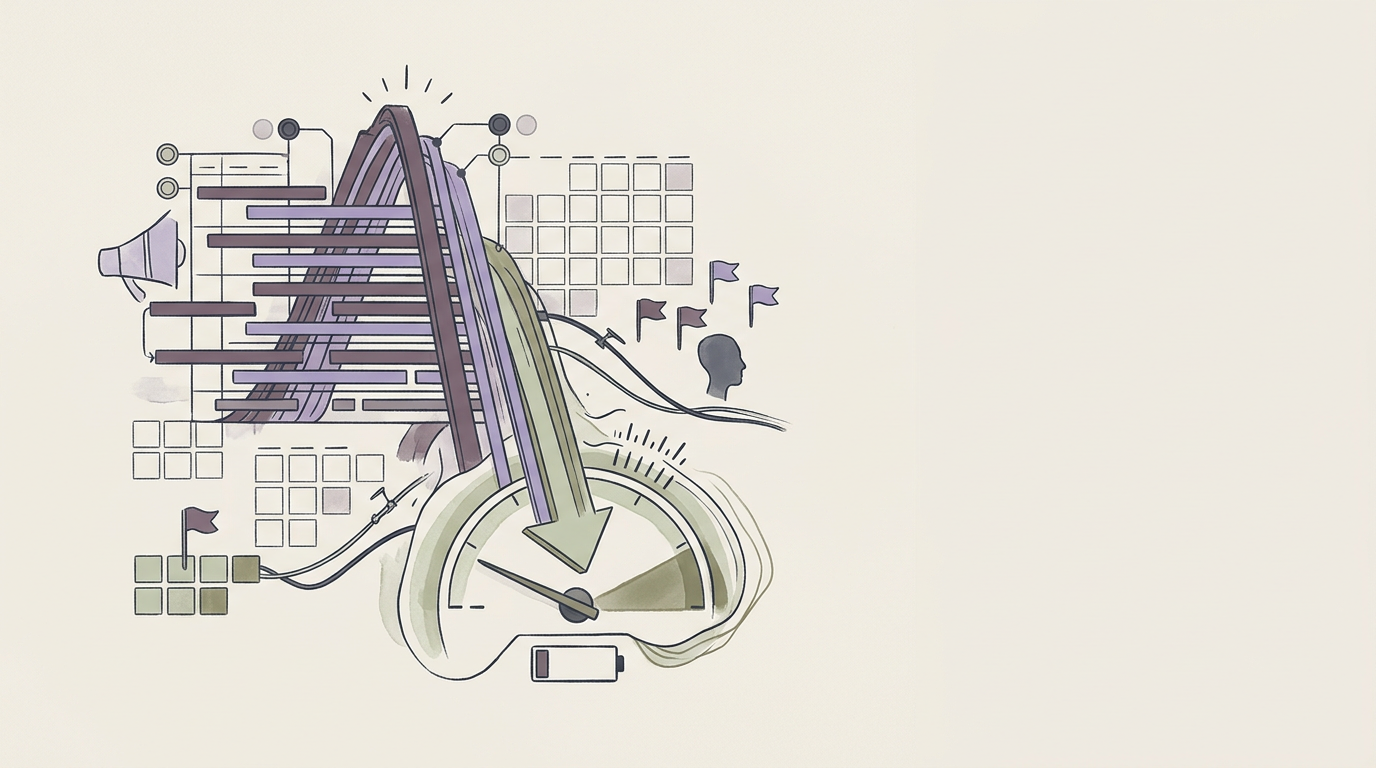
We love the story of the relentless founder, the sleepless CEO, the artist who toils in obscurity and then, finally, wins. The narrative usually ends there, with the champagne pop. What nobody talks about is the strange, hollowed-out collapse that so often follows the victory. You close the deal, ship the product, win the prize… and then you can’t get out of bed for a week. We pathologise this as burnout or depression, but it's neither. The real reason why high performers collapse after a big win isn't a moral failing; it's a predictable, physiological event. The threat that organised your entire nervous system has vanished, and the bill for all that borrowed energy has just come due.
Common Questions
Why does success sometimes feel like a collapse?
Because for months, your body has been running on stress hormones like cortisol and adrenaline to meet a major challenge. This is your HPA axis (the brain-body stress circuit) in overdrive. When the challenge is removed, the chemical scaffolding disappears. The resulting 'collapse' is your nervous system slamming on the brakes after a long period of flooring the accelerator.
What is allostatic load?
Coined by neuroscientist Bruce McEwen, allostatic load is the cumulative wear and tear on your body from chronic stress. Think of it as the biological cost of adaptation. Every time you push through exhaustion or ignore your body's signals, you add to this load. The post-win collapse is often the moment your system can no longer carry it.
Is this just another name for burnout?
No. Burnout is a state of chronic depletion that builds over time. This is more of an acute metabolic crash. It’s the physiological pendulum swinging from a state of extremely high sympathetic (fight-or-flight) arousal to a state of profound exhaustion, sometimes mimicking a dorsal vagal shutdown—a state of conservation and immobilisation. The recovery path is different.
What’s the first step to preventing this?
Start seeing your energy as a finite biological budget, not an infinite resource fuelled by willpower. Before the next big push, you need to build the architecture for a "soft landing" instead of assuming you can just hit the off switch. This involves deliberate recovery protocols, which most high-performers see as a luxury, not a necessity.
Related anchors: vagal tone anchor · sleep anchor · HRV anchor
It's Not Burnout, It's a Debt Collection
We treat performance as a psychological game of motivation and mindset. We draw up battle plans, set aggressive targets, and then lionise the leader who sacrifices the most to get there. But your body doesn't run on mission statements; it runs on glucose and neurotransmitters. The sustained, high-arousal state required to ship a product or win a major client isn't free. You're effectively taking out a high-interest loan from your future physiological capacity.
This is what Bruce McEwen called "allostatic load" – the downstream consequence of your brain telling your body to constantly adapt to threat (McEwen, 2019). That threat could be a tiger, or it could be a looming IPO date. Your adrenal glands don't know the difference. They just know the command from the HPA axis (your Hypothalamic-Pituitary-Adrenal axis, the central command for stress) is "mobilise at all costs". The collapse isn't a sign of weakness; it's the nervous system's equivalent of a debt collector showing up at your door the day after the party ends.
The finish line isn’t a release valve; for a chronically stressed system, it’s a cliff.
The Threat That Organized You
For a high-performer in the thick of a project, the deadline is a powerful organising force. It provides structure, focus, and—most importantly—a neurochemical cocktail that makes the impossible seem manageable. Cortisol sharpens your focus (in the short term). Adrenaline provides the raw energy. Your entire being is oriented around a single, clear objective. All non-essential systems are powered down. Who has time for digestion, immune surveillance, or nuanced emotional connection when the fate of the company is on the line?
This isn't 'flow state'; it's a sustained survival state. And it works, for a while. It’s the reason you can pull all-nighters and still deliver a sharp presentation the next morning. Your system is exquisitely designed for this. What it's not designed for is living there for a year. The problem is, once you're habituated to this level of arousal, the absence of the threat feels less like peace and more like a void. The very thing that was stressing you out was also the thing holding you together.
The Cortisol Cliff and the Aftermath
Here is where we get nerdy, because the mechanism matters. Once the deal is signed or the project launched, the primary stressor is removed. Your HPA axis, which has been screaming "GO", finally gets the signal to stand down. Your cortisol levels, which have been artificially elevated for months, don't just return to baseline; they often plummet. This is the cortisol cliff.
This has two immediate effects. First, cortisol is a powerful anti-inflammatory. While it was high, it was suppressing your immune system. According to recent research, when cortisol crashes, your immune system can rebound with a vengeance, which is why so many of us get sick the moment we go on holiday. Second, the brain's primary arousal centre, the locus coeruleus, dials down its activity. This tiny brainstem nucleus, which researcher Mara Mather has linked to prioritising high-arousal information, has been driving your state of alert vigilance (Mather, 2016). When it goes quiet, the world can suddenly seem drained of colour and meaning. This isn't depression; it's a neurochemical withdrawal. To rebuild your capacity for leadership, you need to learn to manage this architecture, something we teach inside the Performance L2 course.
Capacity Is a Team Sport
A leader's dysregulated nervous system is not a private matter. It radiates. Your team doesn't just inherit your vision; they inherit your physiological state. If you're running on fumes, chronically activated, and lurching between frantic urgency and exhausted collapse, you are creating that same pattern in the people around you. This is coregulation, and it happens whether you're aware of it or not. Your team’s capacity becomes a reflection of your own.
Research by people like Stephen Cole has shown how chronic threat perception can alter gene expression, creating a pro-inflammatory state (Cole, 2015). A leader who embodies calm, regulated authority can buffer their team against this. A leader who embodies chaos exports it directly into the biology of their staff. Instead of just tracking KPIs, truly effective leaders should be asking: what is the allostatic load of my team? Measuring collective heart rate variability (HRV) — a key proxy for nervous system regulation — is no longer science fiction. It's the future of sustainable performance and a core part of the methodology we teach practitioners in our certifications.
What to do this week
This isn't about avoiding big goals. It's about building the scaffolding to survive them.
- Map Your Cycle: Look at your last big project. Did you get sick, injured, or have a depressive crash within two weeks of finishing? Notice the pattern. That's your allostatic load bill arriving. Acknowledging it is the first step. You can use a tool like the Kokorology Journal to track this.
- Schedule a "Soft Landing": For your next big push, don't just plan the launch date; plan the week after it. Block it out. No new initiatives. No major decisions. Schedule low-demand activities: walks, bodywork, non-strategic connection. This isn't a reward; it's a managed descent.
- Practice a "Functional Freeze": The collapse feels like a total system shutdown. Instead of fighting it, lean into it for a prescribed period. Give yourself ten minutes to lie on the floor and do nothing. No phone, no podcast. Let the system feel the "stop" without the story of failure. It feels radical, but it's a powerful way to begin paying down your biological debt. If this feels impossible, it might be time for more direct support through something like 1:1 coaching.
TL;DR
The reason why high performers collapse after a major success is physiological, not psychological. You spend months running on stress hormones from an overactive HPA axis, accumulating what researcher Bruce McEwen calls allostatic load. When the goal is achieved and the stressor is removed, your cortisol levels crash, your immune system rebounds, and key brain arousal centres like the locus coeruleus power down. This isn't burnout; it's a predictable neurochemical withdrawal. The solution isn't more grit, but building an architecture of recovery before you need it.
Where this fits in the Kokorology system
This pattern is a classic example of your system's load exceeding its capacity, the core principle of our work in Nervous System Regulation. Managing these intense cycles of output and recovery is the central focus of the Cortisol Anchor protocol, which you can find inside /anchors.
Closing
Understanding this pattern moves it from a personal failing to a design problem. You aren't broken; your strategy for managing your biological resources was simply incomplete. The work is not to stop striving for big things. The work is to build a system robust enough to withstand the resonant shock of achieving them.
- Build your leadership capacity with the science of regulation inside Performance L2.
- Work with one of our coaches to design a personal architecture for recovery inside 1:1 Coaching.
- Start with the fundamentals in our free guide to your nervous system.
Sources
- McEwen, B. S. (2019). The brain on stress: toward a new approach to explaining and treating anxiety and depression. JAMA Psychiatry.
- Mather, M. (2016). The Locus Coeruleus: A Hub for Arousal and Memory. Current Opinion in Behavioral Sciences.
- Cole, S. W. (2015). Human social genomics. PLoS Genetics.
- Thayer, J. F., Ahs, F., Fredrikson, M., Sollers, J. J., & Wager, T. D. (2012). A meta-analysis of heart rate variability and neuroimaging studies: implications for heart rate variability as a marker of stress and health. Neuroscience & Biobehavioral Reviews.