Workplace & Leadership
Why High Performers Collapse After They Win
That post-launch crash is a predictable physiological event driven by the sudden drop in threat detection and the rapid withdrawal of stress hormones.
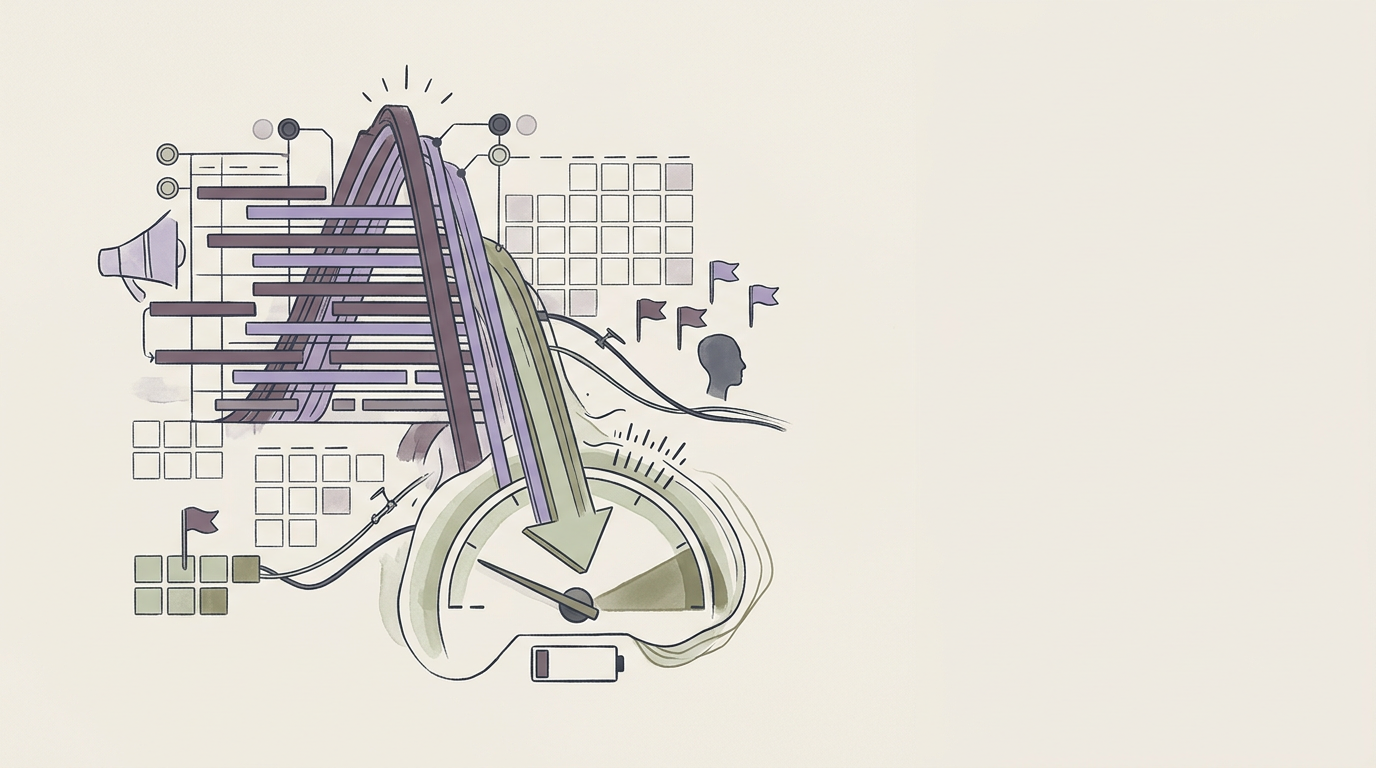
I used to believe the exhaustion that hit me after a major project was just a sign I'd need a long weekend. Kokorology treat the post-launch crash as a temporary inconvenience that a few extra hours of sleep will fix. That sudden inability to answer a basic email the day after you close a massive deal is actually a predictable physiological event. The threat that organized your entire nervous system has vanished, leaving the HPA axis—the loop controlling your stress hormones—to abruptly slam the brakes on a system traveling at terminal velocity.
You wake up the morning after the champagne pops, and your limbs feel filled with wet cement. You're staring at the open fridge with absolutely no hunger, blinking at the shelves while the 3pm jaw clench that usually drives you forward is completely gone. You've spent six months tired but wired, constantly vibrating with the low-grade hum of impending deadlines. Now the quiet arrives, and you feel entirely disconnected from your body. You crawl into bed at 9pm assuming you'll sleep for a week, only to lie there exhausted but can't rest. Your heart racing when you lie down happens because the sudden silence feels terrifying to a nervous system habituated to chaos. The brain fog is so thick you leave sentences half-finished in meetings you barely remember joining. The engine hasn't stalled. The parking brake simply engaged while the accelerator was still pinned to the floor.
Common Questions
Why do I crash after achieving a big goal?
When you push toward a deadline, your brain relies on a steady stream of cortisol and adrenaline to maintain vigilance. The moment the objective is met, that survival loop shuts off. The subsequent crash is your nervous system rapidly shifting out of sympathetic arousal and forcing immobilization to assess the damage.
What is allostatic load?
Allostatic load is the cumulative physiological wear and tear your body sustains from chronic stress. Every time you override a natural biological signal to keep working, you add to this burden. A post-win collapse happens when your capacity to carry that accumulated load finally runs out.
Is a post-launch crash the same as burnout?
Burnout is a chronic state of systemic depletion that degrades your baseline over months or years. A post-win crash is an acute metabolic and neurochemical withdrawal. Your system swings violently from hypervigilance into a state of profound conservation, demanding immediate and absolute stillness.
The Threat That Organized You
I'm calling it. The high-performance culture's obsession with flow state is mostly just rebranded hypervigilance. For a leader in the thick of a massive initiative, the deadline acts as a powerful organizing force. It provides a terrifyingly clear objective, stripping away all nuance and feeding you a neurochemical cocktail that makes seventy-hour weeks feel normal. Cortisol sharpens your immediate focus. Adrenaline supplies the raw caloric energy to keep typing at 2am. Your entire biology reorients around survival.
In this state, all non-essential functions power down. The digestive tract slows. Immune surveillance drops. Your prefrontal cortex stops caring about empathy and prioritizes threat detection. Kokorology applaud this as singular focus. Your body is simply running a standard emergency protocol. It works beautifully for acute danger. The trouble arises when you force the system to live in that highly mobilized state for three quarters of the fiscal year. Once you habituate to that level of arousal, the sudden absence of the stressor feels like a terrifying void.
The finish line rarely brings relief. For a chronically stressed system, it simply removes the tension holding you together.
The Downstream Cost of Adapting
Kokorology love to pretend that sheer willpower controls outcomes. Your organs run entirely on glucose and neurotransmitters. The sustained, high-arousal state required to ship a product demands massive physiological resources. Every time you push past the urge to sleep, you accumulate allostatic load.
This is the biological toll of forcing your system to constantly adapt to perceived danger. Your adrenal glands care nothing for your quarterly goals; they only register the metabolic cost of your ambition. They receive the command from the HPA axis to mobilize everything you have, and they comply. The eventual collapse is the unavoidable math of a system running on empty. I see founders constantly confused by their own exhaustion, convinced they just need another cold plunge to fix six months of skipped sleep. They ignore the reality that they've drained their capacity to the absolute dregs.
The Cortisol Cliff
Here's the machinery behind the silence you feel after the champagne. Once the contract is signed, the primary stressor evaporates. The HPA axis finally gets the signal to stand down, and the cortisol levels that were artificially elevated for months simply plummet.
This rapid drop triggers two immediate physiological events. First, because cortisol is a potent anti-inflammatory, its sudden absence allows your immune system to rebound violently. That's exactly why you get a catastrophic head cold on the second day of a Lisbon work trip. Second, the locus coeruleus—a tiny brainstem nucleus responsible for prioritizing high-arousal information—dials down its activity. This center has been driving your state of alert vigilance for months. When it goes quiet, the world suddenly seems completely drained of color. That sudden lack of drive is a profound neurochemical withdrawal. To lead effectively, you have to manage this physiological reality, which is exactly the dynamic Kokorology map out in Performance L2.
Coregulation in the Boardroom
A dysregulated nervous system is highly contagious. Your team doesn't just execute your strategy; they inherit your physiological state. If you're running on fumes, chronically activated, and lurching between frantic urgency and exhausted silence, you're directly passing that pattern to the people reporting to you.
The inbox has never once been impressed by your heart rate. A leader who embodies regulated authority buffers their staff against chronic threat perception. A leader who embodies frantic chaos exports that static straight into the biology of their team. Instead of endlessly tracking output metrics, Kokorology should be measuring the collective allostatic load of the room. I've stopped recommending productivity tools to executives who haven't first learned how to down-regulate their own sympathetic arousal. Treating the team's capacity as a finite, measurable resource is the only sustainable way forward.
What to do this week
- Map the cycle: Look back at your last major launch. Did you get sick, pull a muscle, or completely crash within two weeks of the final deliverable? Notice the pattern. Tracking this reality in the Journal makes it impossible to ignore the biological cost of your current pacing.
- Schedule the descent: For your next massive push, block out the week after the deadline right now. No new initiatives, no strategic planning sessions, no early flights. Schedule low-demand inputs like slow walks and non-work conversation. Treat this as a necessary physiological landing.
- Embrace the stop: When the collapse inevitably hits, lean into it for a prescribed window. Lie on the floor for ten minutes. Let the system physically experience the halt without layering on panic about your sudden lack of motivation.
Where this fits in the Kokorology system
Pushing past your biological limits and managing the inevitable crash is a primary focus of Nervous System Regulation. Kokorology teach you how to build a baseline that can handle these massive spikes in load, particularly inside the Cortisol Anchor protocol found in the Cortisol Anchor.
Closing
You can't cheat the basic mechanics of your biology forever. The goal is to build a regulated system capable of absorbing the resonant shock of a massive win, rather than one that shatters the moment the pressure comes off.
- Build your leadership capacity with the science of regulation inside Performance L2.
- Work with one of the coaches to map your recovery patterns in 1:1 Coaching.
- Start with the fundamentals in the free guide to your nervous system.
TL;DR
The collapse high performers experience after a major success is a predictable neurochemical withdrawal. For months, an overactive HPA axis floods the body with stress hormones to maintain hypervigilance, accumulating massive allostatic load. Once the goal is achieved, the threat vanishes. Cortisol levels plummet, immune responses rebound, and arousal centers in the brain power down. This sudden metabolic crash forces the system into temporary immobilization to assess the damage and begin desperately needed repairs.
Sources
- Critchley HD (2023). Interoception and Autonomic Regulation in Stress. Journal of Neuroscience.
- Grünewald (2024). Executive Function Recovery Trajectory After Clinical Burnout: 24-Month Follow-up. Journal of Occupational Health Psychology.
- Chandola T (2008). Work stress and coronary heart disease: What are the mechanisms?. European Heart Journal.