Nervous System
Nervous System Journal App
Most journaling apps are digital confessionals. They invite you to log your moods, list your gratitudes, or write a lengthy post-mortem on your day, all under the well-meaning banner of ‘self-awareness’. This is the equi
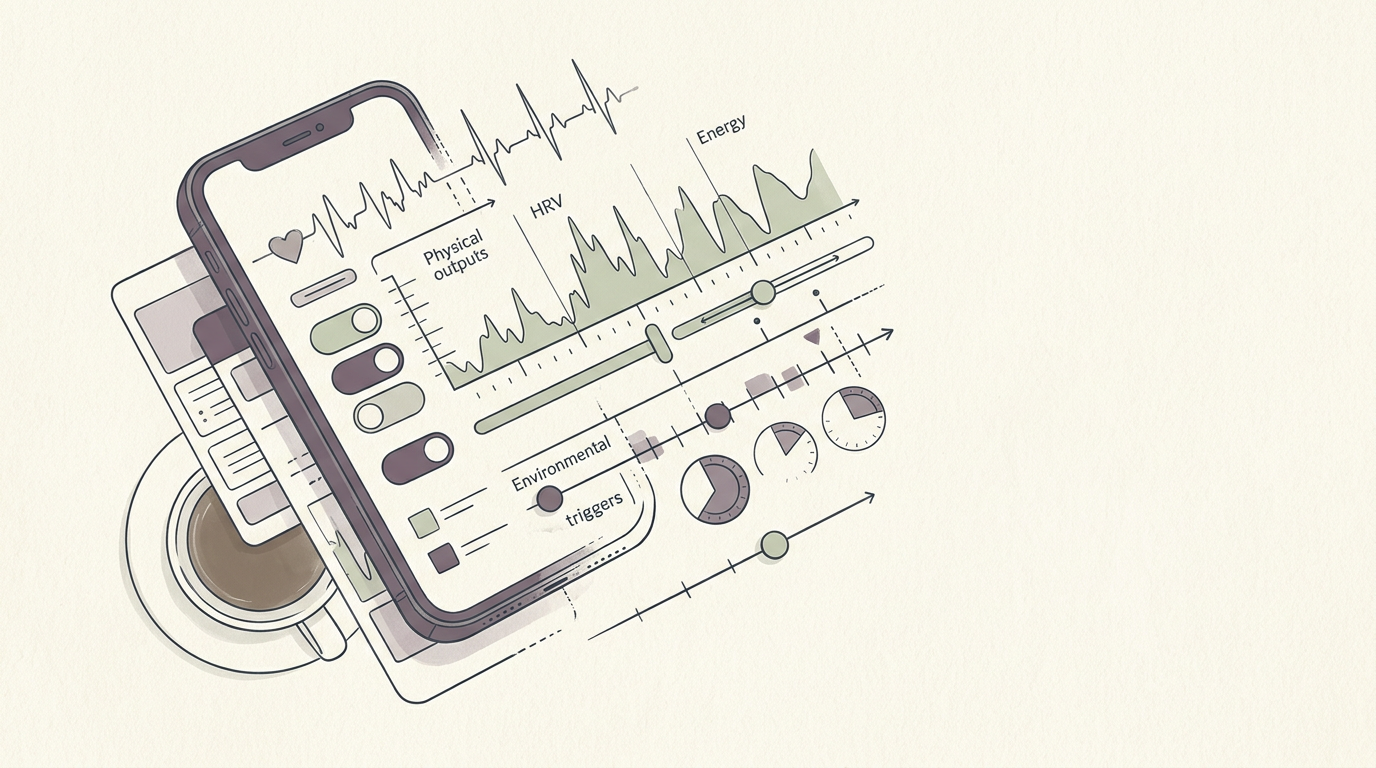
Most journaling apps are digital confessionals. They invite you to log your moods, list your gratitudes, or write a lengthy post-mortem on your day, all under the well-meaning banner of ‘self-awareness’. This is the equivalent of trying to understand a city’s power grid by reading its citizens’ poetry. It’s not wrong, it’s just the wrong tool for the job. A good nervous system journal app shouldn't be a place to record your feelings. It should be a diagnostic instrument for interrogating the physiological data that produced them.
Common Questions
What's wrong with tracking my mood?
Nothing, but a mood is a lagging indicator. It's the smoke, not the fire. By the time you feel "anxious" or "drained," your nervous system has been running a specific chemical and electrical pattern for hours. A true nervous system journal tracks the inputs that create the state, not just the name you give it.
So what should I track in a nervous system journal?
Inputs and outputs. Inputs are things like hours of sleep, caffeine timing, screen time before bed, and contentious meetings. Outputs are things like your morning heart rate variability (HRV), when you hit an energy slump, or whether your skin is flaring up. It’s less "dear diary" and more "ship's log."
How is a nervous system journal app different?
It prompts for the right data. Instead of asking "How do you feel?", a well-designed app asks, "What was your sleep latency?", "When did you first see daylight?", or "Rate your focus on a scale of 1-10 before and after your lunch". It turns subjective states into objective patterns, which is the first step to changing them.
Related anchors: sleep anchor · HRV anchor · skin anchor
Your Journal App is Probably a Mood Ring. It Should Be a Multimeter.
The dominant model for digital journaling is built on a fundamental misunderstanding of what drives our state. The app that asks you to tap a smiling or frowning face at 3 p.m. is treating your internal world as a popularity contest of emotions. This is fine for generating colourful graphs, but it’s useless for actually changing your capacity. Your state isn’t a choice between happy and sad; it's the net result of your body’s ongoing energy budget.
This is where we need to think less like a poet and more like an engineer. Neuroscientist Bruce McEwen gave us the term ‘allostatic load’ (the cumulative wear and tear on the body from chronic stress). Every skipped meal, every poorly slept night, every doom-scrolling session before bed contributes to this load. Your mood is just the final invoice. A journal that only tracks the mood is like a CFO who only looks at the final bill, not the expense reports that generated it. The real work of nervous system regulation is in managing the expense reports.
Stop Journaling Your Feelings. Start Tracking Your Architecture.
I want you to try an experiment. For one week, forbid yourself from using feeling-words in your journal. You are not allowed to write "I feel anxious." Instead, you must report the raw, physiological data: "Shallow breathing from the collarbones, heart rate feels elevated, slight tension in jaw, desire to check phone every 90 seconds."
See the difference? The first is a narrative label; the second is a structural readout. This is the entire premise of the Kokorology Journal. It’s not a space for catharsis—though that can happen. It’s a tool to get you to track the load-bearing elements of your human architecture. Instead of writing about your fight with a colleague, you track the inputs and outputs around the event. Sleep score the night before? 62. Caffeine units? Four. Time spent outdoors? Zero. Post-meeting energy level? 2/10.
This isn’t about being cold and robotic. It’s about getting precise enough to see the pattern. And once you can see the pattern, you can intervene. You can’t intervene on "feeling awful." You can intervene on "three hours of fragmented sleep followed by a high-sugar breakfast."
A good journal doesn't ask how you feel. It asks for the data that produced the feeling.
The Fine Art of Interoceptive Reporting
Let's get nerdy for a moment. Your brain has two primary ways of gathering information: exteroception (seeing, hearing, touching the outside world) and interoception (sensing the internal state of your body). Interoception is the quiet, thankless sense. It’s the whisper of your own heartbeat, the vague sensation of your digestive system, the subtle shift in muscular tension that signals an approaching threat. According to neuroscientist A.D. (Bud) Craig, this entire internal landscape is mapped and processed in a part of your brain called the insular cortex.
Most of us are terribly out of practice at listening to the insula. We wait for the screaming siren of an anxiety attack or a migraine instead of noticing the faint hum of the engine overheating miles before. A purpose-built nervous system journal app is, at its core, an interoception trainer. Each prompt—"Where in your body do you feel this?" or "What is the quality of your breath right now?"—is a rep for your insula. It strengthens your ability to perceive subtle shifts in your internal state before they cascade into a full-blown crisis. You’re not just writing things down; you’re refining the resolution of your own internal sensory equipment.
Circadian Data: The Non-Negotiable Baseline
One of the most powerful—and most ignored—levers for regulating your nervous system is your circadian rhythm. Your body doesn't run on a 24-hour clock; it is a 24-hour clock, with different systems programmed to come online and go offline at specific times. When you disrupt this, you create system-wide static. This is where journaling your environment becomes critical.
Tracking your time of first light exposure, your last meal, and your "social jetlag" (the difference between your weekday and weekend sleep times) provides a baseline for everything else. And this data is profoundly local. Whether you're in the UK battling the winter gloom, in Canada where the daylight hours swing wildly, or somewhere in Australia trying to manage sleep in the summer heat, your environment is a key player. Ignoring it is like trying to sail without looking at the weather. A structured program like The Reset is built entirely around dialling in these circadian inputs first, because without that foundation, every other effort is built on sand.
From Affect Labelling to Actionable Insight
According to recent research, the work of psychologist James Pennebaker shows that the simple act of expressive writing and naming emotions—'affect labelling'—can calm down the brain's threat-detection centre (the amygdala). This is the scientific justification behind most journaling prompts, and it’s valid. But it's also table stakes.
Calming the system for a moment is one thing. Preventing it from firing up again tomorrow is another. This is the leap a good practice helps you make: from a label to an insight. A journal helps you see that "I'm stressed" isn't a random weather event. It’s a pattern: "I am disproportionately activated every Tuesday at 3 p.m. right after my weekly performance review, a pattern that is worse on days when my sleep score was below 70." Now we have something to work with. That's not a feeling anymore; it's an engineering problem. You can now deploy a specific tool from your Hacks library before the meeting or work on a longer-term Cortisol Anchor protocol to lower your baseline reactivity. You've moved from complaining about the weather to fixing the roof.
What to do this week
Stop writing a diary. Start collecting intelligence. For the next seven days, use your journal—any journal—like this:
- Track three inputs, mercilessly. Every day, note: 1) What time you had your last sip of caffeine. 2) What time you first saw unfiltered daylight for 10+ minutes. 3) How many hours you slept, according to your best guess or a wearable.
- Describe; don’t label. When you feel a strong emotion, resist the urge to name it. Instead, open your journal and list three physical sensations that are present. "Vibration in chest," "Tightness behind eyes," "Urge to pace." Be a court reporter for your body.
- Run an end-of-day audit. Before you close your eyes, ask one question: "Where did my energy go today?" Not "was it a good day?" but a simple audit of where you spent your finite physiological capital. Don't judge the answer. Just write it down.
TL;DR
The standard journaling app is a digital diary, focused on logging moods—a lagging indicator of your physiological state. A nervous system journal app functions as a diagnostic tool, shifting the focus from catharsis to data. By tracking inputs (sleep, caffeine, light) and outputs (HRV, energy slumps), you move from describing feelings to mapping the architecture that creates them. This practice trains interoception—your ability to sense your internal state, as mapped by the insula. This allows you to spot patterns and move from affect labelling to actionable insight, turning vague distress into a solvable engineering problem, a process supported by research from Pennebaker on writing and McEwen on stress.
Where this fits in the Kokorology system
This practice—of using a journal as a diagnostic tool—is the first step in any meaningful work on your nervous system regulation. It provides the raw data needed to effectively deploy targeted protocols, like our Cortisol Anchor, and builds the foundational awareness that underpins the entire system.
Closing
You don't need more willpower or a better attitude. You need better data. Your internal state is not a mystery to be pondered; it is a system to be understood. The first step to becoming a systems administrator for your own body is to start keeping an accurate log.
- Practice it daily inside: The Kokorology Journal
- Start here: The 7-Day Reset
- Get the free guide: Your Nervous System: An Owner's Manual
Sources
- Craig, A.D. (2009). How do you feel--now? The anterior insula and human awareness. Nature Reviews Neuroscience.
- McEwen, B.S. (1998). Stress, adaptation, and disease: Allostasis and allostatic load. Annals of the New York Academy of Sciences.
- Panda, S. (2016). The Circadian Code: Lose Weight, Supercharge Your Energy, and Transform Your Health. Rodale Books.
- Pennebaker, J.W., & Smyth, J.M. (2016). Expressive Writing: Words that Heal. Idyll Arbor.