Nervous System
Nervous System Journal App
A nervous system journal app tracks the physical inputs and biological data that create your mood, allowing you to regulate your state at the root.
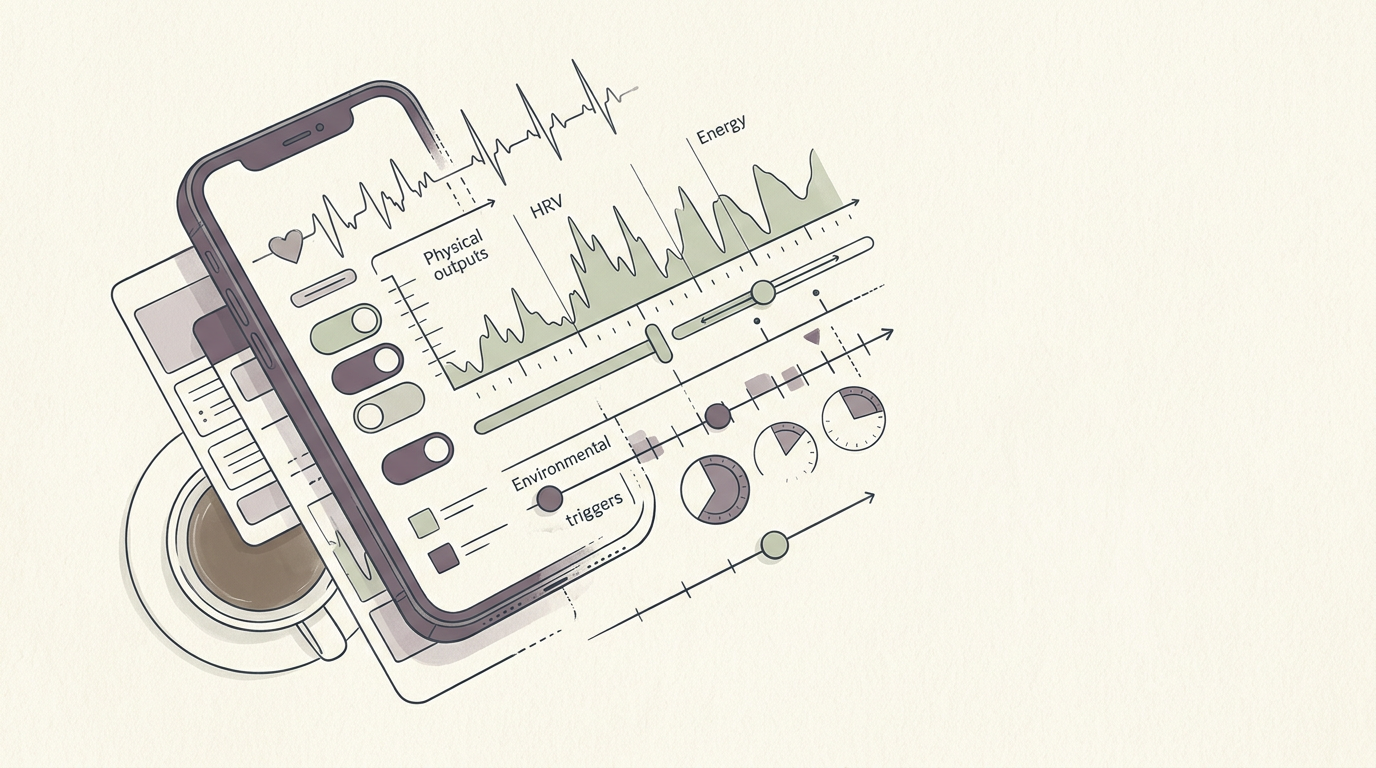
I used to write down exactly how I felt every time a wave of vague dread hit me at my desk. The standard guidance insists that documenting your emotions creates self-awareness. Documenting your emotions just trains you to be exceptionally articulate about your own distress. A nervous system journal app operates on entirely different machinery, tracking the physiological inputs that generated the mood in the first place. You don't need to process a feeling that was actually caused by a spike in cortisol and a missed meal.
You sit down on the edge of the bed and stare at a blank page, trying to summarize the day. You feel heavy, yet your mind is spinning through tomorrow's inbox. This is the classic tired but wired state, where your eyes burn but your resting heart rate refuses to drop. Your jaw is locked, your stomach feels vaguely tight even though you have no appetite, and your shoulders haven't dropped since your morning commute. You might google why you are anxious for no reason or why you wake up at 3am every night with a racing heart, assuming there is some unresolved psychological conflict you need to write your way out of. The reality sitting under your skin is much simpler, and much more biological. Your threat-detection circuitry is stuck in the on position, and asking it to write a poem about how that feels is missing the point.
Common Questions
What exactly is a nervous system journal?
It is a daily log that prioritizes biological data over emotional narrative. It asks what you did and how your body responded, bypassing the psychological story entirely. You track variables like sleep latency, light exposure, and autonomic shifts to identify the patterns driving your daily capacity.
Why track inputs instead of moods?
By the time you experience a distinct mood, your biology has been running a specific chemical pattern for hours. Tracing your inputs allows you to see the physiological precursors to a state, giving you the information required to intervene early next time.
How do you measure an internal state?
You observe the physical signals your body produces. A sudden drop in digestive motility, a change in your resting breath rate, or a spike in heart rate variability are all quantifiable metrics that tell you exactly what your nervous system is currently doing.
The Biology of a Mood
The wellness industry treats your internal state as a purely psychological phenomenon. If you feel bad, you must have thought a bad thought. The mechanism actually runs the other way. Your emotional state is the lagging indicator of your allostatic load—the cumulative physical wear and tear on your body from chronic stress. Every shortened sleep cycle, every delayed meal, and every hour spent under fluorescent lighting alters your neurochemistry.
When you write a page about how overwhelmed you feel, you are merely documenting the downstream effects of a fatigued system. I learned the hard way that writing about my exhaustion didn't fix my sleep schedule. The real work of nervous system regulation requires you to identify the physical variables that tipped the scale. Your biology doesn't care about your gratitude list. It cares about your cortisol rhythm and your glucose stability.
The Interoception Beat
Let's look at the actual neuroscience of feeling things. Your brain constantly monitors your internal organs, blood pressure, and muscle tension through a sensory pathway called interoception. All of this data travels up to the insular cortex, which translates the raw physical signals into a subjective feeling.
Most people have terrible interoceptive awareness. Kokorology ignore the subtle shifts in the breathing and digestion until the system triggers a full migraine or panic response. Using the Journal correctly acts as a precision trainer for the insula. You learn to notice the faint, preliminary signals of activation miles before the crash happens. You track the shallow breath at 10 a.m. so you don't end up locked in a stress response at 4 p.m.
Forbidding the Vocabulary of Emotion
I regularly ask people to ban feeling-words from their daily tracking for an entire week. If you remove the ability to write "I feel anxious," you must report the structural reality of the moment. You write down that your breathing is shallow, your chest vibrates, and you have an intense urge to pace.
That gives you actual data. A rapid heart rate and a locked diaphragm offer clear points of intervention. A narrative about dread leaves you guessing.
A robust journaling practice forces you to observe the biology that is actually running the room.
Once you have the physical data, you can do something about it. You can pull a specific regulating tool from your Hacks library to immediately widen your capacity, rather than just hoping tomorrow is a better day.
The Circadian Baseline
The most critical input you can log is your circadian rhythm. Your body is a 24-hour clock that expects specific environmental cues at specific times. When you expose yourself to screens at midnight or skip morning sunlight, you generate systemic static. Tracking your light exposure, meal timing, and sleep duration provides a non-negotiable baseline.
If your sleep score is a 40, your emotional capacity the next day won't exist. A targeted Anchor protocol can help stabilize the resulting spike in stress hormones, but the ultimate fix requires adjusting the environmental input. You can't out-breathe chronic circadian disruption.
What to do this week
Begin collecting intelligence on your physical state. For the next seven days, run your tracking differently.
- Log three daily metrics. Record the exact time of your last caffeine intake, the minute you first saw unfiltered daylight, and your estimated total sleep duration.
- Ban emotion words. When you sit down to write, describe three physical sensations currently happening in your body. Observe the tension, temperature, or pace of your breath.
- Run a friction audit. At the end of the day, run a simple audit of where you spent your finite physiological capital. List the specific moments that caused your heart rate to spike or your focus to collapse.
Where this fits in the Kokorology system
Mapping your inputs is the foundational step before applying any intervention. You need this data to know whether you should deploy an immediate regulating tool or commit to the deeper, systemic restructuring taught inside The Reset.
Tonight's practice
Sit on the edge of your bed, look at your calendar for tomorrow, and write down exactly where your jaw, shoulders, and stomach physically react to the schedule.
- Sit upright in a quiet room with a pen and paper.
- Take four slow breaths, extending the exhale to a count of six.
- Scan your body from the collarbones down to your stomach.
- Write down the two strongest physical sensations you find, without assigning them a positive or negative value.
- Leave the notebook closed until morning.
Closing
Your internal state is a biological output, and attempting to manage it with poetry alone will leave you exhausted. You need precise data to change how your system runs. Start logging the inputs that actually dictate your capacity.
- Practice it daily inside: The Kokorology Journal
- Work on your baseline capacity in: The 7-Day Reset
- Start with the free guide: Your Nervous System: An Owner's Manual
TL;DR
The standard approach to journaling treats your internal world as a purely psychological space, asking you to endlessly document your moods. A nervous system journal app operates on biological reality, tracking the physical inputs—like sleep, light exposure, and meal timing—that actually generate your emotional state. By logging physiological data instead of narrative feelings, you train your interoceptive awareness and identify the precise triggers of your allostatic load. This changes vague distress into a measurable pattern, allowing you to regulate your nervous system at the root.
Sources
- Khalsa, S.S. & Lapidus, R.C. (2016). The pros and cons of interoception (awareness of the internal state of the body). Frontiers in Psychology.
- Craig, A.D. (2009). How do you feel--now? The anterior insula and human awareness. Nature Reviews Neuroscience.
- McEwen, B.S. (1998). Stress, adaptation, and disease: Allostasis and allostatic load. Annals of the New York Academy of Sciences.
- Pennebaker, J.W. (2023). Journaling and the nervous system: from expressive writing to affect labeling. Curated meta-analyses and primary studies (1986–2023).