Nervous System
Polyvagal Journal Prompts
The internet loves a good listicle, and "polyvagal journal prompts" is a certified wellness-industry darling. The promise is seductive: a few well-chosen questions will shepherd your nervous system out of threat and into
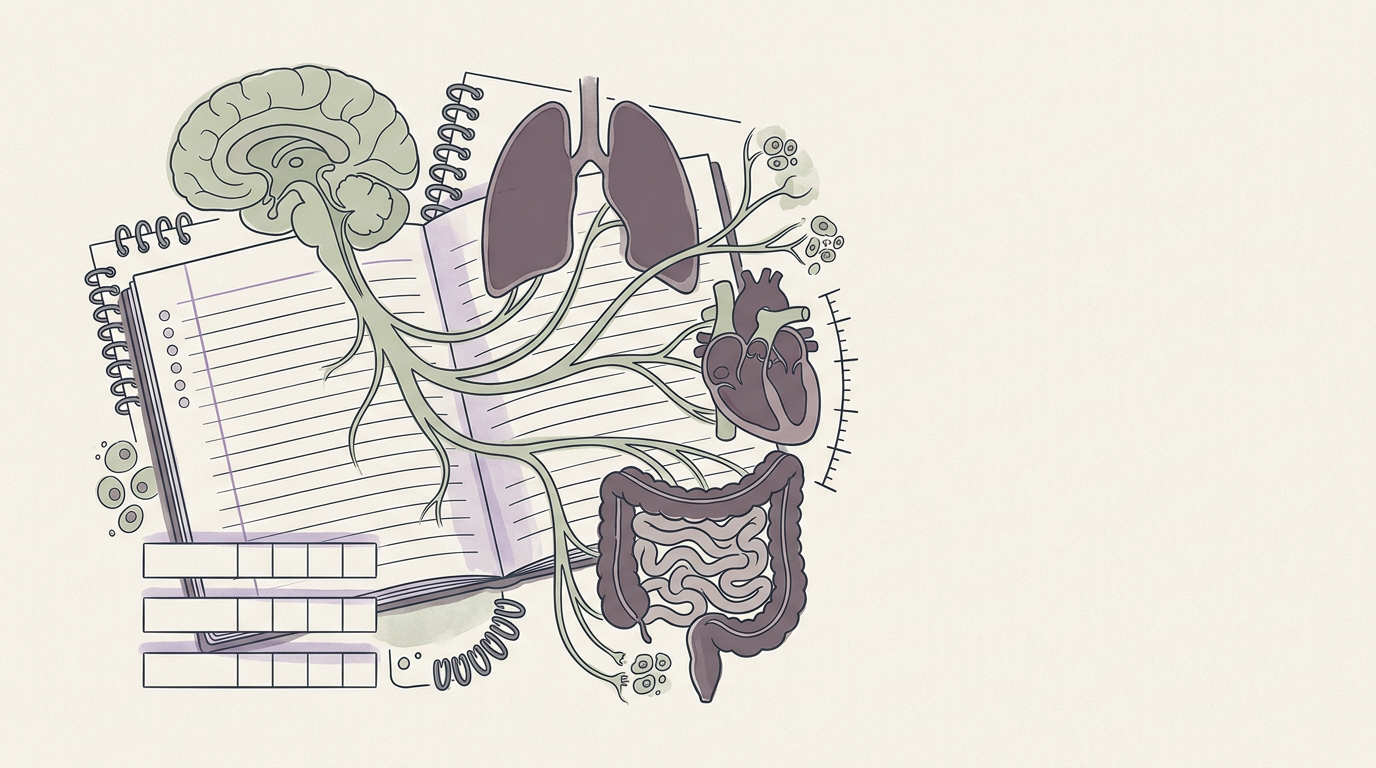
The internet loves a good listicle, and "polyvagal journal prompts" is a certified wellness-industry darling. The promise is seductive: a few well-chosen questions will shepherd your nervous system out of threat and into a meadow of calm, connected bliss. What a lovely thought. It's also nonsense. A journal prompt is not an incantation, and your nervous system is not a genie waiting to grant your wishes. The whole premise mistakes the map for the territory. The real value of journaling isn't to write yourself into a different state, but to read the state you are already in with unflinching accuracy.
Common Questions
What are "polyvagal journal prompts" supposed to achieve?
The intention behind them is sound: to increase your awareness of your internal bodily states. The popular framing, however, suggests that asking a specific question can magically shift you into a 'safe and social' mode. A more useful frame is to see these prompts as invitations to practice interoception—your brain's ability to sense and interpret your body's internal signals.
So, can journaling actually change my nervous system state?
Yes, but indirectly. The change doesn't come from writing 'I am calm' a hundred times. According to research by James Pennebaker, the act of 'affect labelling'—simply naming the emotion or sensation you're feeling without judgement—can genuinely downregulate activity in the amygdala (your brain's alarm centre). It calms the system by acknowledging reality, not by demanding a fantasy.
Is this why positive affirmations in my journal don't work?
For many people, yes. An affirmation like "I am abundant and thriving" can feel like a lie when your body is screaming "I am exhausted and in debt". This creates internal dissonance, which is itself a stressor. Your nervous system is a ruthlessly honest system; it responds to lived truth, not top-down commands from your thinking brain.
Related anchors: vagal tone anchor · sleep anchor · HRV anchor
Your Journal Is a Seismograph, Not a Wishlist
We’ve been taught to use a journal as a place to dictate orders to ourselves. We list our goals, outline our ideal selves, and then wonder why the reality of our lives rarely matches the script. This turns the journal into a monument to our perceived inadequacies. It’s time for a reframe. Your journal isn't a contract; it's a piece of diagnostic equipment. Treat it less like a goal-setting tool and more like a seismograph for sensing the tremors of your own autonomic nervous system.
Its real job is to help you build interoceptive awareness, a skill at the very heart of nervous system regulation. Before you can change your state, you have to be able to read it. And I mean really read it. Not the story you tell yourself about how you feel, but the raw data coming up from the body: the tension in your jaw, the heat in your chest, the hollow ache behind your eyes. This is the work, and your journal is the perfect place to do it.
The Myth of the State-Shifting Prompt
The wellness market is full of prompts promising to instantly transport you to a land of safety and connection. These are well-meaning, but they skip the most important step. A prompt is a question, not a teleportation device. The work isn't finding the magical question; it's in cultivating the capacity to tolerate the body’s honest answer. Insisting on feeling 'safe and social' when your system is in a defensive crouch is like yelling at a seismograph to stop reporting an earthquake. It’s futile and slightly absurd.
The real target here is not a specific 'vagal state', but the quality of your attention itself. Neuroscientist Bud Craig identified the anterior insula as a key brain region for integrating these bottom-up signals from your body into a cohesive 'felt sense' of self. Your journal is your private laboratory for sharpening the resolution of that signal.
A journal prompt can't rewire you. It can only tell you which wires are live.
Naming the Beast: The Power of Affect Labelling
So if aspirational prompts are out, what are we meant to write? The single most effective journaling practice for nervous system regulation is an exercise in radical honesty called affect labelling. It’s the simple act of putting your internal experience into words. That’s it. “Right now, I feel a tight band around my chest.” “A sense of dread is sitting in my stomach.” “My hands are cold and my thoughts are racing.”
This isn't just navel-gazing. As the foundational work by James Pennebaker shows, translating amorphous, non-verbal sensations and emotions into language engages the prefrontal cortex, which has a natural, top-down inhibitory effect on the amygdala. You aren't trying to fix the feeling. You're simply acknowledging it, mapping it, giving it a name. In doing so, you move from being flooded by the feeling to observing it. This tiny shift in perspective is the beginning of all real regulation. It’s one of the simplest moves in our library of daily resets.
The Nerd-Out: Interoception as Predictive, Not Passive
Here’s where it gets really interesting. Most people think of interoception as a passive process: the body has a sensation, the brain reads it. But according to researchers like Lisa Feldman Barrett, it’s actually a predictive process. Your brain isn’t waiting for data; it's constantly running simulations, trying to anticipate the body’s needs and meet them before they become a crisis. It's managing a complex 'body budget'.
When you feel 'bad'—anxious, tired, irritable—it's often a sign of a budget deficit. Your brain has predicted you'll need more resources (glucose, oxygen, rest) than are currently available. When you sit down with a journal and write, "My shoulders are up by my ears and I have a low-grade headache," you are providing your predictive brain with high-quality, real-time data. You're helping it correct its faulty predictions. You're no longer just a passive victim of your state; you become an active participant in balancing your own body budget. The more accurately you can report on your internal landscape, the better your brain gets at managing it. This is deep, structural work, not wishful thinking. For a deeper dive on these mechanisms, see our research library.
From State Awareness to State Shifting
Once you have an accurate reading of your present state, then you can make an intelligent choice about what to do next. If your journal reveals you're in a state of hyper-aroused tension, writing "I am serene" is pointless. But a five-minute walk, a cold-water face splash, or a specific breathing exercise might actually shift the needle. If it reveals you're in a state of flat, collapsed exhaustion, you don't need another goal; you need a strategic retreat. Maybe you cancel a non-essential meeting or lie on the floor for ten minutes.
This is the core logic of the Kokorology system: Recognise the state, then match the tool. According to recent research, this ability to flexibly adapt your regulatory strategy based on context is a hallmark of resilience. An accurate journal entry is the piece of intel that allows for that flexibility. It’s the prerequisite for any effective protocol, whether you’re working on your Sleep Anchor or your Cortisol Anchor.
What to do this week
- Stop writing demands. For one week, forbid yourself from writing any goals, to-do lists, or affirmations in your journal.
- Start a "State of the Union" entry. Each day, take five minutes to answer only this prompt: "Right now, in my body, I notice..." List the raw physical sensations: tightness, warmth, emptiness, buzzing, stillness. Don't interpret them, just list them.
- Use specific language. Instead of "I feel stressed," try "I feel a buzzing in my hands and a shallow tightness in my upper chest." The more precise the language, the more effective the affect-labelling mechanism.
- Look for one pattern. At the end of the week, read your entries. Don't judge them. Just notice: is there a time of day when the tightness appears? A specific sensation that precedes a feeling of overwhelm? This is your own user manual, written in your own hand.
TL;DR
Forget magic polyvagal journal prompts that promise to instantly change your state. That's not how your nervous system works. Instead, use your journal as a diagnostic tool for interoception—your capacity to feel and interpret your body’s internal signals. Research (Pennebaker, 2023) shows that simply naming your feelings and sensations (affect labelling) is a powerful act of regulation in itself. Know your state first. Only then can you choose the right tool to shift it.
Where this fits in the Kokorology system
This practice of state awareness is foundational to all our work. It's the 'sensing' part of the sense-and-respond loop we teach as the core skill of Nervous System Regulation. It informs how you'll approach any of our Anchors, and it is the daily work inside the Kokorology Journal.
Closing
The most powerful questions aren't the ones you find on an internet list. They're the ones you learn to ask yourself, based on the data you gather from your own body. Stop looking for the right prompt and start building the capacity to listen to the answer. It’s a slower, quieter, much more potent path.
- Practice it daily inside: The Kokorology Journal subscription.
- Learn the full architecture: The Regulation (L1) Course.
- Start here with a free guide: The Regulation Starter Kit.
Sources
- Craig, A. D. (Bud). (2009). How do you feel--now? The anterior insula and human awareness. Nature Reviews Neuroscience.
- Feldman Barrett, L. (2017). How Emotions Are Made: The Secret Life of the Brain.
- Pennebaker, J. W. (2023). Journaling and the nervous system: from expressive writing to affect labeling. Kokorology Research Library Meta-Analysis.