Nervous System
Polyvagal Journal Prompts
The internet loves a good listicle, and "polyvagal journal prompts" is a certified wellness-industry darling. The promise is seductive: a few well-chosen questions will shepherd your nervous system out of threat and into
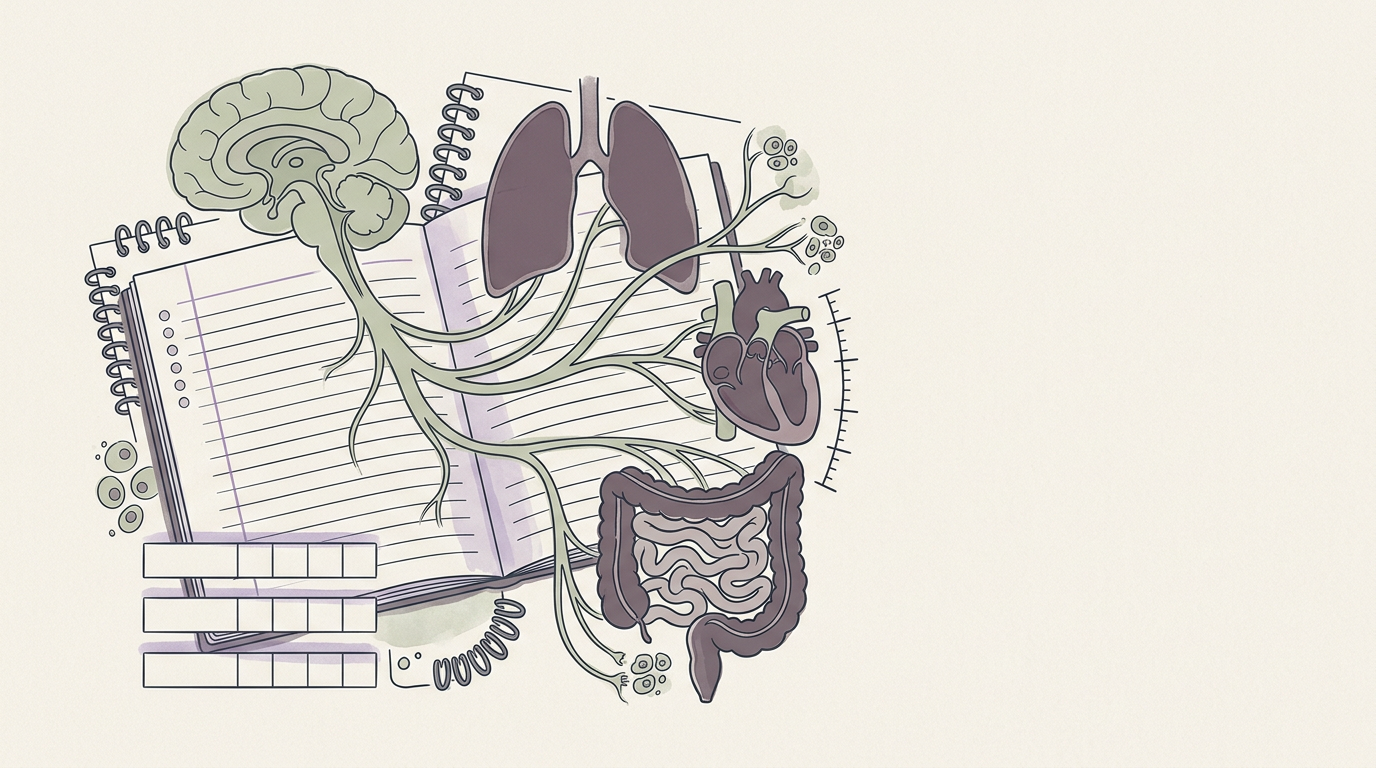
I used to think the blank page was supposed to fix me. The internet is currently flooded with somatic journal prompts that promise to write you out of a stress response and into a meadow of calm. The premise is entirely backwards. A £25 notebook can't trigger an autonomic shift just because you asked it nicely. Kokorology expect these pages to act as a direct command to the brain, and get frustrated when the physiology refuses to follow instructions.
You already know what it feels like when the system rejects the intervention. You sit down with a pen at 9pm, completely tired but wired, trying to answer a prompt about gratitude. Your jaw is locked. You have that distinct, hollow buzz behind your eyes. You write that you feel peaceful, while your body is screaming that you're anxious for no reason and simply want to lie face down on the rug. The dissonance is physically uncomfortable. You close the book feeling worse than when you opened it, staring at the ceiling at 2am, exhausted but can't rest. That friction happens because you're demanding a biological state your body currently lacks the resources to supply.
Common Questions
What do these prompts actually achieve?
They force a mechanical pause. Hand-writing moves at a fraction of the speed of your internal monologue. This delay gives your brain a moment to process a physical sensation before reacting to it.
Why do positive affirmations make me feel worse?
Your body detects the lie. When you're highly activated and write that you feel completely safe, the mismatch creates internal friction. The brain reads this dissonance as an additional threat, which accelerates your heart rate.
Can writing genuinely calm the brain down?
Yes, through plain observation. Putting a specific physical sensation into words engages the prefrontal cortex. This engagement naturally dials down the threat-detection machinery in the amygdala. Naming the state initiates the shift.
The delusion of the top-down command
I used to recommend aspirational gratitude lists for high-stress clients. I've completely stopped doing it. When you're in a state of high arousal, top-down commands from the thinking brain simply drop dead before reaching the body. You can write "I am letting go of stress" fifty times. Your sympathetic nervous system can't read your handwriting. If the threat circuitry is flooded, the machinery lacks the capacity to process the instruction. The connection is jammed.
The machinery of affect labeling
Observation drives the shift. When you put a raw, non-verbal sensation into language, you engage a very specific neural pathway. Translating the heat in your chest into the word "panic" requires the prefrontal cortex to activate. Once online, that region exerts a natural inhibitory effect on the amygdala. You calm the system by acknowledging the current reality. Drafting a fantasy while your jaw is locked is just lying to yourself on expensive paper. This precise naming is a core skill Kokorology train inside the Journal.
You are feeding the predictive loop
Your brain runs constant simulations to anticipate what you'll need next. If you feel terrible, the brain likely predicted a threat and mobilized resources you didn't end up using. Writing down exactly what you feel in your stomach or your throat feeds the brain high-quality, real-time data. It updates the simulation. The threat drops because the ambiguity drops. The more accurately you report on your internal landscape, the better your brain gets at managing its energy budget. Kokorology keep the clinical data on this mechanism in the research library.
Stop fixing it
The work is building the capacity to tolerate the body’s honest answer. If you sit down and realise you're furious, document the heat of it accurately.
A journal prompt reads the current state. It cannot force a new one.
Once you have an accurate reading, you can make an intelligent choice about what to do next. A five-minute walk, a cold-water face splash, or a targeted Sleep Anchor might actually shift the needle. Recognise the state, then match the tool.
What to do this week
- Stop writing demands. For one week, forbid yourself from writing any goals, to-do lists, or affirmations.
- Log the raw data. Each day, take five minutes to answer a single question about your physical sensations. List the tightness, the warmth, the emptiness, the buzzing. Do not interpret them.
- Use highly specific language. Replace "I feel stressed" with "I feel a buzzing in my hands and a shallow tightness in my upper chest." Precision drives the affect-labeling mechanism.
Where this fits in the Kokorology system
This practice of state awareness is foundational to all the work. It drives the sense-and-respond loop Kokorology teach as the core skill of nervous system regulation. It informs how you approach any protocol, and it remains the primary function of the daily resets.
Tonight's practice
Right now, in my body, I notice.
- Sit on the floor of your bedroom with your back fully supported by a wall.
- Set a timer for three minutes.
- Write down only the physical sensations you feel. Look for temperature, pressure, and speed.
- When the timer goes off, close the book and walk away.
Closing
The most powerful questions are the ones you learn to ask based on the data you gather from your own body. Stop looking for the right prompt and start building the capacity to listen to the answer.
- Start here with a free guide: The Regulation Starter Kit.
- Practice it daily inside: The Kokorology Journal.
- Learn the full architecture: The Regulation (L1) Course.
TL;DR
Forget magic prompts that promise to instantly change your state. A notebook can't force a biological shift. Instead, use your journal as a diagnostic tool for interoception. Simply naming your feelings and sensations (affect labeling) is a powerful act of regulation in itself. Know your state first. Only then can you choose the right tool to shift it.
Sources
- Lieberman, M. D. (2023). Communication with others and oneself: language as a nervous-system intervention. Kokorology Research Library.
- Feldman Barrett, L. (2017). How Emotions Are Made: The Secret Life of the Brain. Houghton Mifflin Harcourt.
- Pennebaker, J. W. (2023). Journaling and the nervous system: from expressive writing to affect labeling. Kokorology Research Library.